What does turnkey manufacturing mean?
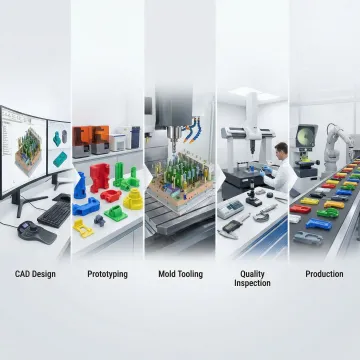
Turnkey manufacturing means a complete, end-to-end service where a single provider manages every aspect of product development and production. At Evok, our turnkey injection molding services cover the entire lifecycle: CAD design and engineering, material selection, rapid prototyping, mold design and fabrication, parts qualification, and high-volume production. This single-source approach eliminates the complexity of coordinating multiple vendors, reduces communication gaps, ensures accountability, and significantly accelerates your time-to-market while maintaining consistent quality throughout the process.
How much does it cost to have an injection mold made?
Injection mold costs vary widely based on part complexity, size, material requirements, cavity count, and production volume expectations. Simple single-cavity molds may start around $3,000-$5,000, while complex multi-cavity production tools can range from $15,000 to $100,000 or more. At Evok, we're extremely transparent about tooling costs upfront, providing detailed quotes that break down expenses so you can make informed decisions. Our goal is to build the most cost-effective tooling solution that balances initial investment with long-term per-part pricing optimization and production efficiency.
What does turnkey product mean?
A turnkey product refers to a complete, ready-to-use solution delivered by a single provider who handles all aspects of development and manufacturing. For injection molded components, this means receiving finished, qualified parts without needing to coordinate design, prototyping, tooling, and production across multiple suppliers. Evok's turnkey approach means we take your concept or existing design and deliver production-ready parts through our integrated pipeline—from initial feasibility analysis through final production—providing a seamless, accountable experience that saves time, reduces risk, and simplifies project management.
What are the different types of injection molding?
The main injection molding types include: thermoplastic injection molding (the most common, using resins that melt and solidify), thermoset injection molding (for materials that cure permanently), insert molding (embedding metal or other components), overmolding (molding one material over another), multi-shot/two-shot molding (combining multiple materials or colors in one process), and gas-assisted injection molding (using gas pressure for hollow sections). At Evok, we specialize in thermoplastic injection molding with capabilities for insert and overmolding applications, helping you select the optimal process for your specific product requirements.
How long does the injection molding process take from design to production?
Timeline varies based on project complexity, but Evok's streamlined 5-stage pipeline typically ranges from 12-20 weeks for most projects. Concept feasibility and alpha research (prototyping phase) usually takes 2-4 weeks, beta development with single-cavity tooling requires 4-6 weeks, production tooling fabrication needs 6-10 weeks, and qualification adds another 1-2 weeks. Our focus on speed-to-market and continuous improvement helps compress these timelines while maintaining quality. Rush services may be available for urgent projects.
What materials can you work with for injection molding?
Evok works with a comprehensive range of thermoplastic materials including commodity resins (PP, PE, PS), engineering plastics (ABS, PC, Nylon/PA, POM), high-performance polymers (PEEK, PEI, PPS), and specialty materials with specific properties like UV resistance, flame retardancy, or food-grade certification. Our material selection service helps you navigate polymer science to choose the optimal resin based on your part's mechanical requirements, environmental conditions, regulatory needs, and budget. We also provide guidance on material textures and finishes to achieve your desired aesthetic.
Do you offer low-volume production or only high-volume manufacturing?
Evok provides flexible manufacturing solutions for both low and high-volume production needs. Our beta development stage uses single-cavity tooling perfect for initial market testing and low-volume runs (hundreds to low thousands of parts). For high-volume production, we design multi-cavity molds optimized for efficiency and per-part cost reduction. We help you plan a scalable tooling strategy that balances initial investment with future volume expectations, ensuring you don't over-invest in tooling before market validation while maintaining a clear path to volume production.
What quality control measures do you implement?
Evok implements rigorous quality control throughout the entire manufacturing process. Our parts qualification includes comprehensive molding trial reports evaluating T1 samples before texturing, monitoring process parameters like mold fill speed, knit line locations, zone temperatures, and cycle time. First article inspection involves 30 measurement points per cavity for critical dimensions and 5 points for non-critical features. We provide detailed Cp and Cpk data to demonstrate process capability and variation control. Our Six Sigma-certified team uses analytical testing tools and application testing to ensure your parts meet specifications before volume production begins.