Introduction
Injection molding remains the backbone of modern manufacturing, delivering billions of plastic components annually to automotive, medical, consumer electronics, and packaging industries. Yet many manufacturers still rely on manual process adjustments, reactive quality control, and operator intuition—approaches that worked in 2010 but cannot keep pace with 2026's demands for tighter tolerances, faster turnarounds, and zero-defect production.
The gap is widening. OEMs and product developers who grasp how AI-driven cavity pressure monitoring, predictive maintenance, robotic automation, and digital twin simulation are reshaping the process can make smarter sourcing decisions, cut waste, and bring parts to market ahead of competitors still running legacy workflows.
This article examines the proven technologies transforming injection molding in 2026, drawing on peer-reviewed research, factory floor results, and real-world ROI data.
Key Takeaways
- AI monitors cavity pressure and temperature in real time, detecting deviations and preventing defects before they occur
- Predictive maintenance uses IIoT sensors to flag component wear before failures cause unplanned downtime
- Robotic systems with simplified programming enable lights-out production and reduce labor dependency
- Digital twins simulate mold filling and cooling before steel is cut, slashing costly tooling rework
- Manufacturers adopting these tools in 2026 are compressing lead times and cutting scrap rates in the same production cycle
AI-Powered Quality Control and Process Optimization
Traditional injection molding quality control happens after defects occur—operators inspect finished parts, adjust parameters manually, and hope the next cycle improves. AI flips this model by monitoring every production cycle in real time, learning what "good" looks like, and flagging deviations before defective parts are molded.
How Real-Time AI Monitoring Works
AI systems integrate with cavity pressure sensors, temperature probes, and injection speed monitors embedded in the mold and press. During each cycle, machine learning algorithms compare live sensor data against an established "reliable zone" (the parameter window where parts consistently meet specifications).
A 2025 study by Koç University and Beko Corporate deployed a convolutional neural network (CNN) baseline model that achieved 98% accuracy in lab conditions and 95% accuracy when integrated into two industrial production lines. The system learned optimal cavity pressure profiles across hundreds of cycles, then flagged anomalies—pressure spikes, temperature drift, or fill-time variations—that correlate with defects like short shots, sink marks, flash, and weld lines.
Zero-Defect Manufacturing in Practice
That anomaly detection capability is what makes zero-defect manufacturing achievable in practice, not just in theory. When AI detects a cycle drifting out of the reliable zone, it identifies which specific parameters (injection pressure, holding time, shot volume, or cooling duration) are responsible and suggests corrective actions to operators.
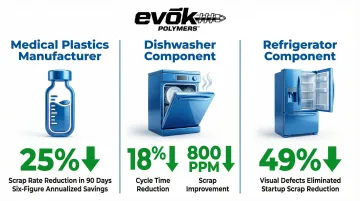
One Fortune 500 medical plastics manufacturer producing specialty vials faced scrap rates exceeding 20% above company average. After deploying an AI + IIoT solution analyzing data from over 300 sensors, the system pinpointed two specific defect types driving the majority of waste. Within 90 days: a 25% scrap rate reduction and six-figure annualized savings.
In another case, the Koç/Beko study documented an 18% cycle time reduction and 800 PPM decrease in scrap rates on a dishwasher component after six months of AI deployment. Visual defects on a refrigerator part were completely eliminated, and startup scrap dropped 49%.
AI as a Force Multiplier, Not a Replacement
At EVOK, AI tools are layered on top of 25 years of injection molding expertise and Six Sigma black belt-led process discipline. This is the practical reality: AI accelerates data collection and anomaly detection across thousands of cycles, but experienced engineers still interpret root causes, validate corrective actions, and refine process windows.
The result is faster convergence on stable parameters, fewer startup cycles wasted on trial and error, and measurable scrap reductions from day one of production.
Predictive Maintenance, IIoT, and Real-Time Machine Intelligence
Unplanned downtime is expensive. Siemens' True Cost of Downtime report estimates large manufacturing plants lose an average of $129 million annually to unscheduled stoppages, with per-hour costs ranging from $39,000 in FMCG facilities to over $2 million in automotive plants. For injection molders running high-value medical or automotive molds, a single press failure can halt production for hours or days.
From Reactive Repairs to Predictive Intelligence
Predictive maintenance replaces "fix it when it breaks" with "fix it before it breaks." IIoT sensors embedded in injection molding machines continuously collect data on:
- Barrel and nozzle temperature fluctuations
- Hydraulic pressure variations
- Motor vibration patterns
- Cycle-to-cycle timing consistency
Machine learning algorithms analyze this data stream, comparing current behavior against historical baselines to identify early warning signs—a gradual temperature drift, an uptick in vibration frequency, or inconsistent cycle times—that precede component failures.
Prescriptive Maintenance Goes Further
A 2023 prescriptive maintenance framework specifically tested on plastic injection molding machines uses deep reinforcement learning to not only predict failures but also recommend the optimal remediation action. The system weighs both economic impact (cost of repair, downtime losses) and environmental factors (energy consumption, waste generation) to suggest whether to replace a component now, schedule maintenance during the next planned downtime, or continue monitoring.
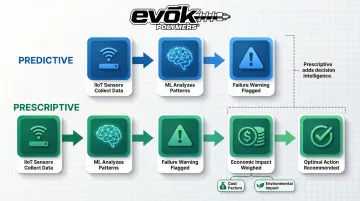
Crucially, this gives less-experienced technicians a data-backed decision framework — reducing dependence on veteran intuition that walks out the door at retirement.
Why Even Mid-Sized Molders Are Adopting IIoT Now
That prescriptive capability translates directly to financial justification. At automotive downtime rates of $2 million per hour, a single prevented failure can cover an entire sensor installation. Even mid-sized molders running lower-value parts reach breakeven fast — one avoided stoppage is often all it takes.
IIoT connectivity also creates a continuous improvement feedback loop: production data from hundreds of cycles informs parameter optimization and flags systemic issues like inconsistent material drying or cooling water temperature drift. Those same data streams support sustainability reporting and long-term cost reduction — two goals that increasingly land on the same side of the ledger.
Robotic Automation and Lights-Out Manufacturing
Injection molding has used robotic part removal for decades, but 2026's systems are faster to program, more adaptable, and capable of running autonomously during off-hours with minimal human oversight.
Modern Robotics Reduce Setup Time and Skill Requirements
Arburg's MULTILIFT robotic systems illustrate the shift. Technical documentation highlights:
- Sequence programming with symbols via SELOGICA and a teach-in function for user-friendly setup
- Synchronous movements coordinating robotic part removal with ejector and mold opening sequences
- Automatic path calculation that reduces programming time and operator training burden
Operators execute and confirm movements in sequence without writing code. The system handles part removal, sorting, secondary assembly, and packaging with greater speed and consistency than manual labor.
What Lights-Out Manufacturing Requires
Lights-out production—facilities running autonomously overnight or on weekends—depends on three conditions:
- Stable, repeatable processes where cycle-to-cycle variation stays tight enough to prevent drift
- Predictive maintenance that flags wear before it causes a mid-run failure
- Automated quality control that detects and responds to defects without human intervention
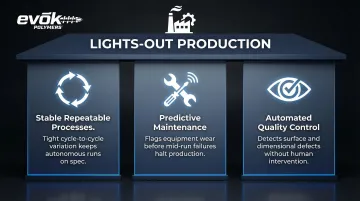
When these elements align, manufacturers can run 24/7 without lighting, climate control, or staffing for second and third shifts. First Mold's smart factory uses centralized control and dynamic parameter adjustment to do exactly that — cutting staffing needs by one to two people per shift. Energy costs per ton of raw material dropped from $107.30 in 2019 to $94 in 2024.
Labor Shortages Accelerate Adoption
The U.S. plastics industry faces over 30,000 open manufacturing roles, with average hourly wages rising 11.3% over two years. The workforce is aging (average age 46.8 years) and turnover runs at 36%. For manufacturers trying to hold output steady, automation is no longer a cost optimization play — it's how production capacity gets protected at all.
Digital Twins and AI-Driven Mold Design Simulation
Mold rework is expensive. For high-volume production molds, maintenance can require 30-40% of the original tooling cost over the tool's life. Offshore molds often need an additional 10% of purchase price in rework to meet U.S. production standards. Errors in gate placement, cooling channel design, or fill-pattern assumptions discovered after steel is cut trigger costly corrections and delay product launches.
What Digital Twins Do
A digital twin is a virtual replica of a mold, part, and production environment. Engineers use computer-aided engineering (CAE) software—Autodesk Moldflow, Moldex3D, and similar platforms—to simulate filling, packing, cooling, and ejection phases before any physical tooling is built.
AI-assisted simulation enhances this process by:
- Identifying optimal cavity pressure sensor placement locations
- Predicting defect-prone areas in complex geometries
- Optimizing gate locations and cooling channel routing
- Recommending conformal cooling designs that reduce cycle time by following part contours
Proven Cost and Time Savings
Machino Plastics used Autodesk Moldflow to eliminate unnecessary mold design iterations, accurately predicting material performance before cutting steel.
Good View deployed Moldex3D simulation to optimize runner designs, achieving:
- 25% reduction in raw material costs
- 67% reduction in labor costs
- Cycle time drop from 14.3 seconds to 12.6 seconds
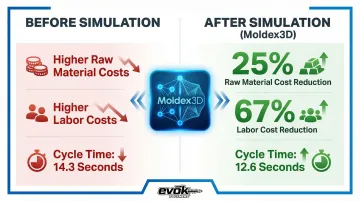
As AI simulation tools grow more accessible in 2026, the gap between teams that validate designs virtually and those that don't is showing up directly in tooling budgets and launch schedules.
What's Driving AI and Automation Adoption in Injection Molding
Three converging forces are accelerating technology adoption across the injection molding industry:
Rising Production Complexity
Manufacturers face shorter product life cycles, smaller batch sizes, and tighter tolerances. The pressure looks different by industry, but the pattern is consistent:
- Medical device OEMs require ±0.001" tolerances with full traceability documentation
- Automotive suppliers manage strict quality standards alongside frequent design changes
- Consumer electronics brands expect prototyping-to-production cycles measured in weeks, not months
Manual process control can't keep pace with these demands. AI-driven parameter optimization and real-time quality monitoring let manufacturers hit tighter specs without inflating costs.
Variable Material Properties
The shift toward recycled and bio-based resins introduces material variability that traditional processes struggle to handle. Recycled content percentages, melt flow rates, and thermal properties vary batch-to-batch, requiring frequent parameter adjustments. AI systems adapt in real time, learning how each material behaves and adjusting injection speed, pressure, and cooling to maintain part quality.
Market Growth and Competitive Pressure
BCC Research values the global plastic injection molding market at $191 billion in 2023, forecasting growth to $235.7 billion by 2029 at a 4.1% CAGR. Grand View Research estimates the injection molded plastics market at $362.47 billion in 2025, projecting $481.42 billion by 2033 at a 4.0% CAGR.
As the market expands, OEMs increasingly demand suppliers who can deliver documented quality traceability, faster turnarounds, and lower total cost of ownership. Suppliers without digital capabilities are losing contracts to those who do.
How AI and Automation Are Reshaping the Injection Molding Industry
The cumulative effect of AI, IIoT, robotics, and digital twins isn't incremental improvement—it's a structural shift in how injection molded parts are designed, produced, and delivered.
Operational Impact
Workflows are changing at every level:
- Quality control shifts from post-production inspection to in-cycle monitoring — defects are prevented rather than detected
- Setup time drops through AI-assisted parameter recommendation — operators start with optimized settings rather than trial-and-error adjustments
- Cycle time optimization becomes data-driven — machine learning identifies the fastest cycle that maintains quality, not operator experience
The Beko/Koç University case demonstrates this shift: 18% cycle time reduction and 800 PPM scrap improvement on a dishwasher component resulted from AI maintaining production within an efficient parameter window rather than relying on manual oversight.
Business Impact
Manufacturers investing in AI and automation reposition themselves as strategic development partners rather than commodity suppliers. EVOK, for example, applies 25 years of injection molding experience alongside process optimization tools to give OEMs measurable outcomes—shorter development cycles, lower scrap rates, and better part performance from the start. OEMs increasingly select suppliers based on engineering collaboration capability, not just per-part pricing.
The ability to simulate mold performance, predict quality outcomes, and adapt processes in real time becomes a competitive requirement, not a premium service.
Workforce Impact
Injection molding technicians are shifting away from manual parameter adjustment and reactive troubleshooting. Today, the job looks more like AI system oversight, data interpretation, and exception handling—monitoring dashboards for process health, investigating flagged anomalies, and validating recommended corrections.
Manufacturers face a real skills gap here. Traditional operator expertise is becoming less relevant as data literacy takes center stage. The companies handling this best are investing in retraining programs that cover scientific molding principles, robotics setup, PLC basics, and process data analysis—upskilling existing teams rather than replacing them.
The U.S. plastics industry supports over 1 million jobs, but turnover runs at 36% and the workforce is aging. Companies that successfully transition their teams to human-AI collaboration workflows will have a significant advantage in attracting and retaining talent.
Future Signals and What This Means for Your Production Strategy
Several next-horizon developments will define injection molding through 2027 and beyond:
- Closed-loop AI systems are moving from pilot to production, feeding parameter corrections back into machines without operator intervention and reducing cycle-to-cycle variation
- Generalized AI models will adapt across different part geometries and materials with minimal retraining data, lowering the barrier to adoption for mid-sized molders
- Sustainable material processing will improve as AI-driven parameter adaptation makes recycled and bio-based resins easier to run consistently — without sacrificing quality or raising costs
Act Now to Compress Development Timelines
These shifts are already underway. The OEM partners who move first — selecting suppliers integrating AI-aware processes, digital simulation tools, and continuous improvement frameworks — will compress development timelines and avoid costly late-stage tooling corrections.
Working with partners like EVOK is a practical first step. With 25 years of injection molding experience, proprietary optimization tools, and a Six Sigma-driven improvement process, EVOK gives OEMs access to advanced capabilities without needing to develop that capability in-house.
The companies that treat AI and automation as strategic investments rather than line-item costs will set the competitive baseline for part quality and cost over the next three to five years. Those who wait will find themselves competing on price alone — with shrinking margins and little room to grow.
Frequently Asked Questions
Frequently Asked Questions
What is the latest technology in injection molding?
AI-driven cavity pressure monitoring, IIoT-connected machines with predictive maintenance, digital twin mold simulation, and robotic systems with simplified programming represent the leading edge in 2026.
Will AI replace Lean Six Sigma?
No—AI augments rather than replaces Lean Six Sigma. AI accelerates data collection across thousands of cycles and flags anomalies instantly, while Six Sigma provides the structured framework for root cause analysis and process improvement. The two methodologies are increasingly complementary.
How does AI improve part quality in injection molding?
AI monitors real-time sensor data—cavity pressure, temperature, injection speed—and compares each cycle against an established "reliable zone" to catch deviations before they become defects. The system suggests or applies parameter corrections to prevent short shots, sink marks, flash, and weld lines automatically.
What is predictive maintenance in injection molding?
Predictive maintenance uses IIoT sensors and machine learning to continuously analyze machine health—temperature, pressure, vibration, cycle timing—and flag failure warning signs before they cause downtime. Advanced systems also recommend corrective actions based on economic and operational factors.
What is a digital twin in injection molding?
A digital twin is a virtual simulation of a mold and production process. Engineers use CAE software to test filling, packing, cooling, and ejection parameters before physical tooling is built. This reduces expensive mold rework, optimizes gate placement and cooling channel design, and compresses development timelines by catching design issues in simulation rather than after steel is cut.
How does automation affect injection molding costs?
Automation reduces labor dependency, cuts scrap rates through real-time quality monitoring, and enables lights-out production—all of which lower per-part costs over time. Upfront investment in robotic systems and AI platforms still requires ROI planning based on production volume, part complexity, and labor costs.