The automotive industry is changing fast, driven by electric vehicles, stricter efficiency standards, and the need for lighter, more durable components.
Automotive injection molding sits at the core of this shift, enabling manufacturers to produce complex plastic parts with high precision, consistency, and speed.
For engineers and procurement teams in the U.S., understanding automotive injection molding is now essential. It allows metal parts to be replaced with lightweight polymers without compromising safety or performance.
From interior trims to exterior body components, this process plays a critical role in modern vehicle design and scalable production.
Key Takeaways
Replacing metal components with injection molded plastic auto parts can reduce individual component weight by up to 50%, directly impacting vehicle performance and battery life.
Once the automotive plastic mold is validated, the process allows for the production of millions of identical parts with tolerances as tight as 0.001 inches.
Modern automotive injection relies on a spectrum of resins, from commodity polypropylene to high-performance polyamides that can withstand the harsh environments found under the hood.
Engineers can use injection molding automotive parts to combine multiple components into a single molded piece, reducing assembly labor and potential failure points.
Partnering with regional automotive injection molding suppliers reduces lead times and shipping costs, especially for large components like truck injection molding panels.
What is Automotive Injection Molding?
Automotive injection molding is a manufacturing process in which molten plastic is injected under high pressure into a precision-machined metal mold to produce vehicle components at scale. It is designed for speed, accuracy, and repeatability, making it ideal for producing large volumes of identical parts.
Unlike machining, which removes material, this is a forming process where nearly all material contributes to the final part, resulting in high efficiency and minimal waste.
The process starts with plastic pellets being melted inside a heated barrel and pushed into the mold using a reciprocating screw. Once injected, the plastic cools and solidifies into the exact shape of the cavity before being ejected.
In automotive applications, the process is tightly controlled, as even small changes in temperature or pressure can affect part strength or appearance. Advanced sensors ensure every molded component meets strict safety and quality standards.
Having established the mechanical definition of the process, we can now explore the specific functional benefits it offers to vehicle manufacturers.
5 Benefits of Automotive Injection Molding
The widespread adoption of automotive plastic injection molding is not accidental. It provides a unique set of advantages that other manufacturing methods simply cannot match in terms of scale and precision.
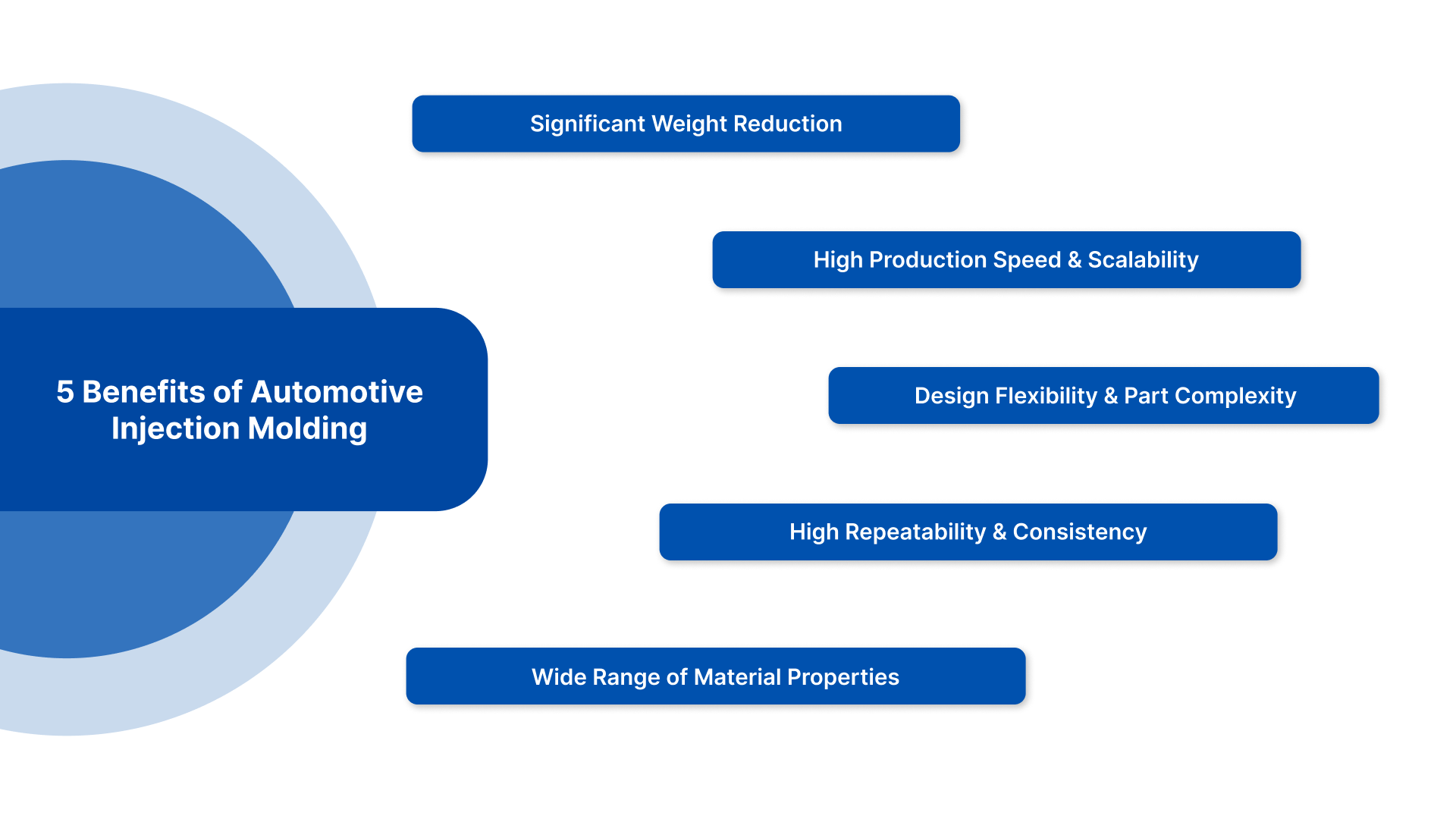
1. Significant Weight Reduction (Lightweighting)
Weight is the enemy of efficiency. In the era of electric vehicles, reducing mass is the primary way to increase battery range. Automotive plastic injection molding allows manufacturers to replace heavy steel or aluminum components with high-strength polymers.
For example, replacing a metal intake manifold with one made of glass-filled nylon can reduce the part's weight by 40-60%. This cumulative weight saving across the entire vehicle is what allows modern cars to achieve better fuel economy and performance.
2. High Production Speed and Scalability
Once the initial investment in the automotive plastic mold is made, the per-unit cost drops dramatically. Injection molding automotive parts is a rapid process, with many cycles taking less than 60 seconds.
This speed allows automotive injection molding companies to produce thousands of parts per day.
For high-volume vehicle platforms that sell hundreds of thousands of units annually, this scalability is the only way to meet market demand while maintaining a competitive price point.
3. Design Flexibility and Part Complexity
Traditional metal stamping or casting has significant geometric limitations. In contrast, plastic injection molding for automotive applications allows for incredibly complex shapes, including internal ribs, thin walls, and intricate undercuts.
Engineers can use this flexibility to consolidate parts. Instead of assembling five separate metal pieces with screws and adhesives, they can design a single molded component that performs all five functions. This reduces assembly time and eliminates potential points of mechanical failure.
4. High Repeatability and Consistency
The automotive industry demands perfection in every unit. Because the automotive injection process relies on a fixed metal tool and automated controls, the level of variation between the first part and the millionth part is negligible.
This repeatability is crucial for safety-critical components like airbag housings or brake system brackets, where even a fraction of a millimeter of deviation could have catastrophic results.
5. Wide Range of Material Properties
The plastic injection molding automotive industry utilizes a vast library of engineered resins. Manufacturers can choose materials that are flexible, rigid, heat-resistant, UV-stabilized, or even self-lubricating.
By adding reinforcements like glass fibers or carbon fibers, automotive injection molding suppliers can create plastic parts that are actually stronger than some metals. This allows for a tailored approach to engineering where the material is perfectly matched to the specific stress and environment of the part.
Fundamentals of the Automotive Injection Molding Process
To understand how injection molding automobile parts works, one must look at the intersection of high-pressure physics and chemical engineering.
The process follows a strict sequence to ensure that the molten polymer fills every corner of the automotive plastic mold without trapping air or creating internal stresses.
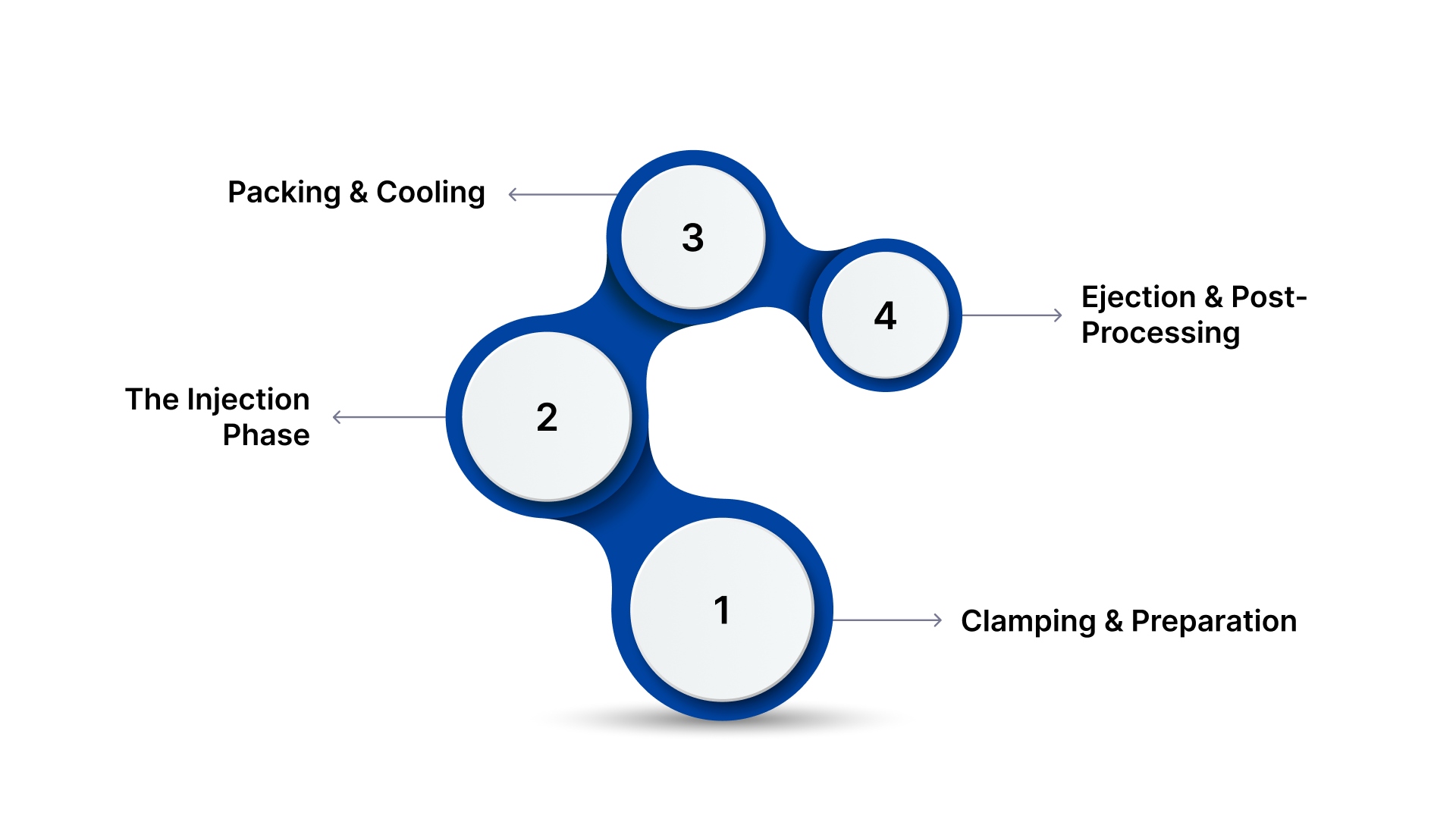
1. Clamping and Preparation
Before any plastic moves, the two halves of the mold must be clamped together with immense force. In automotive injection molding, this clamping force can range from 50 tons for small clips to over 3,000 tons for truck injection molding panels.
The force must be greater than the pressure exerted by the incoming plastic to prevent the mold from blowing open, which would cause a defect known as flash.
2. The Injection Phase
The injection molding machine's screw pushes the molten resin through a nozzle and into the mold. In the automotive plastic injection molding world, speed is often prioritized during this phase to prevent the plastic from cooling before it reaches the furthest corners of the cavity.
However, if the speed is too high, it can cause shear heating, which degrades the molecular structure of the plastic.
3. Packing and Cooling
Once the cavity is full, the machine continues to apply pressure. This is called packing. It is necessary because plastic shrinks as it cools. Packing forces extra material into the mold to compensate for this shrinkage, ensuring the final part has the correct dimensions. Cooling is the longest part of the cycle.
Engineers use complex water channels inside the automotive plastic mold to pull heat away as quickly as possible. Faster cooling means shorter cycle times and lower production costs.
4. Ejection and Post-Processing
After the part has solidified, the mold opens, and ejector pins push the part out. Many injection molded automotive parts are ready to use immediately. However, some may require secondary operations like ultrasonic welding, painting, or the addition of metallic inserts.
Leading automotive injection molding companies often integrate these steps into the automated cell to minimize human handling.
Essential Materials in Plastic Injection Molding Automotive Parts
The performance of injection molded automotive parts is entirely dependent on the resin used. Automotive manufacturers classify materials based on their physical properties, chemical resistance, and thermal stability.
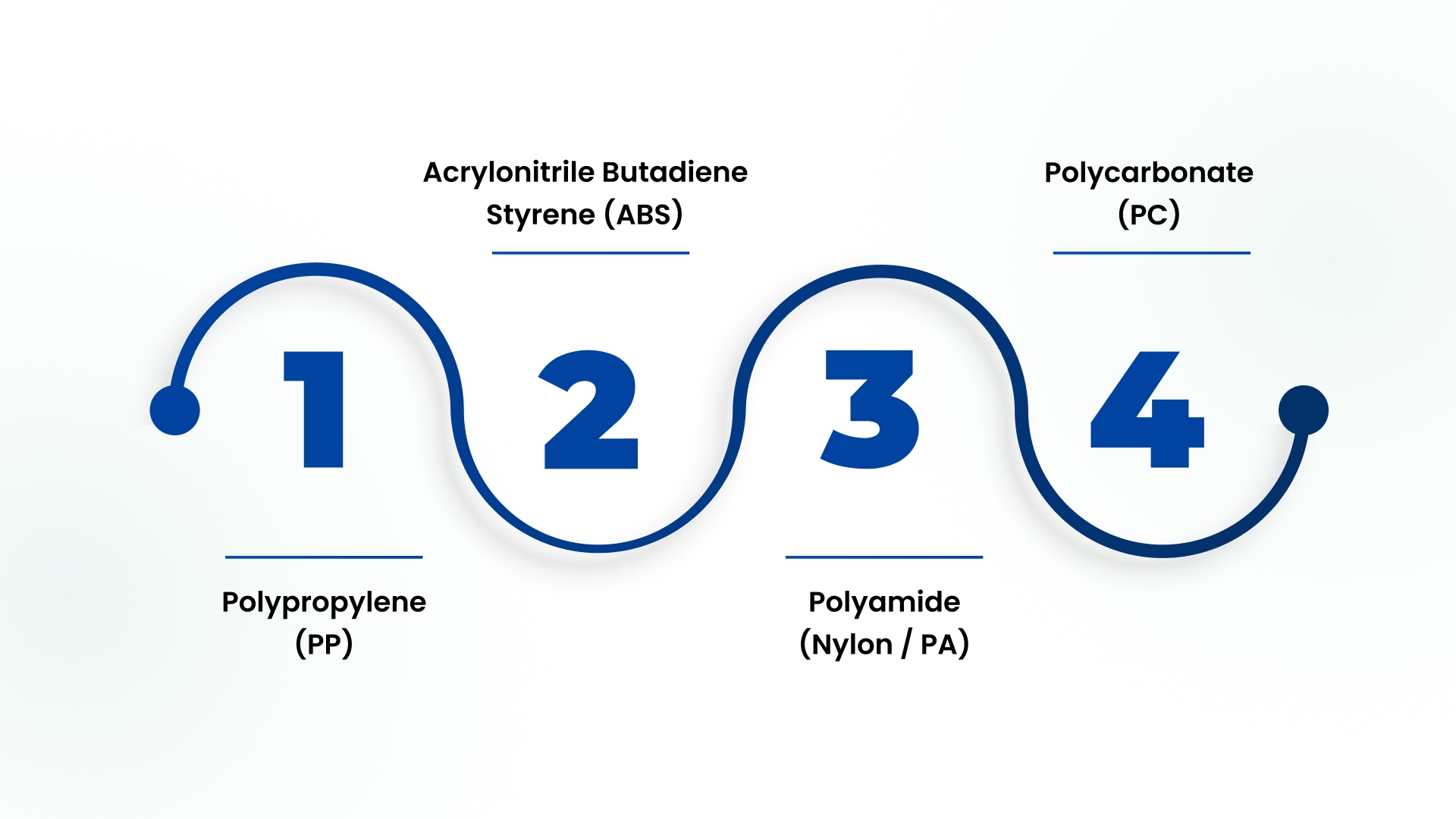
1. Polypropylene (PP)
Polypropylene is the workhorse of automotive plastic molding. It is a thermoplastic polymer used for its excellent chemical resistance and low density.
Applications: Bumpers, battery cases, and interior door panels.
Benefit: It is cost-effective and highly recyclable, aligning with 2026 sustainability goals.
2. Acrylonitrile Butadiene Styrene (ABS)
ABS is favored for its impact resistance and superior surface finish. It is the primary material for injection molding automotive components that require a high-quality aesthetic appearance.
Applications: Dashboards, console covers, and wheel covers.
Benefit: It can be easily painted or chrome-plated.
3. Polyamide (Nylon / PA)
Nylon is an engineering plastic known for its high mechanical strength and ability to withstand heat.
Applications: Engine covers, intake manifolds, and cooling fan blades.
Benefit: When reinforced with glass fibers, it can replace heavy aluminum parts in the engine compartment.
4. Polycarbonate (PC)
Polycarbonate offers exceptional clarity and impact resistance, making it the standard for injection molding automotive parts related to lighting.
Applications: Headlamp lenses and interior light covers.
Benefit: It is significantly lighter and more shatter-resistant than traditional glass.
Key Applications: From Engine to Interior
The reach of automotive injection molding extends to every corner of the vehicle. By categorizing these applications, we can see how specific engineering requirements dictate the molding strategy.
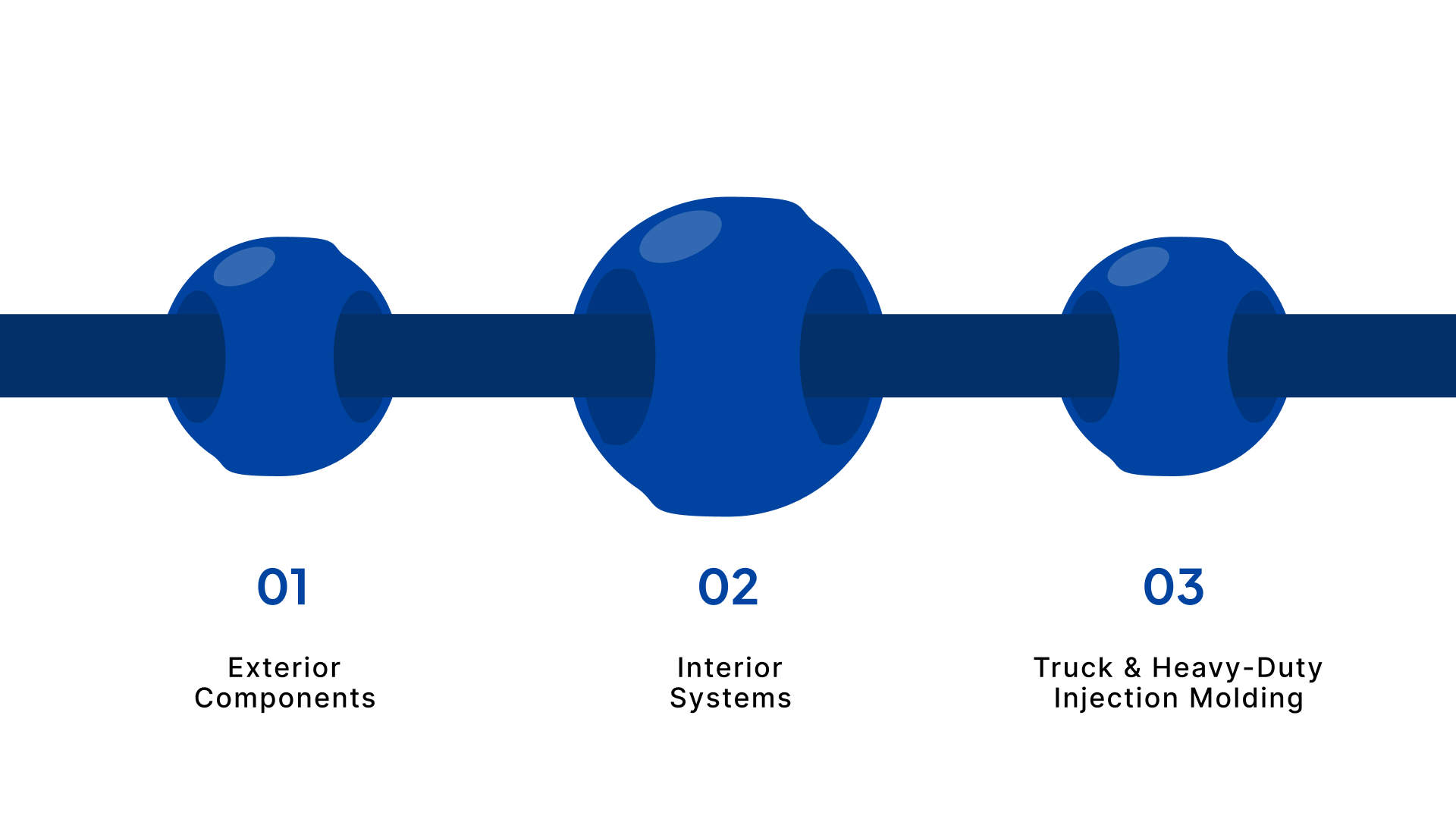
Exterior Components
Exterior parts must withstand UV radiation, road debris, and temperature fluctuations. Injection molding automotive techniques for exteriors often involve large-scale parts like bumpers and grilles.
These components are designed with aerodynamic profiles to reduce drag, which is a key factor in improving the efficiency of modern vehicles.
Interior Systems
Modern car interiors are designed for comfort and safety. Plastic injection molding for automotive interiors focuses on haptic feedback and noise management. Overmolding, where a soft material is molded over a rigid substrate, is a common technique used to create premium-feeling handles and knobs.
Truck and Heavy-Duty Injection Molding
The requirements for truck injection molding differ significantly from passenger cars. Truck injection molding manufacturers must produce parts that are much larger and more durable to handle the high-mileage and heavy-load demands of the logistics industry.
These parts often feature thicker wall sections and heavy reinforcement to ensure they can withstand thousands of hours of service in harsh environments.
Conclusion
The selection of a manufacturing strategy in the automotive sector is a defining moment for a project's success. Automotive injection molding represents the perfect intersection of engineering precision and industrial scale.
Whether you are aiming to reduce vehicle weight, lower production costs, or create complex new geometries, this process provides the tools necessary to innovate.
At Evok Polymers, we believe that transparency in the engineering phase leads to success in the production phase. We don't just build molds; we develop optimized manufacturing solutions tailored to the needs of US-based engineering teams.
Our expertise in automotive plastic injection molding ensures that your project is built on a foundation of quality and technical excellence.
Ready to optimize your next automotive project?
Request a Quote from Evok Polymers today and let our engineering team help you select the perfect strategy for your application.
Frequently Asked Questions (FAQs)
1. How does automotive injection molding contribute to EV range?
By replacing metal parts with lightweight injection molded automotive parts, the overall weight of the vehicle is reduced. Since electric vehicles are inherently heavy due to their battery packs, every pound saved through plastic substitution directly translates into increased mileage per charge.
2. What is the difference between passenger car and truck injection molding?
Truck injection molding generally involves much larger components and requires machines with higher clamping forces, often exceeding 3,000 tons.
Additionally, the materials used for trucks are often selected for higher durability and impact resistance to survive the more demanding operating conditions of commercial transport.
3. What are the most common defects in automotive plastic injection molding?
Common defects include sink marks, weld lines, and splay. These are minimized through rigorous mold flow analysis and the use of precision engineered injection molding equipment that maintains tight control over processing variables.
4. Why is IATF 16949 certification important for automotive injection molding suppliers?
This certification ensures that the supplier follows a standardized quality management system specifically designed for the automotive industry. It focuses on defect prevention, waste reduction, and continuous improvement, which are critical for the safety and reliability of injection molding automotive parts.
5. Can complex electronic components be integrated during the molding process?
Yes, through a process called insert molding. Electronic connectors, sensors, or metal bushings are placed into the automotive plastic mold before injection. The molten plastic then flows around these inserts, creating a single, integrated component that requires no further assembly.