Are you struggling with parts that need sealing, soft-touch surfaces, or multiple materials but fail during assembly or wear out too quickly?
Many manufacturers still depend on adhesives, gaskets, or manual assembly that introduce variability and long-term failure risk.
In the U.S., plastics-dependent industries generate over $1 trillion in economic output and employ 4.8 million people, meaning component reliability directly impacts product safety and warranty cost. Weak bonding and secondary assembly defects often lead to recalls, scrap, and production delays.
That’s where two-shot injection molding design becomes critical. Proper engineering eliminates secondary assembly, improves durability, and stabilizes quality, while poor planning causes delamination and cosmetic defects.
In this guide, you will learn how two-shot injection molding design works, what controls bond strength, and how to transition confidently from concept to production.
Key Takeaways
Two-shot injection molding design eliminates secondary assembly by bonding materials within a single controlled molding cycle.
Material compatibility and interface geometry determine long-term bond strength more than processing adjustments alone.
Thermal balance, shrinkage matching, and flow direction directly impact adhesion reliability and dimensional stability.
Precision tooling architecture, rotary or index systems, drives alignment accuracy and cosmetic consistency.
Early engineering validation in two-shot injection molding design prevents delamination, scrap, and costly post-tool corrections.
What Is Two-Shot Injection Molding?
Two-shot molding produces a single component using two different materials in one automated cycle. The machine injects the first material, then rotates or transfers the part and injects the second material onto or around it.
Unlike overmolding, the second material bonds while the first shot is still dimensionally controlled inside the mold. The two-shot injection molding design requires precise geometry planning, material pairing, and thermal control.
Engineers typically choose it when the part requires:
Integrated seals
Soft-touch grips
Multi-color cosmetics
Chemical-resistant interfaces
Elimination of assembly steps
A successful result depends primarily on proper two-shot injection molding design, not just machine capability.
How Two-Shot Injection Molding Design Works?
Two-shot injection molding design follows a tightly controlled sequence inside a single molding cycle. The mold and machine work together to place two materials in precise locations while maintaining bonding temperature and alignment.
Here is what actually happens at each step:
First material fills cavity A: The primary substrate (rigid resin) is injected into the first cavity to form the structural base. Cooling begins immediately, but the surface remains hot enough to accept bonding with the second material.
Mold rotates or indexes: The mold platen rotates, slides, or transfers the semi-molten first shot into a second cavity. Accurate positioning prevents flash, mismatch, or distortion before the second injection occurs.
Second material injects into cavity B: The secondary resin (often elastomer or soft polymer) flows onto or around the first shot. The interface temperature is carefully controlled to promote adhesion rather than separation.
Materials bond mechanically or chemically: Bonding occurs through melt fusion, diffusion, or mechanical interlock features. Compatibility between polymers determines whether the bond becomes structural or cosmetic.
Part ejects fully assembled: After cooling, ejectors release the completed multi-material component. No secondary assembly is required, reducing handling and alignment variation.
Because bonding depends on heat, pressure, and timing, two shot injection molding design must tightly coordinate geometry with processing windows.
Advantages of Two-Shot Injection Molding Design Over Traditional Assembly
Manufacturers often compare multi-material molding with adhesive bonding or mechanical assembly. The difference becomes clear when evaluating long-term performance, cost control, and production stability.
A well-engineered two-shot injection molding design delivers structural and operational advantages that traditional assembly methods cannot consistently match.
Well-executed two-shot injection molding design provides measurable performance gains, including:
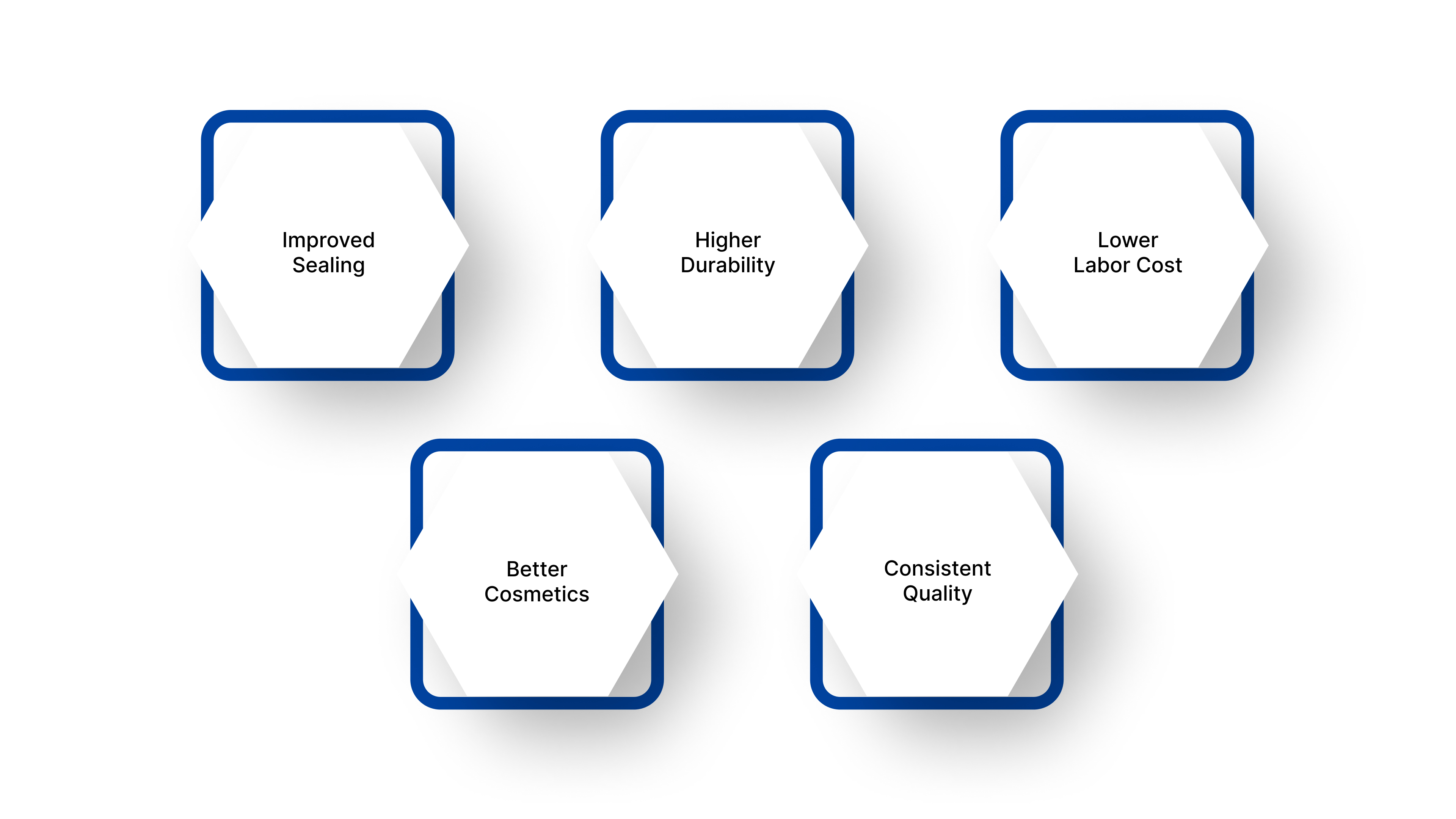
Improved Sealing: Two-shot injection molding design integrates elastomeric seals directly into the rigid substrate during molding. It eliminates separate O-rings, adhesives, or compression-fit seals that may shift over time. Integrated sealing improves leak resistance, ensures uniform compression, and reduces long-term failure risk in fluid-handling or protective components.
Higher Durability: The molecular or mechanical bond created during two-shot injection molding design forms a unified structure rather than a joined assembly. It reduces micro-movement at interfaces, improves vibration resistance, and enhances chemical and environmental durability under repeated stress conditions.
Lower Labor Cost: By combining materials in a single automated cycle, two shot injection molding design eliminates secondary assembly stations, manual bonding, and additional inspection steps. This reduces labor dependency, shortens production flow, and lowers the probability of alignment or assembly errors.
Better Cosmetics: Two-shot injection molding design enables precise material separation lines and controlled color transitions within the mold. This eliminates glue marks, parting line inconsistencies, and visual defects often associated with post-molding assembly.
Consistent Quality: Automation ensures both materials are injected under controlled temperature and pressure conditions within the same cycle. Two-shot injection molding design reduces operator variability and improves repeatability across high-volume production.
As performance depends heavily on bonding integrity and geometric alignment, the design phase ultimately determines the success of two shot injection molding design.
Material Selection and Compatibility Requirements
Material pairing forms the backbone of reliable two-shot injection molding design. The bond strength, durability, and cosmetic quality depend primarily on how the two polymers interact during the molding cycle.
Engineers must evaluate:
Chemical Compatibility: Polymers must either chemically fuse or support strong mechanical interlocking. Compatible molecular structures allow diffusion across the interface during molding, forming a permanent bond rather than a simple surface attachment.
Melt Temperature Overlap: The second shot temperature must soften, but not degrade, the first material. Proper overlap enables interfacial bonding while preserving dimensional stability and preventing deformation or gloss variation in the substrate.
Shrinkage Similarity: If shrink rates differ significantly, residual stresses form during cooling. This leads to warpage, edge lifting, or long-term delamination under cyclic load or temperature fluctuations in service environments.
Surface Energy: Low surface energy plastics resist adhesion. Designers compensate by adding textures, grooves, or undercuts so the second material anchors mechanically rather than relying purely on chemical bonding.
Moisture Absorption Behavior: Materials with different moisture absorption rates expand differently after molding. This dimensional change can weaken the interface over time, especially in humid environments, causing gradual separation or sealing failure.
Common successful combinations include:
TPU over Nylon: Nylon offers strength and temperature resistance, while TPU adds abrasion resistance and flexibility. The pair performs well in automotive and industrial components exposed to vibration, oils, and mechanical wear.
TPE over Polypropylene: Polypropylene provides rigidity while TPE delivers sealing and grip. Their compatible polarity enables strong bonding without adhesives, making the combination widely used in consumer goods, closures, and ergonomic handles.
Silicone over Engineered Thermoplastics (with primer systems): Silicone provides excellent temperature stability and sealing performance. Primers chemically activate the substrate surface, enabling durable bonding in medical devices and electronics where long-term reliability and biocompatibility matter.
Incorrect material pairing remains the most common failure source in two-shot injection molding design, making early material validation essential before tooling begins.
Core Design Principles for Two-Shot Injection Molding
A strong two-shot injection molding design depends on controlling how two materials meet, bond, cool, and eject together. The interface behaves like a structural joint, not just a cosmetic boundary.
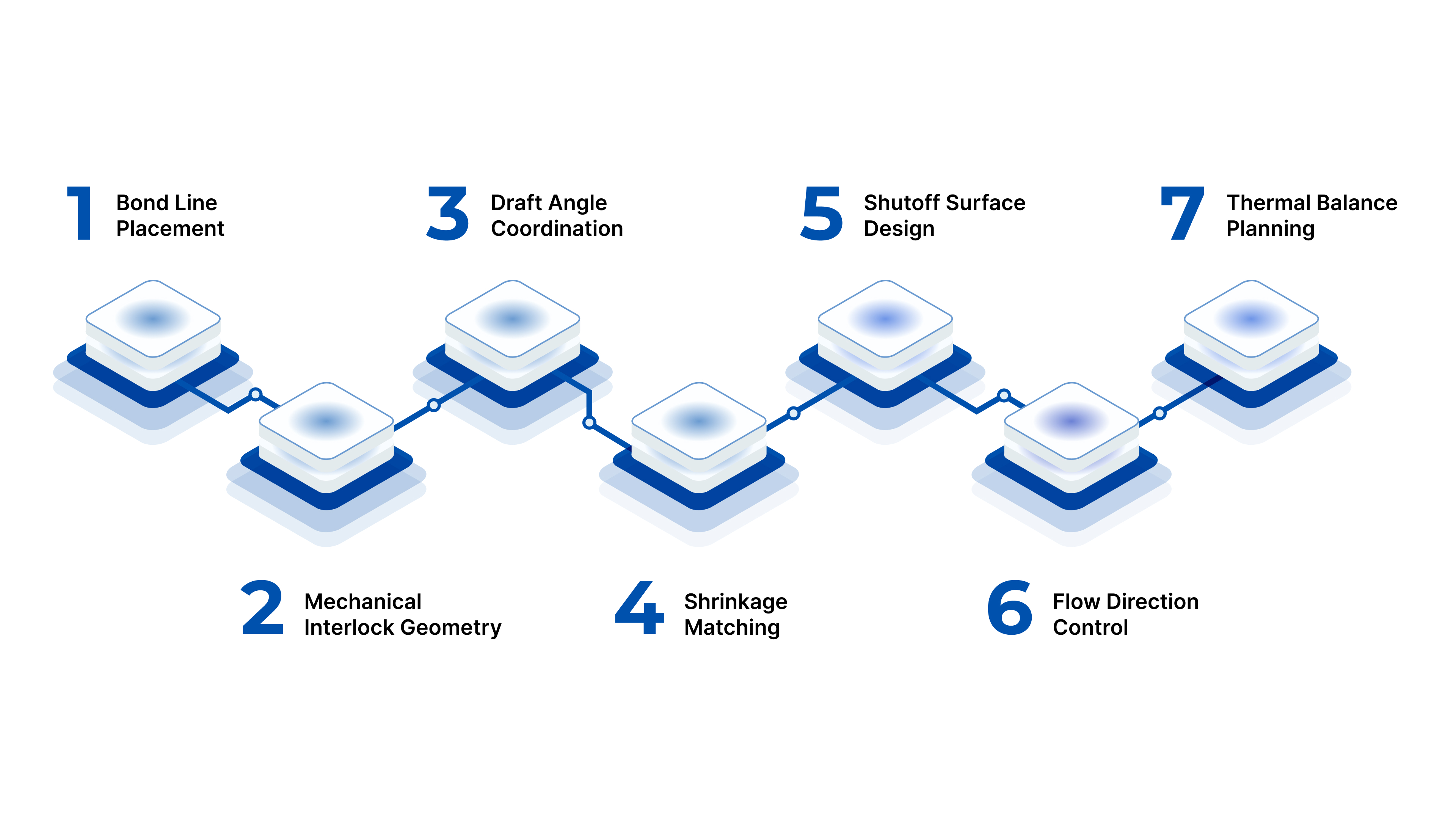
The following principles guide engineers toward stable, repeatable performance:
Bond Line Placement: Locate the interface away from bending, torsion, or impact zones. Placing the bond line in neutral stress regions prevents peel loading and fatigue propagation, significantly improving long-term durability in functional components.
Mechanical Interlock Geometry: Design grooves, perforations, or undercuts to physically trap the second material. Mechanical retention distributes load through the substrate rather than relying entirely on adhesion, ensuring reliability even with marginal chemical compatibility.
Draft Angle Coordination: Provide compatible draft directions for both materials so they release together during ejection. Mismatched draft causes differential friction, leading to tearing, distortion, or partial delamination during part removal.
Shrinkage Matching: Select materials and wall thickness ratios that cool and contract uniformly. Balanced shrinkage minimizes residual stress at the interface and prevents curling, edge lifting, or long-term separation after repeated thermal cycling.
Shutoff Surface Design: Machine-precise shutoff surfaces where materials meet inside the mold. Proper sealing prevents flash migration, preserves sharp transitions, and maintains dimensional accuracy in cosmetic and sealing surfaces.
Flow Direction Control: Direct the second material to flow across the bond interface. Cross-flow improves wetting and pressure contact, increasing molecular diffusion and producing stronger adhesion compared to parallel flow paths.
Thermal Balance Planning: Maintain sufficient heat in the first shot during the second injection. Proper temperature control promotes interfacial bonding while preventing substrate deformation, gloss variation, or dimensional instability.
Applying these principles early ensures predictable bonding behavior before tooling investment and keeps two-shot injection molding design consistent across production cycles.
Processing Parameters That Control Part Quality
Even a strong two-shot injection molding design fails if processing conditions drift outside the bonding window. Stable processing ensures both materials interact exactly as engineered.
Here are the parameters that directly influence adhesion, appearance, and dimensional stability:
Injection Timing Controls Interface Bonding: The second shot must inject while the first shot remains within its thermal bonding window. Delayed timing cools the substrate surface, reducing molecular diffusion and weakening adhesion strength across the interface.
Holding Pressure Controls Seal Compression: Proper pack and hold pressure compress the second material against the first shot. Insufficient pressure leaves micro-gaps, while excessive pressure causes flash, deformation, or displacement of soft sealing features.
Cooling Balance Prevents Warpage: Balanced cooling across both materials prevents differential shrinkage. Uneven cooling pulls the interface in opposing directions, producing warpage, internal stress, and eventual separation under mechanical load or temperature cycling.
Shot Size Consistency Maintains Cosmetic Quality: Consistent shot volume ensures uniform coverage and color transitions. Variations produce short shots, flow hesitation, visible witness lines, or inconsistent overmold thickness that affects both esthetics and sealing performance.
Barrel Temperature Alignment Prevents Degradation: Both materials require stable melt temperatures within compatible ranges. Excess heat degrades polymers and weakens bonding, while low temperatures prevent proper wetting, causing poor adhesion and dull surface finish.
A controlled process window reinforces two-shot injection molding design reliability and reduces setup sensitivity during production changeovers.
Common Two-Shot Injection Molding Design Mistakes That Lead to Failure
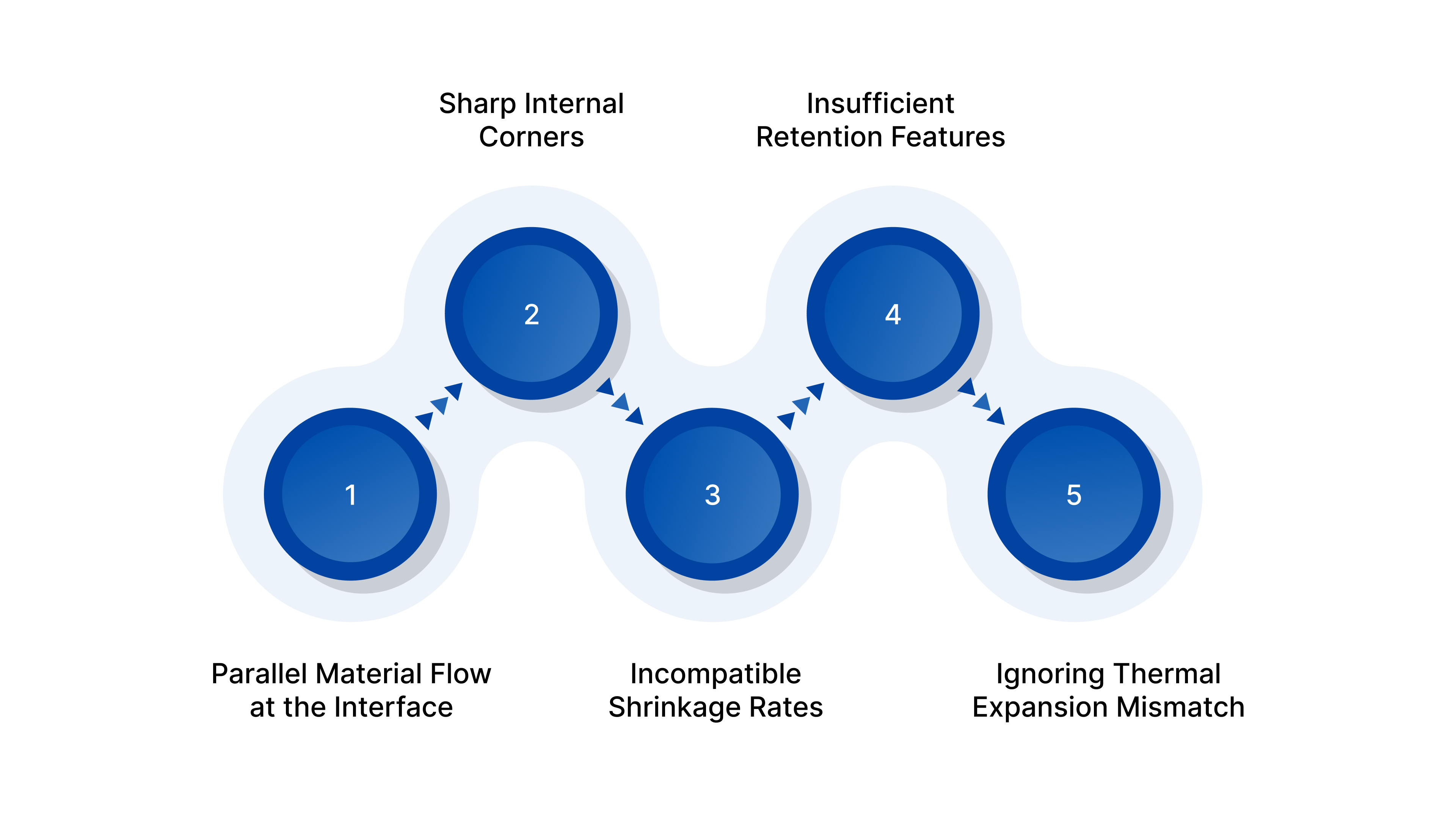
Many product issues blamed on materials or processing actually originate in early engineering decisions. A weak two-shot injection molding design often creates bonding failures, cosmetic defects, or dimensional instability long before the mold ever runs. Identifying these mistakes early prevents costly rework and scrap.
Below are the most common design errors and how engineers can correct them.
Parallel Material Flow at the Interface: When the second material flows parallel to the bond line, it barely wets the substrate surface. This reduces molecular interaction and weakens adhesion.
Redirect the gate, so flow crosses the interface, increasing wetting pressure and bonding strength.
Sharp Internal Corners: Sharp corners concentrate stress and create crack initiation points at the material boundary. Repeated loading quickly propagates failure along the bond line.
Add generous radii to distribute load evenly and protect the bonded interface from fatigue cracking.
Incompatible Shrinkage Rates: Large shrink differences between materials pull the interface apart during cooling. This causes visible gaps, curling, or long-term separation.
Match shrink rates where possible and adjust wall thickness to balance contraction forces.
Insufficient Retention Features: Relying only on chemical bonding often fails under vibration or thermal cycling. The overmolded material can peel away over time.
Integrate grooves, undercuts, or through-holes to provide mechanical interlocking support.
Ignoring Thermal Expansion Mismatch: Different expansion rates create cyclic stress during heating and cooling, eventually leading to delamination.
Select compatible materials and place the interface away from high-temperature or load-bearing zones.
Correcting these issues early significantly improves two-shot injection molding design reliability and long-term performance.
Industry Applications of Two-Shot Injection Molding Design
Manufacturers across regulated and high-performance sectors use two-shot injection molding design to improve durability, eliminate assembly, and enhance product reliability.
The ability to bond multiple materials in one cycle makes it especially valuable where sealing, ergonomics, and structural integrity matter.
Medical Industry: Medical device manufacturers use two shot injection molding design for integrated seals, soft-touch grips, and overmolded housings. It improves infection control by eliminating assembly gaps and enhances durability in devices that undergo repeated sterilization and handling.
Automotive Industry: Automotive suppliers apply two-shot injection molding design in switches, sensor housings, and sealing components. It enhances vibration resistance, integrates weather seals directly into rigid parts, and reduces part count in high-volume vehicle production.
Consumer Electronics Industry: Electronics manufacturers rely on two-shot injection molding design for buttons, keypads, and protective casings. It delivers precise color separation, tactile feedback, and improved moisture resistance without adhesives or secondary bonding operations.
Industrial Equipment Sector: Industrial product designers use two-shot injection molding design for rugged housings and protective covers. It strengthens impact zones, integrates sealing features, and reduces maintenance issues in harsh operating environments.
Wearable Product Manufacturers: Wearable device brands implement two-shot injection molding design for ergonomic grips and flexible interfaces. It improves user comfort, enhances sweat resistance, and maintains long-term adhesion under repeated bending and daily use.
Applications benefit most when durability, sealing performance, and assembly reduction directly influence product reliability and lifecycle cost.
How Evok Polymers Supports Two-Shot Injection Molding Projects?
Evok Polymers is an engineering-driven plastics design and manufacturing partner supporting OEMs, product developers, and industrial brands that require reliable multi-material components. We specialize in production-intent tooling, validation, and scalable molding programs where performance and repeatability matter as much as cost.
For complex two-shot injection molding design, we integrate design, tooling, and processing expertise so parts transition smoothly from concept to production.
Analyze load paths: Evaluate structural forces at the material interface and recommend retention geometry that prevents peeling, fatigue cracking, and long-term delamination under vibration, compression, and thermal cycling in real-world operating environments.
Validate material pairing: Test resin compatibility and define temperature windows that promote molecular bonding while preventing degradation, ensuring consistent adhesion across production lots and reducing scrap caused by unstable processing conditions.
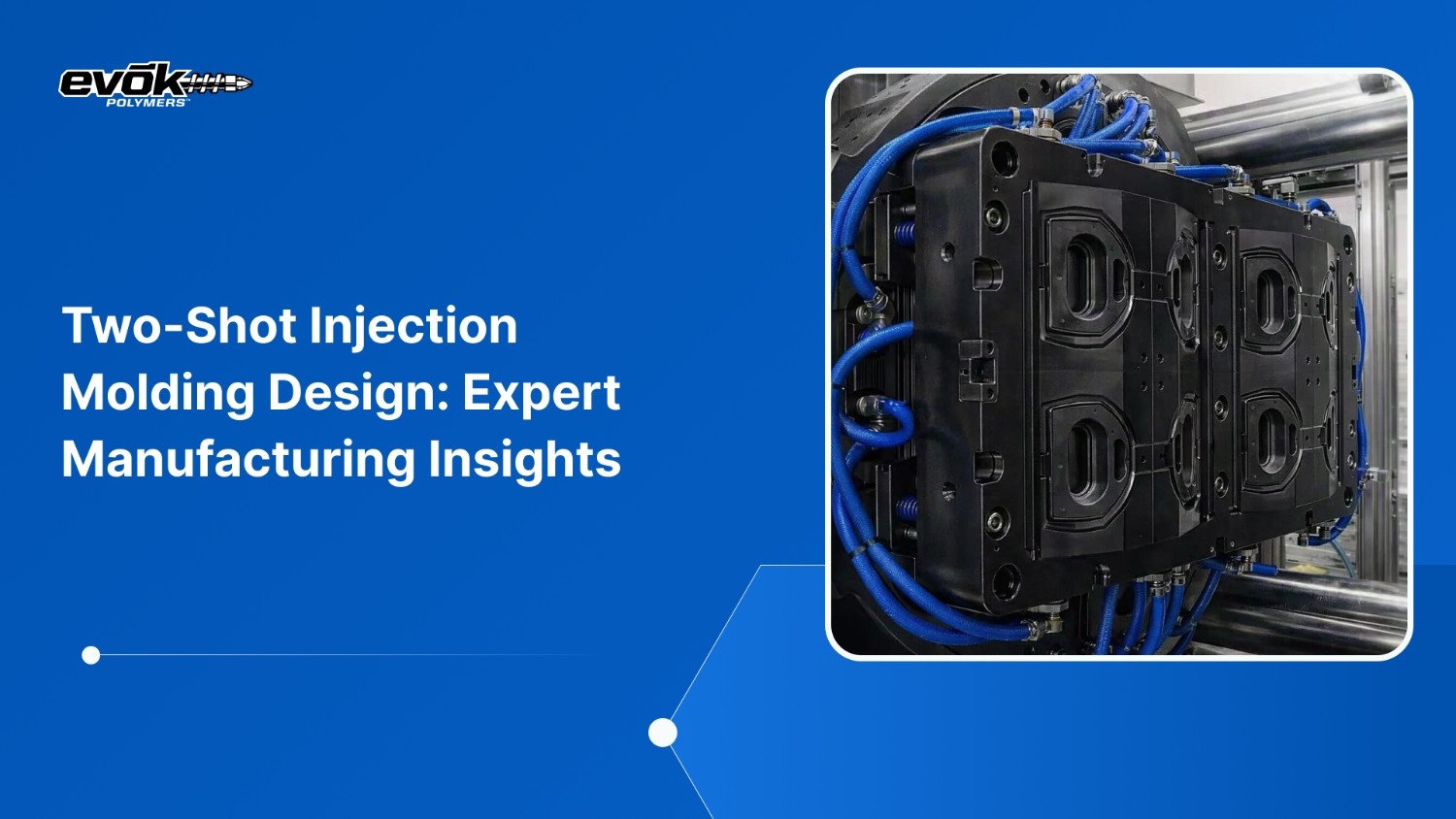
Engineer precision tooling: Design rotary or index molds with tight shutoff control and accurate cavity alignment so both shots register perfectly, preventing flash, mismatch, and cosmetic defects in high-volume manufacturing.
Simulate flow behavior: Run mold-flow analysis to predict bonding coverage, pressure distribution, and air entrapment, allowing corrections before tool build and avoiding expensive tooling rework after sampling.
Control production repeatability: Develop stable process windows, monitoring pressure, temperature, and timing to maintain consistent bond strength across thousands of cycles and protect long-term product reliability.
Engineers choose Evok Polymers because our design and manufacturing teams collaborate early, reducing risk before steel is cut and improving launch confidence.
Conclusion
Multi-material components fail when bonding depends on luck instead of engineering. A structured two-shot injection molding design approach aligns materials, geometry, tooling, and processing into one controlled system.
When properly executed, it eliminates assembly, improves durability, and stabilizes production quality. When overlooked, it causes delamination, scrap, and repeated tooling modifications.
If your current parts rely on adhesives or secondary assembly, could a redesigned interface solve reliability problems permanently?
Working with experienced engineering partners like Evok Polymers helps validate feasibility early and protect long-term production performance. Request a quote today!
Frequently Asked Questions
1. What is a two-shot injection molding design?
Two-shot injection molding design is a manufacturing method where two different materials are molded in one cycle using a specialized mold. The first shot forms the base structure, while the second bonds over it to add sealing, grip, or insulation. This eliminates secondary assembly and improves durability and consistency.
2. How strong is the bond between the two materials?
Bond strength depends on material compatibility, interface geometry, and processing temperature. Chemical bonding produces the strongest adhesion, while mechanical interlocking supports lower-compatibility materials. Proper design and processing can achieve bonds stronger than adhesive assembly and resistant to vibration, moisture, and fatigue during long-term use.
3. What materials work best for two-shot molding?
Common combinations include TPE over polypropylene, TPU over nylon, and elastomers over engineering plastics. Successful pairing requires compatible melt temperatures and surface energy. Engineers often run validation tests because even similar polymers behave differently depending on additives, fillers, and processing conditions.
4. Is two-shot molding more expensive than traditional molding?
Initial tooling costs are higher due to complex molds and machine requirements. However, eliminating assembly labor, adhesives, inspection, and sealing components typically lowers total production cost. Over medium-to-high volumes, two shot injection molding design usually provides better lifecycle economics and improved product reliability.
5. When should engineers choose two-shot injection molding?
Choose it when parts require sealing, vibration resistance, ergonomic grip, electrical insulation, or permanent multi-material bonding. It is especially valuable for medical devices, automotive switches, and consumer electronics, where assembly failure risks are unacceptable, and consistent quality across production runs is essential.