As manufacturers plan new products in 2026, understanding injection molding cost has become a critical part of early decision-making. For engineers, founders, and operations teams, cost clarity determines whether a design moves forward or stalls at the planning stage.
Questions like how much does injection molding cost and where expenses actually come from are no longer just procurement concerns, they directly affect timelines, pricing, and scalability.
Injection molding costs typically fall into two areas: upfront tooling and per-part production. While unit costs drop significantly at higher volumes, tooling can represent a major initial investment.
Making sense of these trade-offs requires a clear view of design complexity, materials, and production efficiency.
Key Takeaways
The injection mold cost is a fixed expense that must be balanced against the total production volume to find the true unit price.
Choosing between commodity resins and high-performance polymers is a major driver of the cost of plastic injection molding.
Small design changes can lead to substantial savings in the average cost to make a product with injection molding.
The plastic injection price drops dramatically as quantities increase, making high-volume runs the most efficient use of resources.
Factors like machine tonnage and cycle time are critical components of the injection molding price.
To get started, it is vital to examine the specific drivers of the initial tooling phase, as this often represents the highest barrier to entry.
Factors Influencing Injection Molding Tooling Cost
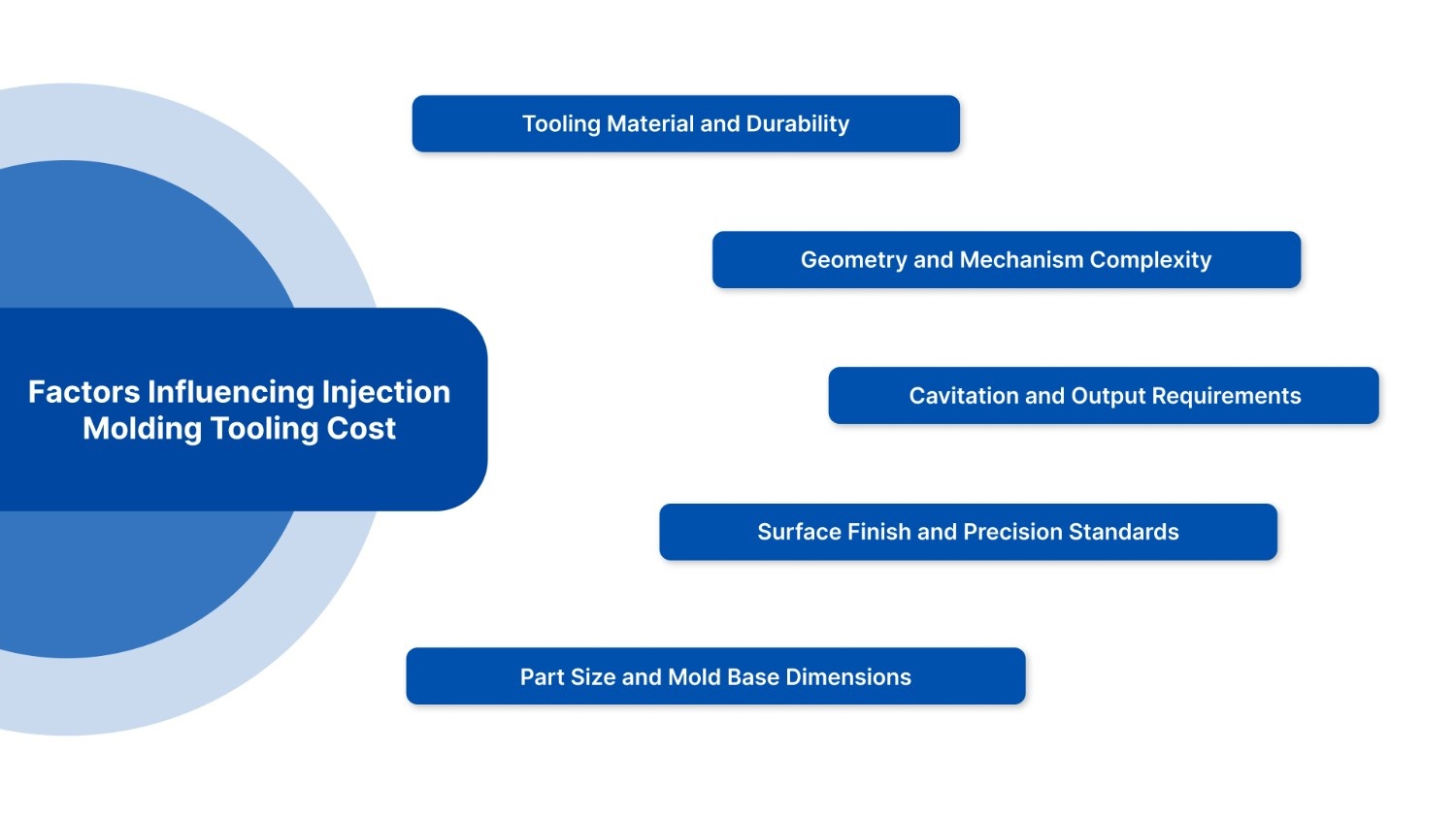
When asking how much does a plastic injection mold cost, it is important to realize that every mold is a custom-engineered piece of equipment.
The injection molding mold cost is influenced by the technical requirements of the part and the longevity needed for the tool. Here are five detailed factors that shape these expenses:
1. Tooling Material and Durability
The type of metal used to create the mold is a fundamental driver of plastic injection molding tooling cost. For low-volume production or prototyping, aluminum is a frequent choice because it is easier to machine and provides excellent heat dissipation.
However, for high-volume mass production, hardened steel is necessary. Steel tools, such as those made from H13 or S7 steel, are built to withstand millions of cycles without losing dimensional accuracy.
While the plastic injection mold price for steel is higher, it ensures the lowest cost per part over the life of the project.
2. Geometry and Mechanism Complexity
The physical shape of the part determines the internal complexity of the mold. Features that prevent a part from being pushed straight out of the tool, such as holes on the side or internal clips, require moving components.
These are known as side actions or lifters. Each moving part increases the injection molding mold cost because it requires additional engineering, precision machining, and maintenance.
Simplifying a design to remove these features is one of the most effective ways to lower the custom injection molding cost.
3. Cavitation and Output Requirements
Cavitation refers to the number of identical parts produced in a single machine cycle. A single-cavity mold is the most affordable injection mold cost upfront, but it results in a higher plastic injection molding price because only one part is made at a time.
Multi-cavity molds, which might produce 4, 8, or even 64 parts simultaneously, involve a much higher injection molding tooling cost.
However, they significantly reduce the labor and machine time needed for each unit, which is essential for achieving a competitive average cost to make product with injection molding.
4. Surface Finish and Precision Standards
The level of detail required on the surface of the part directly impacts the precision plastic injection molding price. Molds that require a high-gloss, mirror-like finish or specific textures must be hand-polished or chemically etched, adding labor hours to the fabrication process.
Furthermore, parts with extremely tight tolerances require the mold to be built with surgical precision using advanced CNC and electrical discharge machining. This level of accuracy ensures consistency but increases the overall price of injection molding tools.
5. Part Size and Mold Base Dimensions
The overall dimensions of the part dictate the size of the mold base and the amount of material needed to build the tool. Larger parts require massive blocks of steel or aluminum, increasing the raw material component of the injection mold costs.
Additionally, larger molds require bigger machines to operate, which ties into the ongoing price of injection molding during the production phase.
Once the tool is built, the focus shifts to the ongoing expenses of running the machine and processing the raw materials.
Also Read: Common Design Mistakes That Increase Production Costs
Determining the Price of Injection Molding Parts
The cost of injection molding for each individual piece is a variable expense that fluctuates based on the market price of resin, machine energy consumption, and labor.
Understanding how much is injection molding on a per-part basis allows companies to set accurate retail prices and manage margins.
Plastic Resin Selection
The primary material expense is the resin itself. In 2026, commodity plastics like polypropylene and polyethylene remain affordable, but specialized engineering resins like PEEK or Ultem can cost significantly more.
The plastic injection price is calculated by the weight of the part plus any waste generated during the process. High-performance materials are often used in medical or aerospace applications where the precision plastic injection molding price is justified by the performance of the part.
Machine Tonnage and Hourly Rates
Injection molding machines are categorized by their clamping force, measured in tons. Smaller parts can be produced on 50-ton machines with lower hourly rates, while large automotive components might require 1000-ton presses.
The injection molding costs include the electricity, floor space, and maintenance associated with these machines. In the US market, hourly rates for machine time typically range from $65 to over $150 depending on the size and technology level of the equipment.
Labor and Post-Processing
While the molding process is largely automated, labor is still required for machine setup, quality inspections, and packaging.
Additionally, if a part requires secondary operations like assembly, ultrasonic welding, or painting, the plastic molding costs will increase. Minimizing the hands-on time required for each part is a key strategy for reducing the cost of plastic injection molding.
To arrive at a final budget, you must combine all these variables into a comprehensive calculation.
Calculating Injection Molding Cost: Detailed Breakdown
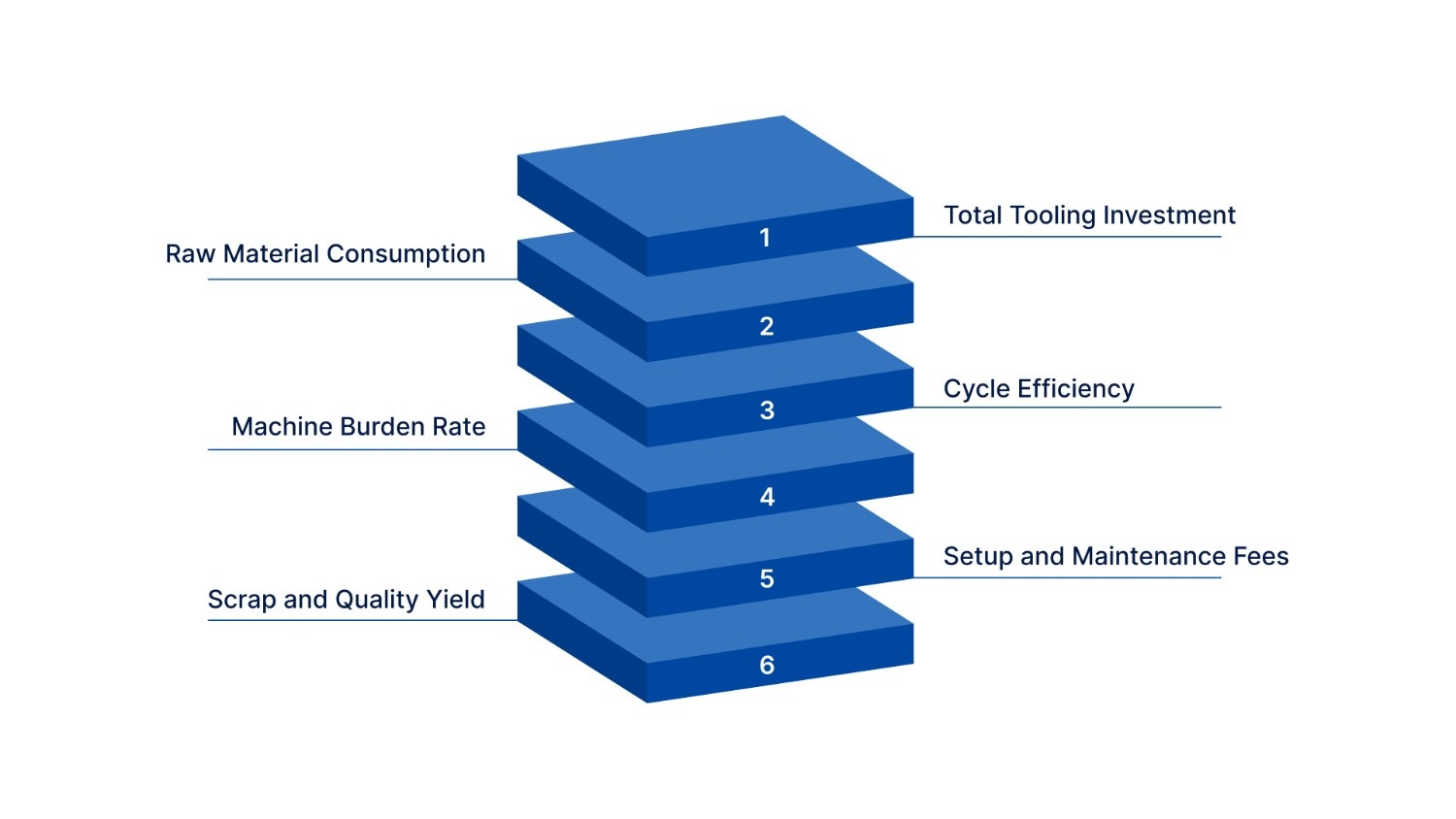
Professional manufacturers use a structured approach to provide an accurate injection molding cost estimate. Rather than looking at a single number, the budget is built from several distinct pillars of expense.
Total Tooling Investment: This is the one-time payment for the design and construction of the mold. To understand the impact on the final product, this amount is divided by the total number of parts expected to be produced over the life of the tool.
Raw Material Consumption: This involves calculating the weight of the part and adding a factor for the material that fills the channels leading to the part. The current market price for the specific resin is then applied to this total weight.
Cycle Efficiency: This is the time it takes to complete one full cycle of the machine. It includes the time to inject the plastic, the cooling period, and the ejection of the part.
Reducing this time by even a few seconds can have a massive impact on the plastic injection molding cost over a large run.
Machine Burden Rate: Every hour the machine runs, it incurs a cost. This rate covers energy, overhead, and equipment depreciation. The machine cost for a single part is determined by how many parts are produced per hour.
Setup and Maintenance Fees: Every production run requires time to install the mold, calibrate the machine, and reach a steady state of quality. These setup costs are usually fixed per batch, meaning larger batches result in a lower injection molding price per unit.
Scrap and Quality Yield: No process is 100% efficient. A small percentage of parts may have defects and need to be recycled or discarded. This scrap rate is factored into the cost of injection molding to ensure the final quote covers the actual material used.
By identifying these cost pillars, engineers can then look for specific strategies to bring the total expenditure down.
Strategies to Optimize and Lower Injection Molding Costs
If the initial injection molding cost estimate is higher than expected, there are several professional methods to refine the project. Reducing the price of injection molding does not always mean lowering quality; often, it means increasing efficiency.
Design for Manufacturing (DFM)
Engaging in a DFM review is the most effective way to lower the custom injection molding cost. By ensuring that walls are a uniform thickness, the cooling time is minimized.
Adding a slight taper to vertical walls, known as a draft, allows the part to eject more easily, which reduces wear on the mold and shortens the cycle time.
Optimized Cavitation
Choosing the right number of cavities is a balancing act. If you are only making 5,000 parts, a single-cavity tool is the best way to keep the plastic injection mold price low.
However, if you are making 500,000 parts, an 8-cavity tool will pay for itself very quickly by lowering the machine time and labor costs associated with the plastic injection molding price.
Material Substitution
Sometimes, a slightly more expensive resin can actually lower the injection molding costs. For example, a material that cools faster or flows more easily might reduce the cycle time enough to offset the higher price per pound.
Our Team of Experts can help analyze these trade-offs to find the most economical solution.
Regional Sourcing and Logistics
For US-based companies, sourcing locally can eliminate the hidden expenses of international shipping, customs duties, and long lead times.
When you look at the total landed cost of plastic injection molding, a domestic partner like Evok Polymers often provides the best overall value by reducing supply chain risk.
View Our Capabilities: Molded Parts Gallery
Understanding how these strategies scale is best done by looking at how costs change across different production tiers.
Injection Molding Prices by Production Volume
The answer to how much does plastic injection molding cost is highly dependent on the scale of the operation. The following table illustrates how the relationship between tooling and unit price shifts as volume increases.
Volume Category | Typical Units | Tooling Material | Estimated Tooling Cost | Estimated Part Price |
Prototyping | 1 - 500 | Aluminum / 3D Printed | $1,000 - $4,000 | $5.00 - $15.00 |
Low-Volume | 1,000 - 10,000 | Machined Aluminum | $4,000 - $12,000 | $2.00 - $5.00 |
Mid-Volume | 10,000 - 100,000 | Pre-hardened Steel | $12,000 - $35,000 | $1.00 - $2.50 |
High-Volume | 100,000+ | Hardened Steel | $35,000 - $100,000+ | $0.25 - $1.00 |
This table shows that while how expensive is injection molding depends on the initial investment, the long-term efficiency is unmatched by other manufacturing methods.
For high-volume projects, the injection molding tooling cost becomes a minor fraction of the total budget when spread across millions of units.
Conclusion
Navigating the injection molding cost is a complex but rewarding process. By understanding the interplay between the initial injection molding tooling cost and the ongoing plastic injection molding price, manufacturers can unlock the massive economies of scale that this process provides.
In 2026, the key to success lies in early collaboration, smart material selection, and a commitment to design efficiency.
At Evok Polymers, we are dedicated to helping our partners understand every aspect of the cost of plastic injection molding.
From the first injection molding cost estimate to the final delivery of parts, our focus is on providing high-quality, cost-effective US manufacturing solutions.
Request a Quote from Evok Polymers today!
Frequently Asked Questions (FAQs)
1. How much does a plastic injection mold cost for a basic household part?
For a relatively simple part with no complex internal features, a standard aluminum mold for low-volume production typically costs between $3,000 and $6,000.
If the part requires mass production in the millions, a high-quality steel mold could cost upwards of $20,000 due to the durability requirements.
2. What is the average cost to make product with injection molding including the mold?
The average cost to make product with injection molding depends heavily on volume. For a project requiring 10,000 units with a $10,000 mold and a $1.00 part price, the total investment is $20,000, leading to a real cost of $2.00 per unit.
As the volume increases to 100,000 units, that same project would see the real cost drop closer to $1.10 per unit.
3. Does the choice of material significantly change the plastic injection molding price?
Yes. Commodity resins like polypropylene are very inexpensive, often costing less than $1.00 per pound. Engineering resins or high-performance polymers used for heat resistance or strength can cost ten times that amount.
This choice is a primary component of the plastic injection molding cost.
4. Why is the injection molding tooling cost so high compared to other methods?
The cost is high because an injection mold is a high-pressure vessel that must be machined to extremely tight tolerances from solid blocks of metal. It must also include intricate cooling channels and ejection systems.
This precision engineering is what allows for the rapid production and low plastic injection price during the manufacturing stage.
5. How much does it cost to make a plastic mold for a multi-part assembly?
If an assembly has five different plastic parts, you will generally need five separate molds. The how much does a plastic injection mold cost question then applies to each individual component.
In some cases, multiple parts can be placed in a single mold base to save on the injection molding mold cost, provided they are made from the same material.