Are you struggling to balance part performance, cost, and manufacturability when designing plastic components?
In the United States, the injection molding market for plastics generated around USD 49.98 billion in revenue in 2023 and might reach USD 59.98 billion by 2030. The growth will continue to grow as demand for precision parts rises across industries.
The challenge many teams face is that poor design or a lack of process understanding leads to defects, extended timelines, and higher costs, especially when moving from prototype to production. Without a clear process roadmap and design strategy, parts may warp, sinks may form, or tooling revisions may become inevitable.
A solid understanding of injection molding can help you avoid these pitfalls and simplify production. In this guide, you will learn what general plastics injection molding is, how it works, key design considerations, materials used, and how top industries apply this process in real production scenarios.
Key Takeaways
Design drives cost more than tooling does. Early DFM decisions in general plastics injection molding directly impact cycle time, scrap rate, and long-term unit economics.
Material choice defines performance limits. Mechanical strength, heat resistance, and chemical exposure all hinge on selecting the correct resin family.
Process control prevents expensive defects. Stable temperatures, pressures, and cooling rates are critical for dimensional consistency and cosmetic quality.
Tooling strategy determines scalability. Cavitation, gate design, and steel selection influence both throughput and mold life.
Engineering–manufacturing alignment reduces risk. Clear communication between design, purchasing, and production teams minimizes delays and rework.
What Is General Plastics Injection Molding?
General plastics injection molding is a manufacturing process where plastic pellets are melted and injected under high pressure into a precision mold cavity to form identical parts.
This process relies on thermoplastics; materials that soften when heated and solidify when cooled, making them ideal for high-volume, repeatable production.
The key advantage is the combination of rapid cycle times, detailed features, and consistent quality across thousands to millions of parts.
Understanding this foundation helps clarify how the process operates step by step.
How General Plastics Injection Molding Works?
The process follows a repeatable molding cycle engineered for consistency, dimensional control, and cycle efficiency. Each phase influences mechanical performance, cosmetic quality, and production cost.
The core stages that define general plastics injection molding include:
Clamping: The mold halves close under a calculated clamp force that exceeds injection pressure to prevent flash. Proper tonnage ensures cavity sealing and dimensional consistency during filling.
Injection: A reciprocating screw drives molten polymer through runners and gates into the mold cavity at controlled velocity and pressure. Injection speed affects shear rate, material orientation, and surface finish.
Cooling: Internal cooling channels circulate temperature-controlled water to remove heat efficiently. Controlled cooling minimizes differential shrinkage and reduces warpage risk.
Ejection: Once the part reaches ejection temperature, ejector pins release it without deforming features. Proper ejection design prevents stress marks and part distortion.
Key Steps in the Injection Molding Process
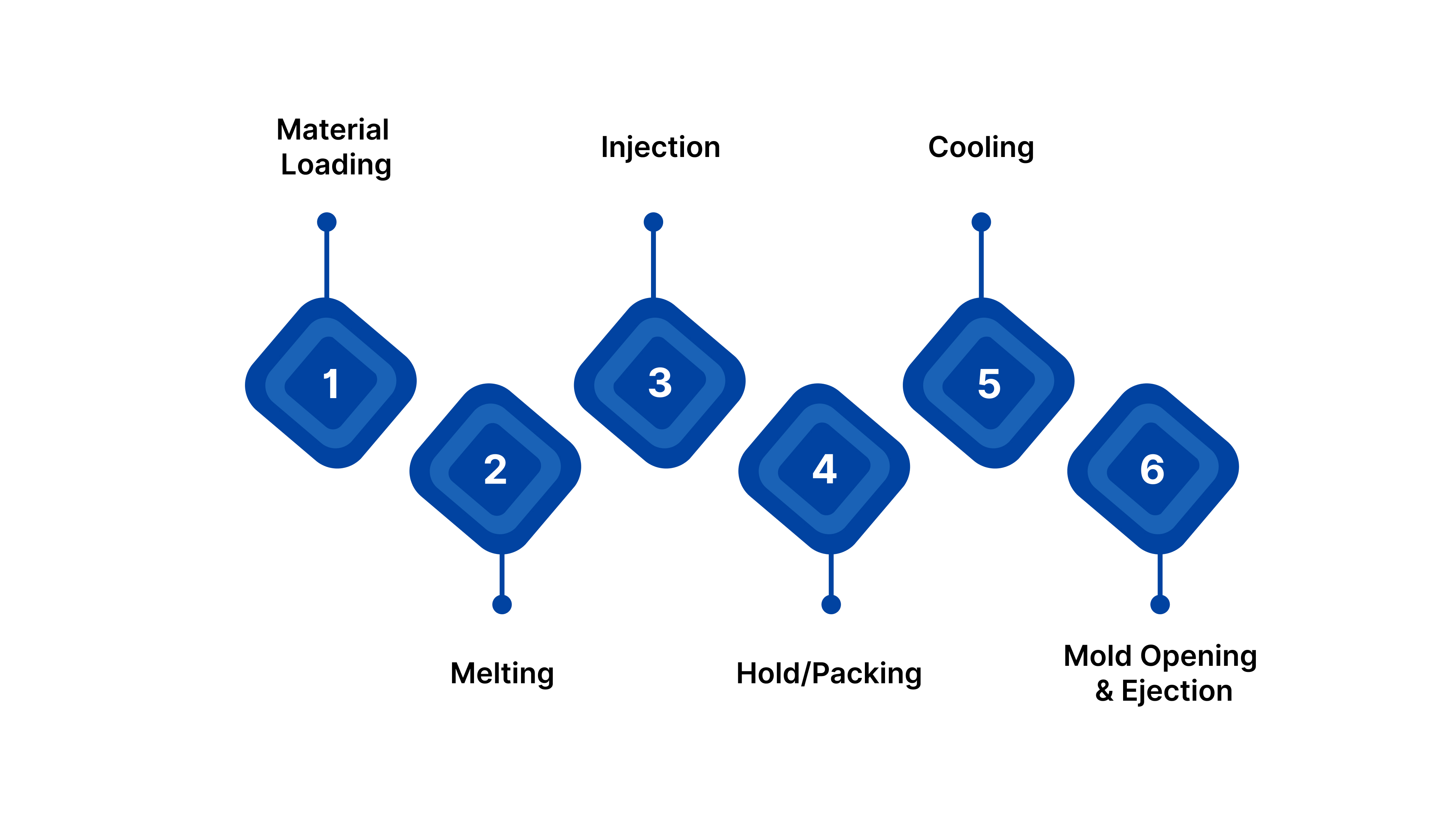
Every stage within general plastics injection molding must operate within defined process windows to maintain quality and repeatability. Even minor deviations in temperature or pressure can alter part performance.
Below are the essential process stages:
Material Loading: Resin pellets enter the hopper and may pass through a dryer to remove moisture content. Moisture control prevents splay defects and maintains molecular integrity.
Melting: The rotating screw conveys resin forward while heaters and shear friction melt the material uniformly. Proper melt temperature ensures consistent viscosity and flow characteristics.
Injection: The screw advances as a plunger, forcing molten plastic into the mold under high pressure. Controlled injection rate prevents short shots and reduces weld line weakness.
Hold/Packing: Additional pressure compensates for volumetric shrinkage as the polymer cools. Correct packing pressure improves density and reduces sink marks.
Cooling: Mold temperature controllers regulate heat removal to stabilize crystallization or solidification. Balanced cooling ensures dimensional accuracy across the part.
Mold Opening & Ejection: The mold opens once the part temperature reaches a safe handling range. Ejection systems must distribute force evenly to avoid deformation.
This structured sequence allows general plastics injection molding to deliver repeatable, production-grade components at scale.
Materials Used in Injection Molding
Material selection defines mechanical performance, thermal stability, and cost efficiency in general plastics injection molding. Engineers must evaluate strength, chemical exposure, regulatory requirements, and environmental conditions.
Here are common material categories:
Thermoplastics (ABS, PP, PE, Nylon, PC): These materials soften under heat and solidify when cooled, allowing reprocessing and recycling. Their mechanical properties vary from impact resistance to chemical durability, making them versatile for diverse applications.
Thermosets: These materials cure permanently during molding through chemical cross-linking. They offer superior heat resistance and dimensional stability, but cannot be remelted.
Elastomers: Flexible polymers provide elasticity and sealing capability. They are used where vibration damping or compression recovery is required.
Selecting the correct resin enhances part longevity and supports efficient general plastics injection molding production.
Design Considerations for Plastic Injection Molding
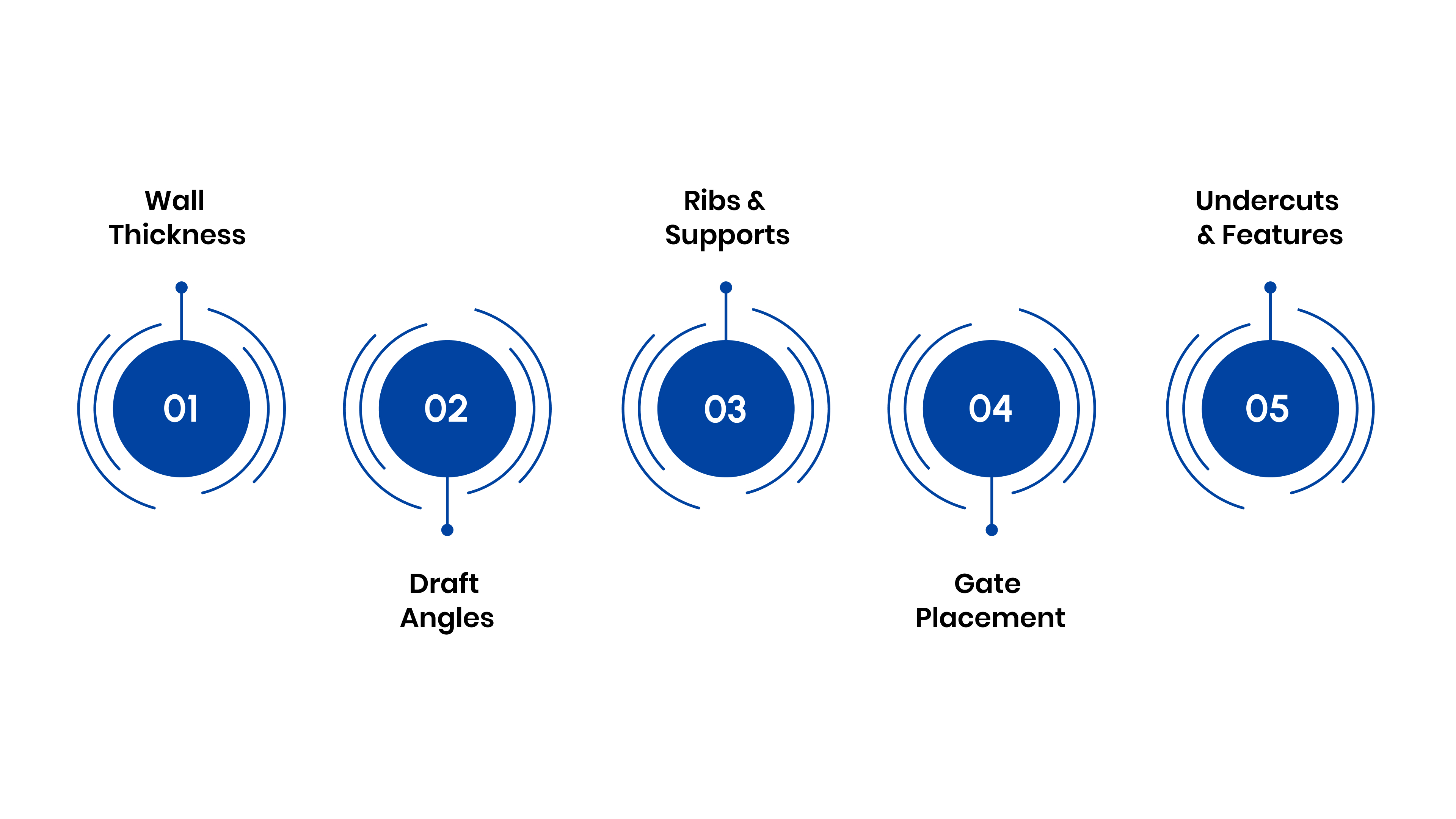
Strong design principles reduce risk, improve manufacturability, and control cost in general plastics injection molding. Engineers must design with both flow dynamics and cooling behavior in mind.
Below are the most vital considerations:
Wall Thickness: Maintain uniform thickness to promote even flow and consistent cooling rates. Variations can create differential shrinkage and internal stress. Rib walls should be no less than 40-60% of the adjacent wall thickness, and all sections must fall within the recommended thickness range for the selected resin to prevent sink, voids, or warpage.
Draft Angles: Apply adequate draft (typically 1–3°) to vertical walls to ease ejection. Insufficient draft increases drag and surface defects.
Ribs & Supports: Use ribs to enhance stiffness without increasing overall wall thickness. A proper rib-to-wall ratio prevents sink marks.
Gate Placement: Position gates to balance flow path lengths and minimize weld lines. Gate design affects packing efficiency and cosmetic appearance.
Undercuts & Features: Complex geometries may require slides or lifters in tooling. Minimizing undercuts reduces tooling cost and maintenance complexity.
Careful design integration strengthens general plastics injection molding outcomes and reduces expensive tool modifications.
Industry Uses of General Plastics Injection Molding
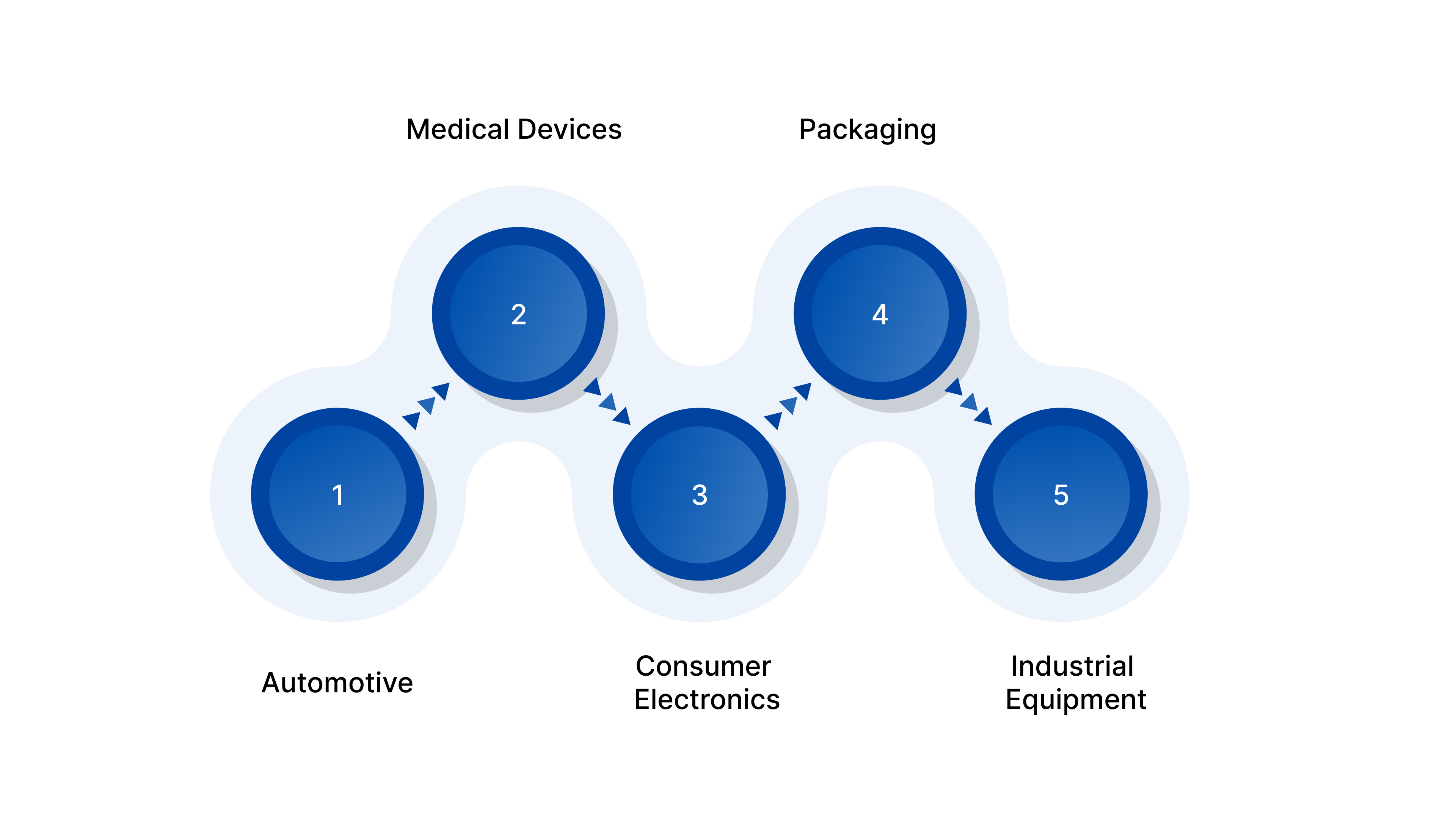
The scalability and precision of general plastics injection molding make it indispensable across U.S. industries. It supports both structural components and high-cosmetic consumer products.
Here’s how industries apply it:
Automotive: Manufacturers produce interior panels, clips, housings, and structural brackets. These parts must withstand vibration, thermal cycling, and mechanical loads.
Medical Devices: Single-use components, housings, and fluid management parts rely on tight tolerances and material traceability. Cleanroom molding ensures compliance with regulatory standards.
Consumer Electronics: Enclosures, connectors, and buttons demand high cosmetic standards and dimensional precision. Mold design controls surface texture and snap-fit performance.
Packaging: Caps, closures, and containers require a lightweight design and rapid cycle times. High cavitation molds support large-volume production.
Industrial Equipment: Functional components such as gears, spacers, and covers must deliver mechanical strength and durability. Material selection ensures resistance to chemicals and environmental exposure.
These applications demonstrate why general plastics injection molding remains central to modern manufacturing.
How Evok Polymers Support Injection Molding Success?
Evok Polymers is a Minneapolis-based design, development, and manufacturing partner focused on helping companies deliver production-ready injection molded parts with clarity and engineering excellence.
We focus on five core services:
Part Design Optimization: We refine geometry to enhance manufacturability and structural integrity. Early DFM analysis reduces tooling risk and accelerates launch timelines.
Material Selection Guidance: We match resin properties to performance demands and environmental exposure. Proper material choice ensures durability and compliance.
Mold Engineering and Development: We design tooling for balanced flow, efficient cooling, and repeatable cycles. Precision machining supports tight tolerances.
Prototyping and Validation: We test design assumptions before full-scale production. Functional validation reduces costly production errors.
Production Qualification and First Article Approval: We verify dimensional consistency and repeatability. Statistical validation ensures process stability.
Evok Polymers helps transform general plastics injection molding from a process into a strategic production advantage.
Conclusion
Are you facing tooling delays, rising production costs, or inconsistent part quality in your plastic components? Many manufacturers invest in molding without fully optimizing design, material selection, or process control, only to encounter avoidable setbacks during production.
General plastics injection molding delivers scalability, precision, and cost efficiency, but only when engineering and manufacturing work in sync from the start. Early DFM alignment, controlled process parameters, and validated tooling make the difference between repeat issues and repeatable success.
With a structured engineering-to-production approach, transparent cost modeling, and disciplined qualification processes, firms like Evok Polymers help you reduce risk and launch with confidence.
If you’re ready to move from concept to reliable production, request a quote today!
Frequently Asked Questions
1. What is general plastics injection molding?
General plastics injection molding is a manufacturing process where molten thermoplastic material is injected into a precision-machined mold cavity to form solid parts. It is widely used for high-volume production because it offers repeatability, tight tolerances, and cost efficiency once tooling is established and validated for production.
2. What materials are used in general plastics injection molding?
Common materials include polypropylene (PP), polyethylene (PE), ABS, polycarbonate (PC), nylon (PA), and acetal (POM). Material selection depends on mechanical strength, temperature resistance, chemical exposure, impact performance, and regulatory requirements. Engineers must match resin properties to part function and long-term environmental conditions.
3. What are the main advantages of injection molding?
Injection molding provides high production speed, consistent part quality, complex geometry capability, and low per-unit cost at scale. It also reduces material waste through controlled processing. However, achieving these advantages requires proper mold design, process control, and upfront engineering validation to prevent defects.
4. What are common defects in plastic injection molding?
Common defects include sink marks, warpage, short shots, flash, burn marks, and weld lines. These issues often stem from improper wall thickness, poor venting, incorrect gate design, or unstable processing conditions. Addressing defects requires coordinated adjustments to tooling, material choice, and molding parameters.
5. How much does injection molding cost?
Injection molding costs include tooling investment, material pricing, cycle time, labor, and overhead. Tooling can range from thousands to hundreds of thousands of dollars, depending on complexity. Per-part cost decreases significantly at higher volumes, making it most economical for medium-to-high production runs.