Introduction
In 2026, manufacturers are no longer simply optimizing existing processes—they're rethinking how parts are designed, sourced, and produced from the ground up. The pressure is coming from every direction.
For OEMs and product brands, three forces are converging at once:
- AI and automation are shifting from competitive advantages to baseline expectations
- Sustainability mandates are moving from voluntary initiatives to legal requirements
- Supply chain disruptions have exposed the vulnerability of offshore tooling dependencies
The manufacturers who respond will unlock lower costs, faster time-to-market, and better-performing parts. Those who don't risk falling behind competitors who've already embraced smarter automation, advanced molding techniques, and Design for Manufacturability (DFM) as strategic investments.
Adapting isn't optional anymore. The only real variable is how fast you move.
Key Takeaways
- AI-driven quality control is cutting defect response times from 50 minutes to under 5 minutes and reducing scrap rates by over 90%
- IIoT sensors deliver 200%–400% ROI within 2–3 years through predictive maintenance and live production monitoring
- EU and U.S. regulations are forcing rapid adoption of post-consumer recycled resins and bio-based materials
- Overmolding and insert molding are eliminating assembly steps and reducing total manufacturing costs by 15%–40%
- DFM optimization locks in over 70% of a part's cost at design stage, so pre-tooling reviews are the highest-ROI step in production
Smarter Automation: AI, IIoT & Real-Time Quality Control
Automation in 2026 means far more than robots on an assembly line. Machine learning algorithms, sensor networks embedded in every press, and real-time decision-making built into the molding process itself are now standard expectations. The result: quality control shifts from a reactive bottleneck into a system that catches problems before they become scrap.
AI-Driven Quality Control
AI vision systems are detecting micro-level surface defects, dimensional drift, and color inconsistencies that human inspectors would miss—or catch too late. According to McKinsey research, implementing smart inline quality control cuts response time to defects from an average of 50 minutes to under 5 minutes. In practical applications, these systems have slashed scrap rates from 3.2% to 0.3% while maintaining false rejection rates below 0.1%.
The shift is from periodic quality checks to continuous, cycle-by-cycle monitoring. Most manufacturers are landing on a practical split: AI handles repetitive, quality-critical inspection tasks—surface blemishes on medical device housings, dimensional variance in automotive connectors—while skilled operators focus on setup, troubleshooting, and process optimization.
By 2026, over 70% of injection molding operations will deploy advanced vision systems integrated with AI. Commercial platforms are proving this technology is no longer experimental:
- Cognex achieved over 30% waste reduction in packaging by reducing false rejects
- Keyence delivered a sixfold reduction in razor reject rates using real-time shade correction filters
- Landing AI reduced setup complexity for semiconductor manufacturers through cloud-based Large Vision Models
IIoT & Real-Time Production Monitoring
Industrial Internet of Things (IIoT) sensors embedded in machines and molds are giving manufacturers live visibility into machine status, cycle times, temperature variance, and press availability. This replaces manual shift logs with usable data that flows directly into production scheduling systems.
Real-time visibility systems help plants improve Overall Equipment Effectiveness (OEE) by 10%–22% within the first year. Analysis of over 34 million machine-minutes in plastics and packaging shows the median runtime for injection molding machines sits at 71%. Top-quartile performers reach 97% runtime during scheduled hours. That 26-percentage-point gap is recoverable capacity—no new capital equipment required.
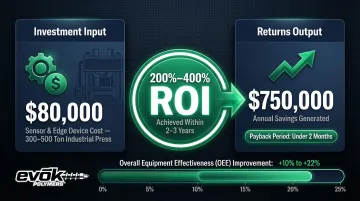
Among IIoT investments, predictive maintenance consistently delivers the fastest returns. Typical ROI runs 200%–400% within 2–3 years. On a 300–500 ton press, an $80,000 investment in sensors and edge devices can yield $750,000 in annual savings through downtime reduction. That's a payback period of under two months.
Digitization is also extending into production scheduling. Emerging buyer-oriented marketplaces are matching available press time with demand, reducing waste on both sides and helping molders optimize capacity utilization in real time.
Sustainable Materials & Advanced Molding Techniques
Sustainability in injection molding is no longer a marketing preference. Regulation, OEM procurement requirements, and measurable performance improvements are all pushing in the same direction.
The convergence of environmental mandates and technology maturity is making sustainable materials and advanced molding techniques both necessary and cost-justified.
Sustainable & Bio-Based Materials
Three main sustainable material categories are seeing measurable adoption:
Post-Consumer Recycled (PCR) Resins: Typically blended at 10%–30% with virgin resin to maintain mechanical properties. The global PCR plastics market is projected to reach $21.64 billion by 2030, growing at 10.4% annually. In the U.S., average PCR content in plastic packaging nearly doubled—from 5.3% in 2019 to 10.7% in 2023—among companies with stated sustainability goals.
Bio-Based Plastics: Derived from corn starch, sugarcane, or other renewable feedstocks. While PLA and PHA offer genuine biodegradability, they carry a 20%–50% price premium over virgin fossil-based resins and require strict processing controls. Engineered crystalline PLA grades can now achieve heat deflection temperatures of 149°C—making them viable for semi-durable goods if proper drying protocols are followed.
High-Durability Traditional Polymers: The most sustainable choice is often a traditional engineering resin designed to outlast short-lived "eco" alternatives. A durable ABS or polycarbonate part that lasts 10 years often has a lower lifecycle environmental impact than a bio-based part that degrades prematurely.
Single-use plastic legislation is tightening globally and directly affecting OEMs:
- EU Packaging and Packaging Waste Regulation (PPWR): Applies from August 12, 2026, mandating all packaging be recyclable by 2030 with minimum PCR percentages
- California SB 54: Requires 100% of single-use packaging to be recyclable or compostable by 2032, with producers joining a Producer Responsibility Organization by January 1, 2027
- Colorado HB 22-1355: Producers must pay responsibility dues on covered materials starting January 2026
Advanced Molding Techniques: Overmolding & Insert Molding
Overmolding combines two molded materials into a single complex part without separate assembly: think soft-touch grips over rigid substrates. Insert molding places metal or plastic inserts into the mold pre-injection for added strength. Both techniques are gaining adoption as manufacturers seek to reduce part count, assembly labor, and total unit cost.
The 2-Shot Injection Molding Market is expected to reach $15.82 billion in 2026, growing at 5.98% annually. Implementing overmolding can reduce total manufacturing costs by 15%–40%, depending on part geometry and production volume.
Industry applications delivering measurable results:
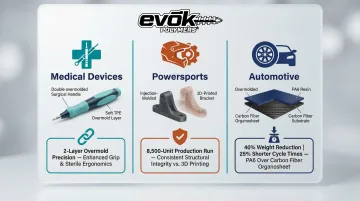
- Medical devices: Double overmold surgical instrument handles with quick attach-and-release mechanisms that save fixture assembly time
- Powersports: Injection-molded brackets replacing 3D-printed parts for 8,500-unit runs, providing uniform strength in all directions and eliminating directional weakness under dynamic vibration loading
- Automotive: Thermoplastic composite overmolding (PA6 resin over 40% carbon fiber organosheet) achieving 40% weight reduction compared to aluminum and 25% shorter molding cycles
3D printing is now widely used alongside these techniques for prototype validation before committing to steel tooling—reducing tooling risk and accelerating time-to-market. Evok Polymers supports this step directly: SLA and FDM rapid prototyping lets customers validate fit, form, and function before committing to production tooling investment.
Design for Manufacturability (DFM) & Tooling Innovation
Design for Manufacturability (DFM) is the practice of optimizing part geometry, wall thickness, draft angles, and gate placement during the design phase—before a mold is ever cut. In 2026, this is the highest-leverage cost reduction tool available to manufacturers.
More than 70% of a part's cost is locked in once its design is finalized. Applying DFM early can save 15%–30% on total costs by eliminating the need for complex slides and lifters. Conversely, late-stage CNC mold rework typically costs $2,000–$5,000 and adds 1–2 weeks of production downtime per revision.
Mold flow analysis and pre-tooling design reviews are now considered best practice rather than optional steps. Partners like Evok Polymers integrate mold flow studies, tolerance analysis, and compliant mechanism design early in the design phase—reducing tooling revisions, lowering scrap rates, and shortening time to production-ready parts.
What modern simulation software delivers:
- Develops process windows virtually, eliminating scrap from unsuccessful physical trials
- Reduces calculation times by 30% through solver optimizations
- Feeds real machine behavior back into simulation models, catching mold issues before pilot sampling begins
Rapid Tooling & Aluminum Prototype Tooling
Choosing the right tooling material drastically impacts upfront costs and lead times:
| Tooling Material | Upfront Cost | Lead Time | Cycle Life & Performance |
|------------------|--------------|-----------|--------------------------|
| Aluminum (QC-10 / 7000 Series) | 50%–75% less than steel | 7–25 business days | 10,000+ cycles; superior thermal control reduces cycle times 25%–40% |
| Steel (P20 / Hardened) | $10,000–$50,000+ | 35–60 business days | Millions of cycles; required for abrasive resins and complex geometries |
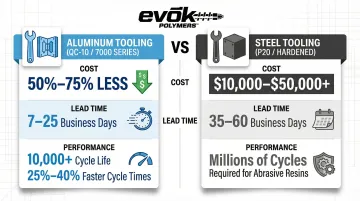
Aluminum tooling works well for bridge production and low-volume runs—cutting both cost and lead time significantly compared to steel. For high-volume production with abrasive materials like glass-filled nylon, hardened steel remains the only viable option.
What's Driving These Injection Molding Trends
Four forces are converging to accelerate these trends simultaneously: technology becoming affordable, customer expectations rising, margins tightening, and regulatory pressure intensifying.
Technology Maturity and Falling Costs
AI, IIoT sensors, and simulation software that were cost-prohibitive for small and mid-sized manufacturers just five years ago have reached price points that make them accessible across the industry. Industrial-grade vibration sensors have dropped from $200–$500 to $50–$100, while basic environmental sensors have declined from $20 to below $5.
The Injection Molding Software Market was valued at $1.6 billion in 2024 and is expected to grow to $4.5 billion by 2035, representing 9.9% annual growth. Simulation technology improvements and cost-reduction pressure are the primary drivers.
Customer and OEM Expectations
End customers and OEM procurement teams are demanding tighter tolerances, faster lead times, more sustainable material options, and transparent cost breakdowns. This is shifting the buyer-seller dynamic and putting real pressure on molders to modernize.
Manufacturers who bring their molding partners in as design collaborators early in development are compressing product timelines as a result.
Cost and Margin Pressure
Three pressures are pushing manufacturers to find efficiency gains in tooling design, cycle time, and scrap reduction:
- Resin price volatility creating unpredictable material costs across production runs
- Rising energy costs making cycle time optimization a direct financial lever
- Labor availability accelerating the ROI case for automation and DFM investments
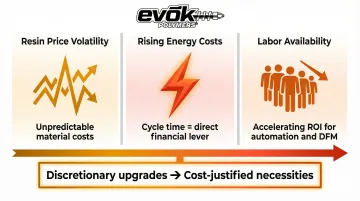
What were once discretionary upgrades are now cost-justified necessities.
Regulatory and Supply Chain Forces
Plastic regulation timelines, reshoring incentives (like the IRA's 48C 30% advanced energy tax credit and CHIPS Act funding for precision manufacturing), and post-pandemic supply chain lessons are accelerating nearshoring decisions. In 2024, 244,000 U.S. manufacturing jobs were announced via reshoring and Foreign Direct Investment, with electrical equipment (including EV batteries) accounting for 42% of these reshored jobs.
How These Trends Are Impacting Manufacturers
While the trends above represent opportunities, they're also creating real operational and strategic challenges—especially for mid-sized OEMs and product brands that lack internal engineering depth.
Operational Impact
Manufacturers are moving from reactive quality management (inspect-and-sort) to proactive process control (monitor-and-adjust in real time). This requires:
- Investment in sensor infrastructure and AI vision systems
- Operator retraining on data interpretation and process engineering
- Data integration with ERP or MES systems
- Shift from calendar-based preventive maintenance to condition-based predictive maintenance
Business Impact
Strategic investment priorities are shifting. Capital is moving from capacity expansion toward process intelligence, tooling optimization, and supplier partnerships that deliver engineering value alongside production volume.
That shift changes how manufacturers evaluate molding partners. Suppliers are now being assessed on their ability to provide:
- Mold flow analysis and tolerance studies
- DFM recommendations before tooling is cut
- Design collaboration that compresses product development timelines
Manufacturers treating their molding partners as design collaborators—rather than just vendors—are bringing products to market faster and with fewer costly tooling revisions.
Workforce Impact
The workforce picture is more complex than "automation replaces workers." By 2030, the manufacturing skills gap could result in 2.1 million unfilled jobs, potentially costing the economy $1 trillion.
Automation is redefining what skilled molding technicians need to know—not eliminating them. The role is shifting toward:
- Process engineering and real-time data interpretation
- DFM collaboration with product development teams
- Oversight of AI-assisted quality and maintenance systems
Overall employment of manual metal and plastic machine workers is projected to decline 7% from 2024 to 2034 as firms expand use of CNC tools and robotics. Manufacturers are deploying AI-powered predictive maintenance and smart machine controllers to support operators at any skill level, reducing the cognitive load on newer team members.
Future Signals: What to Watch for 2027 and Beyond
The 2026 trends covered above aren't endpoints — they're early pressure on three structural fault lines: materials sourcing, design automation, and regulatory compliance. Each is moving faster than most manufacturers' current planning cycles account for.
Technologies and developments to monitor:
- Multi-material and hybrid molding processes moving from specialty to standard — the hybrid PCR and bio-resin polymer market is projected to reach $6.71 billion by 2036 (13.7% CAGR)
- AI-generated mold design entering commercial tooling software — Autodesk's Neural CAD foundation models can already generate 3D CAD geometry from text prompts, with automated DFM feedback loops close behind
- Bio-based polymers closing the performance gap with traditional engineering resins through advanced nucleating agents and processing techniques
- Circular economy requirements becoming procurement prerequisites — the EU's Digital Product Passport registry goes live in July 2026, with take-back mandates and recyclability reporting likely to follow in US supply chains
Strategic foresight action: Begin auditing your current supplier relationships, tooling portfolios, and material specifications now — identifying where legacy decisions create brittleness under the coming changes. An injection molding partner with DFM review, material selection depth, and production tooling experience — like Evok Polymers — can flag those vulnerabilities before they become costly redesigns.
Frequently Asked Questions
What are the injection molding trends for 2026?
The five major trends are AI-driven quality control, IIoT adoption for real-time monitoring, sustainable and bio-based materials, advanced molding techniques (overmolding and insert molding), and DFM-focused tooling design. Technology maturity, regulatory pressure, and shifting OEM expectations around speed and quality are all accelerating adoption.
How is AI being used in injection molding today?
AI is primarily applied for real-time visual defect detection, process drift monitoring, and predictive maintenance. These systems work alongside skilled operators rather than replacing them—handling repetitive inspection tasks while operators focus on setup, troubleshooting, and process optimization.
What sustainable materials are gaining traction in injection molding?
Three categories are seeing the most growth: post-consumer recycled (PCR) resins blended at 10%–30% with virgin material, bio-based plastics like PLA and PHA from renewable feedstocks, and high-durability polymers engineered for long lifecycles. Each involves trade-offs in performance, cost, and regulatory compliance.
What is Design for Manufacturability (DFM) and why does it matter in 2026?
DFM is the practice of optimizing part geometry, wall thickness, draft angles, and gate placement before production tooling is cut. Over 70% of a part's total cost is determined at the design stage—early DFM work can reduce that cost by 15%–30% while cutting tooling revisions and time-to-market.
How are supply chain pressures shaping injection molding decisions?
Disruptions since 2020 pushed manufacturers toward nearshoring, reducing reliance on overseas tooling and raising the value of domestic partners who offer speed and direct communication. In 2024, 244,000 U.S. manufacturing jobs were reshored, with federal incentives like the IRA and CHIPS Act continuing to support that shift.
What should manufacturers prioritize when selecting an injection molding partner in 2026?
Prioritize partners with DFM expertise, mold flow analysis capabilities, and transparent cost structures. The strongest partners function as engineering collaborators—helping optimize part design before any tooling investment, which reduces risk and accelerates time-to-market.