TLDR: Key Takeaways for Choosing an Injection Molding Manufacturer
- Technical capabilities and certifications outweigh lowest price for long-term value
- Communication quality and transparency during quoting predict future partnership reliability
- Strong design support prevents costly tooling mistakes through DFM analysis before steel is cut
- Industry-specific experience reduces risk and ensures regulatory compliance
- Total landed cost analysis beats upfront price comparison every time
What is Custom Injection Molding Manufacturing?
Injection molding is a manufacturing process where molten plastic is injected into a mold cavity under high pressure to create precise, repeatable plastic parts. This process enables manufacturers to produce complex geometries with tight tolerances at high volumes, making it ideal for everything from automotive components to medical devices.
Custom injection molding manufacturers handle the entire process from initial mold design and fabrication through production runs ranging from prototypes to millions of parts.
Unlike off-the-shelf suppliers, these partners work with your specifications to create unique components tailored to your application.
The manufacturer's role extends far beyond simply running machines. Key services include:
- Material selection guidance based on your performance requirements
- Design for Manufacturability (DFM) feedback to optimize parts before tooling
- Quality control procedures implemented throughout production
- Process optimization to improve efficiency and reduce costs
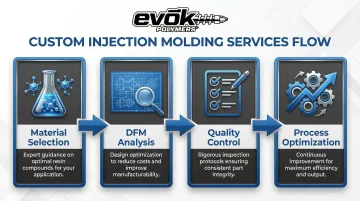
The right manufacturer becomes a strategic partner who contributes technical expertise throughout your product lifecycle.
Key Factors to Consider When Choosing an Injection Molding Manufacturer
Selecting the right manufacturer requires evaluating both technical capabilities and business practices across six critical dimensions. These factors help buyers move beyond simple price comparison to assess total value and partnership potential.
The global injection molded plastics market is projected to reach $647.90 billion by 2034, with growth driven by precision demands in automotive, medical, and packaging sectors—making your manufacturer selection increasingly strategic.
Technical Capabilities and Equipment
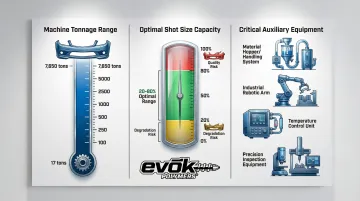
Verify the manufacturer has appropriate injection molding machines for your part specifications. Machine tonnage determines clamping force, with standard machines ranging from 17 tons to 7,650 tons.
Your part's projected area determines required tonnage—undersized machines cause flash, while oversized machines waste energy.
Shot size capacity matters equally.
The machine's shot capacity should accommodate your part weight within 20-80% of rated capacity. Using less than 20% causes polymer degradation from long residence times, while exceeding 65-80% risks melt quality issues.
Research their auxiliary equipment:
- Material handling systems (automated loaders, central dryers) for hygroscopic resins
- Robotics for consistent part removal and reduced cycle time variability
- Temperature control units (TCUs) and chillers for dimensional stability
- Quality inspection equipment (CMM machines, vision systems)
Inquire about machining capabilities for mold building and maintenance. In-house CNC, EDM, and wire EDM equipment enables faster repairs and tighter tolerances. Wire EDM achieves tolerances as tight as ±0.01 mm for complex geometries that conventional machining cannot produce.
Modern equipment indicates investment in quality and efficiency, but experienced operators matter just as much. Key personnel considerations include:
- Technician training programs and certifications
- Average years of experience per operator
- Staff turnover rates and retention strategies
Certifications and Quality Systems
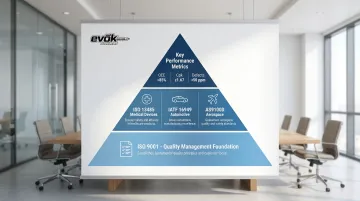
Equipment quality directly connects to systematic quality management. Reliable manufacturers track specific KPIs including inspection frequency, measurement equipment calibration schedules, and statistical process control. IATF 16949 certified facilities typically target Overall Equipment Effectiveness (OEE) above 85% and maintain Cpk values ≥1.67 for new processes.
ISO 9001 certification demonstrates commitment to quality management systems and process documentation. This baseline certification ensures the manufacturer follows standardized procedures for continuous improvement, risk-based thinking, and customer focus.
Industry-specific certifications become essential when your application requires them:
- ISO 13485 for medical devices—requires process validation (IQ/OQ/PQ), traceability, and device history records
- IATF 16949 for automotive—mandates defect prevention, APQP, PPAP, and typically defect rates below 50 ppm
- AS9100D for aerospace—focuses on product safety, counterfeit part prevention, and configuration management
Verify certifications remain current and request documentation of their inspection procedures. The quality system should include sampling plans, non-conforming material protocols, and clear escalation procedures. The quality system should include incoming material inspection, in-process monitoring, and final inspection protocols.
Experience and Industry Expertise
Manufacturers with experience in your specific industry understand unique requirements that generic molders miss. Medical device manufacturers know FDA validation requirements, while automotive suppliers understand PPAP documentation.
This specialized knowledge prevents costly mistakes and regulatory issues.
Review their portfolio and case studies to assess complexity of parts they've successfully produced. Look for:
- Part geometries similar to yours
- Materials matching your application requirements
- Production volumes in your range
- Tolerance capabilities meeting your specifications
Verify how many years they've been in business and about their team's technical expertise. Established manufacturers with experienced engineers, skilled toolmakers, and certified quality specialists bring problem-solving capabilities that newer operations lack.
Request references from customers with similar applications to yours. Speak directly with these references about communication quality, problem resolution, on-time delivery, and overall satisfaction. A manufacturer confident in their work readily provides multiple references.
Design Support and DFM Capabilities
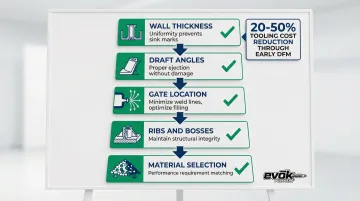
Manufacturers who provide Design for Manufacturability (DFM) analysis help optimize parts before expensive tooling is built. Effective DFM can reduce tooling costs by 20-50% and shorten lead times by weeks through early identification of potential issues.
Strong design support includes mold flow analysis using software like Moldex3D or Autodesk Moldflow. This simulation predicts filling patterns, identifies weld lines, and reveals warpage risks before steel is cut. In one case study, simulation led to a 25% reduction in raw material costs and 67% reduction in labor costs through runner system optimization.
Confirm they have in-house design engineers and what tools they use. Manufacturers should provide specific recommendations on:
- Wall thickness uniformity to prevent sink marks
- Draft angles for proper part ejection
- Gate location to minimize weld lines and optimize filling
- Rib and boss design to maintain structural integrity
- Material selection based on performance requirements
Manufacturers who challenge your design to improve it—rather than just quote what you send—add significant value. They should identify potential defects like sink marks, warpage, and ejection issues during the quoting phase, not after tooling is complete.
Communication and Project Management
Clear, responsive communication throughout the project lifecycle prevents misunderstandings and delays. Evaluate their responsiveness during the quoting process as an indicator of future communication quality. If they take days to respond to initial inquiries, expect similar delays during production.
Clarify about their project management approach:
- Do they assign dedicated project managers to your account?
- What is their standard communication frequency (weekly updates, milestone reports)?
- Do they provide online portals for order tracking and documentation access?
- How do they handle timeline changes or technical challenges?
The best manufacturers use structured frameworks like Advanced Product Quality Planning (APQP) to ensure all requirements are met before mass production. They provide Gantt charts, gated reviews, and clear milestone tracking.
Emphasize the importance of transparency about challenges, timeline changes, and cost implications. Manufacturers who hide problems create bigger issues down the road. Partners who proactively communicate obstacles enable collaborative problem-solving.
Cost Structure and Pricing Transparency
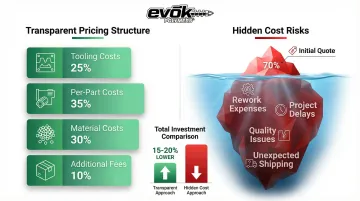
The lowest quote often isn't the best value when factoring in tooling longevity, part quality, and hidden costs. A documented case study revealed a $12,000 overseas mold resulted in total costs of $98,500 due to rework and delays, compared to a $49,000 domestic tool that was production-ready.
Request detailed quotes that break down:
- Tooling costs (mold design, steel, machining, assembly)
- Per-part costs (material, machine time, labor, overhead)
- Material costs with specific resin grades
- Additional fees (setup charges, inspection, packaging, shipping)
Discuss about their approach to cost optimization and whether they suggest design changes to reduce costs. Manufacturers focused on partnership help you understand tradeoffs between initial tooling investment and per-part production costs.
Manufacturers who explain their pricing methodology demonstrate trustworthiness and help you make informed decisions. They should clarify why their pricing differs from competitors and what value justifies any premium.
Red Flags to Watch For When Evaluating Manufacturers
During your evaluation process, watch for these warning signs that signal potential partnership problems:
- Refuses references or facility tours — limits transparency
- Missing certifications or quality documentation
- Poor communication or delayed quote responses
- Unexplained low pricing compared to competitors
- No DFM feedback or design support offered
- Can't explain process or answer technical questions
- High-pressure tactics or rushed decision timelines
- Outdated equipment or poorly maintained facilities
- No validation capabilities (IQ/OQ/PQ)
- Vague responses about lead times or capacity
Any of these red flags should prompt deeper scrutiny or reconsideration. Problems identified during evaluation typically worsen during production.
Compare at least three manufacturers before committing. A thorough vetting process now prevents costly production issues later.
How EVOK Can Help You Achieve Injection Molding Success
EVOK Polymers brings 25 years of injection molding expertise focused on delivering "jewelry quality at optimized price" through deep customer partnerships. Unlike traditional mold houses, EVOK operates with a trust-based process where transparency and customer collaboration drive every decision.
This relationship-focused approach means you receive more than parts—you gain a manufacturing partner invested in your project's success from initial design through production.
The technical team's credentials demonstrate their capability to handle complex projects:
- Founder Paul Dathe holds four U.S. utility patents and Six Sigma black belt certification
- 25+ years solving injection molding challenges for major brands like Polaris, General Mills, and Boston Scientific
- Formal methodology combined with hands-on experience to identify risks during quoting
- Design optimization performed before steel is cut, reducing costly modifications
This expertise translates into practical design support through EVOK's industrial design team.
Jason Weber and Shawn Monitor lead EVOK's design support capabilities. They create prototypes, conduct DFM reviews using Autodesk Moldflow Insight, and refine part features before tooling.
Shawn specializes in building complex mechanical and visual prototypes in various materials. This allows physical validation of design solutions before committing to production tooling, reducing risk on large-scale projects.
EVOK's commitment to cost transparency helps customers understand tradeoffs during critical decision points. Their proprietary Polyestimator tool provides instant access to financial and timeline data for informed decisions about design modifications.
Working hand-in-hand with customers, EVOK negotiates tolerances and refines designs to deliver production parts at prices as low as $0.01 per part through continuous improvement.
Conclusion
Choosing an injection molding manufacturer is a strategic decision that impacts product quality, time-to-market, and long-term success.
The right manufacturer acts as a partner who brings technical expertise, problem-solving capabilities, and commitment to your success—not just a vendor executing orders.
Use this framework to evaluate potential manufacturers. Prioritize partnership qualities over lowest price alone:
- Communication and transparency
- Design support and technical expertise
- Industry-specific experience
- Problem-solving commitment
The investment in finding the right manufacturing partner pays dividends through reduced risk, faster time-to-market, and higher quality products that strengthen your brand reputation.
Frequently Asked Questions
What product design criteria affect the injection molding process?
Wall thickness uniformity, draft angles, undercuts, gate location, and material selection all significantly impact moldability, cycle time, and part quality. Manufacturers with strong DFM capabilities optimize these factors early, preventing costly tooling modifications.
What is the typical lead time for injection molding tooling and production?
According to industry data, simple molds take 4-6 weeks while complex multi-cavity molds take 12-16 weeks. Production runs typically range from days to weeks once tooling is approved.
How much does injection molding cost compared to other manufacturing methods?
Injection molding has higher upfront tooling costs ($5,000-$100,000+) but very low per-part costs, making it most economical for volumes above 500-1,000 parts. CNC machining offers lower setup costs but higher per-part costs.
Should I choose a domestic or overseas injection molding manufacturer?
Domestic manufacturers offer easier communication, faster iterations, stronger IP protection, and no import duties. Overseas manufacturers may offer lower per-part costs for very high volumes, but total landed cost must account for shipping, tariffs, and supply chain risks. Decision depends on your priorities.
What certifications should my injection molding manufacturer have?
ISO 9001 is baseline for quality management. Industry-specific certifications become essential for regulated applications: ISO 13485 for medical devices, AS9100 for aerospace, IATF 16949 for automotive. Verify certifications are current and ask about their quality control procedures.
How can I verify an injection molding manufacturer's quality capabilities?
Request facility tours to see equipment and processes firsthand. Review their inspection equipment and procedures, ask for sample parts and quality documentation, and check references from current customers with similar applications. Strong manufacturers readily provide this information.