How much do custom molds cost?
Custom mold costs depend on part size, complexity, material selection, and production volume. CAD design services start at $110/hour, rapid prototypes range from $100-$300 per part, single-cavity tooling for beta testing takes 4-6 weeks, and production tooling generally requires 8-12 weeks. High-volume production pricing can be as low as $.01 per part. Evok Polymers provides complete cost transparency from day one, itemizing every element so you can optimize your design for value.
What is included in Evok Polymers' 5-stage new part development pipeline?
The pipeline includes: (1) Concept Feasibility Assessment evaluating manufacturability and production feasibility; (2) Alpha Research & Design Refinement with rapid prototyping and functional testing; (3) Beta Development & Tooling creating single-cavity production tooling for real-world testing; (4) Production Qualification & First Article with molding trial reports and 30-point dimensional inspection; and (5) Product Launch & Scale-Up with optimized high-volume production and continuous improvement support.
How does Evok Polymers ensure precision and quality in injection molded parts?
Evok employs comprehensive quality control including molding trial reports that monitor fill speed, knit lines, zone temperatures, and cycle time. First article inspection measures 30 critical dimension points per cavity, and continuous Cp/Cpk statistical process control ensures parts meet exact tolerances. The Six Sigma certified team maintains jewelry-quality standards throughout production while optimizing for cost-effectiveness.
Can Evok Polymers help optimize my existing part design for injection molding?
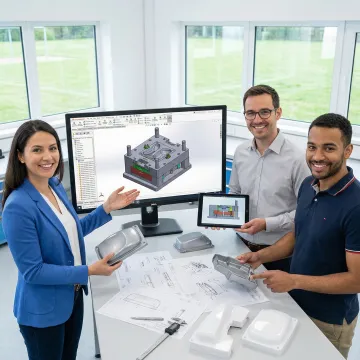
Yes, Evok's expert CAD design services review and optimize customer files for moldability at $110/hour. The team implements design changes for draft angles, wall thickness, gate locations, and venting using SOLIDWORKS and advanced CAD tools. Whether you have a 3D file or need modeling from scratch, Evok ensures your design is optimized for efficient, cost-effective injection molding production.
What makes Evok Polymers different from other custom molding parts manufacturers?
Evok Polymers offers 25 years of specialized injection molding expertise with proprietary optimization technology, complete cost transparency from day one, a streamlined new part development pipeline that accelerates speed to market, and white-glove customer service built on trust and deep partnerships. The team includes Six Sigma certified professionals, patent holders, and industry experts dedicated to delivering jewelry-quality parts at optimized prices.
What types of projects and industries does Evok Polymers work with?
Evok serves diverse industries including OEMs, consumer products, powersports, semiconductors, medical devices, and packaging. With 25 years of experience, projects have ranged from lawn mower components to biotech facilities, ultra-clean semiconductor liquid delivery systems to high-performance sporting goods. The team works with both Fortune 500 companies and innovative startups, bringing specialized expertise to solve unique challenges across any application.
What happens during the Beta Development & Tooling stage?
During Beta Development & Tooling, Evok completes single-cavity production tooling to manufacture beta parts for comprehensive testing and validation. This stage produces actual molded components in your chosen material, allowing real-world performance evaluation, stakeholder feedback, and verification of fit, function, and aesthetics before committing to full production tooling and high-volume manufacturing.
How does material selection impact my injection molding project?
Material selection directly affects mechanical performance, environmental resistance, cosmetic appearance, and budget. Evok works with thermoplastic materials including ABS, polycarbonate, nylon, polypropylene, TPE, and specialty engineering resins. The material selection service helps navigate material and texture science to choose optimal resin based on your application's specific mechanical requirements, environmental conditions, cosmetic expectations, and cost constraints, integrating material decisions throughout the entire design and manufacturing process.