Introduction
Product development teams face relentless pressure to compress cycles and validate designs faster than ever. Choosing the wrong rapid prototyping partner means weeks of delays, costly tooling rework, and parts that don't translate to production. The rapid prototyping injection molding market reached $10.8 billion in 2025 as companies seek partners who deliver production-grade parts in days, not months.
Selecting the right partner dramatically impacts both timeline and budget:
- Early Design for Manufacturability (DFM) intervention prevents $7,000-$15,000 in tooling rework costs per project
- Aluminum rapid tooling cuts lead times by 30-50% compared to traditional steel
- Best partners bridge the gap between design concept and scalable production
The companies profiled below excel not just in speed, but in delivering functional prototypes that translate seamlessly to high-volume manufacturing.
Key Takeaways
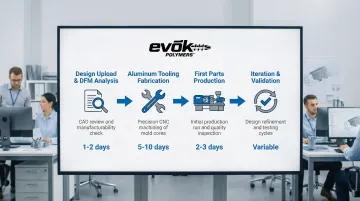
- Leading providers deliver first parts in 5–15 days using aluminum tooling versus 6–12 weeks for traditional steel
- Strategic tooling pathways bridge prototype validation to full-scale manufacturing
- DFM analysis catches manufacturability issues early and reduces tooling costs
- Material selection guidance ensures prototype testing validity for production applications
Overview of Rapid Prototyping in Injection Molding
Product teams need to validate designs before committing tens of thousands to production tooling. Rapid prototyping injection molding addresses this by using prototype-grade tooling—typically aluminum or soft steel—to produce production-grade plastic parts with accelerated lead times.
Unlike traditional injection molding, which prioritizes tool longevity and high-volume efficiency, rapid prototyping emphasizes speed, design iteration support, and lower volumes (typically 100–10,000 units).
Market drivers pushing demand in 2025 include:
- Shorter product lifecycles requiring faster development cycles
- Increased customization demands from end customers
- Competitive time-to-market pressures across industries
The rapid injection molding market is growing at 7.7% CAGR through 2032, as manufacturers use rapid tooling to de-risk product launches before committing to expensive production tooling.
We selected the companies below specifically for their rapid prototyping capabilities—not just general injection molding services. Each excels in fast turnaround times, tooling flexibility, and the design consultation necessary to transition successfully from prototype to production.
Top 5 Injection Molding Companies for Rapid Prototyping in 2025
We selected these companies based on turnaround speed, tooling flexibility, design consultation capabilities, and proven rapid prototyping track records with documented customer success.
Protolabs
Founded in 1999, Protolabs automated the quoting and toolpath generation process for rapid injection molding. The company focuses on speed and automated design feedback.
Key capabilities include:
- Automated interactive DFM analysis with every quote
- Identifies draft angles, wall thickness issues, and undercuts before tooling
- Standard lead time of 15 days, with expedited options as fast as 1 day for simple parts
- Aluminum tooling for prototypes and low-volume production
- Lifetime mold guarantees for on-demand manufacturing
Protolabs serves volumes from 25 to 10,000+ parts. This makes them ideal for bridge production while production tooling is being built.
| Attribute | Details |
|---|---|
| Rapid Prototyping Turnaround | Standard 15 days; expedited options as fast as 1 day for simple geometries |
| Tooling Options | Aluminum tooling for prototypes; lifetime mold guarantees for on-demand reorders |
| Design Support Services | Automated interactive DFM analysis with every quote; identifies draft, wall thickness, and undercut issues |
Evok Polymers
Evok Polymers is a 25-year injection molding specialist focused on delivering "jewelry quality at optimized price" through deep customer collaboration and design optimization expertise. The company's founder, Paul Dathe, holds four U.S. utility patents and brings Six Sigma black belt certification to the rapid prototyping process.
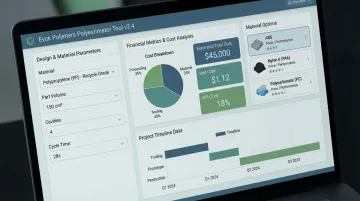
Unlike competitors focused purely on speed, Evok uses a design-first methodology. Their proprietary Polyestimator tool provides instant financial and timeline data, enabling customers to make informed design decisions that balance performance with cost.
The company's cross-functional team includes in-house industrial designers who conduct pre-molding design reviews, reducing risk on large-scale projects.
Strategic prototyping approach:
- Selects materials and processes that best simulate production behavior
- Example: Uses softer SLA materials over stiffer FDM to better represent how snap-and-lock features will perform with production olefin materials
- Reduces risk before committing to expensive production tooling
Evok has worked with major brands including Polaris, Nautique, Boston Scientific, General Mills, and Rollerblade across industries ranging from powersports and marine to medical devices and consumer products.
| Attribute | Details |
|---|---|
| Rapid Prototyping Approach | Design-first methodology with upfront cost analysis via Polyestimator tool; strategic material and process selection to simulate production behavior |
| Team Expertise | In-house industrial designers; 25+ years injection molding experience; Six Sigma black belt certification; four U.S. utility patents |
| Client Industries | Powersports, medical devices, consumer products, marine, semiconductor, packaging |
Quickparts
For regulated industries, Quickparts stands out. Established in 1990, the company specializes in rapid prototyping and low-volume production with a strong focus on aerospace and defense applications. The company is ITAR registered and ISO 9001:2015 certified.
Prototyping capabilities:
- Aluminum prototype tools ship parts in 1–2 weeks
- Class 105 prototype molds rated for 250–2,500 parts
- Class 103 production molds for customers ready to scale
- Comprehensive material certifications and first article inspection reports
Their expertise in regulated industries requiring documentation, traceability, and compliance makes them ideal for medical and aerospace prototyping projects.
| Attribute | Details |
|---|---|
| Rapid Prototyping Turnaround | 1–2 weeks for aluminum prototype tooling and first parts |
| Tooling Options | Class 105 prototype molds (250–2,500 parts); Class 103 production molds for scaling |
| Key Strengths | ITAR registration; ISO 9001:2015 certification; strong aerospace and defense expertise |
Fictiv
Fictiv operates as a digital manufacturing ecosystem connecting a vetted network of partners. The company uses a "GlobalFlex" tooling strategy to optimize for either speed or cost based on customer priorities.
Fictiv delivers aluminum tools in 10–15 days and steel prototype tools in 3 weeks. The company offers both aluminum and soft steels (P20, NAK80) depending on volume requirements and material compatibility.
AI-powered platform features:
- Materials.AI for resin selection and DFM feedback
- Analyzes uploaded CAD files automatically
- Provides recommendations on material alternatives, gate locations, and design modifications
- Low-volume molding services support 100 to 10,000 pieces
| Attribute | Details |
|---|---|
| Rapid Prototyping Turnaround | 10–15 days for aluminum tooling; 3 weeks for soft steel prototype tools |
| Tooling Options | Aluminum and soft steels (P20, NAK80); GlobalFlex strategy optimizes for speed or cost |
| Special Capabilities | AI-powered Materials.AI for resin selection and automated DFM feedback |
Xometry
Xometry is an AI-driven marketplace with a network of over 10,000 partner manufacturers. This provides access to massive capacity and specialized resins through digital infrastructure.
Xometry delivers prototype tools as fast as 7 business days by matching projects to partners based on tooling needs, material requirements, and geographic location. The platform scales from single prototypes to high-volume production through its distributed network.
Unique marketplace capabilities:
- ITAR enclave for sensitive defense projects
- Instant marketplace filtering for material grades, certifications, and quality standards
- AI-driven matching system optimizes for lead time, cost, or quality
- 10,000+ partner network provides specialized expertise
| Attribute | Details |
|---|---|
| Rapid Prototyping Turnaround | As fast as 7 business days for prototype tooling and first parts |
| Tooling Options | Network-based matching to aluminum or steel tooling based on volume and material requirements |
| Notable Strengths | 10,000+ partner network; ITAR enclave for defense projects; AI-driven project matching |
How We Chose the Best Rapid Prototyping Companies
Common mistakes when selecting rapid prototyping partners include:
- Focusing only on speed without evaluating design support capabilities
- Choosing the lowest price without considering tooling quality that affects part consistency
- Neglecting to assess prototype-to-production transition capabilities that determine scaling success
To avoid these pitfalls, we developed a comprehensive evaluation framework.
Our evaluation criteria prioritized rapid prototyping turnaround times, with emphasis on companies delivering first parts in 5–15 days.
We evaluated tooling flexibility, specifically whether providers offer clear pathways from aluminum prototype tools through bridge tooling to production steel. Design consultation and DFM support were critical, as early intervention prevents costly tooling rework.
Additional evaluation factors included:
- Material selection guidance to ensure prototype testing validity
- Prototype-to-production scalability to maintain part consistency during scaling
- Quality control processes for low-volume runs
- Proven track records with similar projects across relevant industries
Key Considerations When Choosing a Rapid Prototyping Partner
Tooling Strategy for Rapid Prototyping
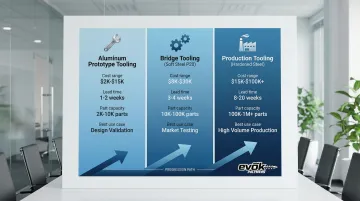
Understanding tooling options is essential for balancing speed, cost, and volume requirements. Aluminum tooling costs typically range from $2,000–$15,000 compared to $15,000+ for steel, with aluminum molds machined 30–50% faster than steel.
Aluminum prototype tooling works well for:
- Design validation runs of 100–2,000 parts
- Fast iteration cycles requiring design modifications
- Non-abrasive materials that won't accelerate tool wear
- Projects where speed is prioritized over tool longevity
Aluminum molds typically last 2,000–10,000 cycles, making them unsuitable for long-term production but ideal for validation and bridge production. Bridge tooling using soft steel (P20) extends lifespan to 10,000–100,000 parts, covering market entry while production tools are being built.
Production tooling using hardened steel (H13, S136) supports 100,000–1,000,000+ parts but requires 8–20+ weeks lead time. The strategic approach: aluminum for validation, bridge tooling for market testing, and production steel once volumes justify the investment.
Design Consultation Impact on Project Costs
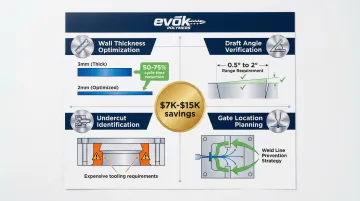
Once you've selected your tooling strategy, design consultation becomes your next cost-control lever. Design consultation services during prototyping deliver measurable ROI by catching manufacturability issues before production tooling investment. Early DFM intervention prevents $7,000–$15,000 in tooling rework costs per project.
Essential DFM elements include:
- Wall thickness optimization – Reducing walls from 3mm to 2mm can cut cycle times by 50–75%, directly lowering part cost
- Draft angle verification ensuring 0.5° to 2° prevents ejection issues and tool damage
- Undercut identification – Flagging features requiring expensive side-actions before tooling begins
- Gate location planning to minimize weld lines and prevent weak points
Leading providers integrate automated or engineering-led DFM directly into their quoting process, identifying issues during design rather than after tooling is complete.
Prototype-to-Production Transition Capabilities
Seamless scaling from prototype to production reduces risk and maintains part consistency. Transitioning from single-cavity aluminum prototype molds to multi-cavity steel production molds can introduce dimensional drift and defect rates up to 12% if not managed properly.
Key transition considerations include:
- Thermal behavior differences — Aluminum cools faster than steel, affecting shrinkage rates and cycle times
- Gate and vent changes — Prototype tools often use simple edge gates while production tools use sub-gates or hot runners, changing weld line locations
- Cavity pressure monitoring — Scientific molding techniques establish robust process windows transferable to production tools
- Pilot runs — Conducting 2,000+ part pilot runs on bridge tooling establishes process capability (Cpk) before cutting steel
Partners with strong transition capabilities conduct thermal imaging during pilot runs to identify hot spots. They use cavity pressure monitoring to establish separate molding parameters and provide documentation that transfers process knowledge from prototype to production tooling.
Material Selection for Prototyping vs. Production
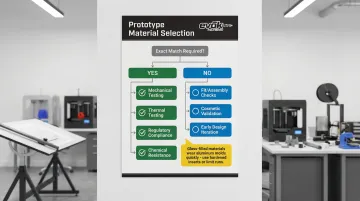
Material selection significantly impacts prototype testing validity. For accurate functional testing, prototype material should match production material, in regulated industries where using exact production resin is mandatory to avoid re-qualification.
When to match materials exactly:
- Mechanical testing requiring specific tensile strength, impact resistance, or flexural modulus
- Thermal testing where Heat Deflection Temperature (HDT) is critical
- Regulatory compliance in medical (ISO 13485) or aerospace applications
- Chemical resistance validation for specific exposure environments
When acceptable substitutes work:
- Early fit and assembly checks where mechanical properties aren't critical
- Cosmetic validation for surface finish and appearance
- Initial design iteration before final material selection
Glass-filled materials wear down aluminum molds quickly, so projects using abrasive resins should limit prototype runs or use hardened steel inserts in aluminum molds.
Material expertise matters. Partners with deep material knowledge help you balance testing validity against prototype tooling limitations, ensuring your prototypes deliver meaningful data without destroying your molds.
Conclusion
The best rapid prototyping partner combines speed with design expertise, not just fast turnaround times. Companies that excel in rapid prototyping offer comprehensive tooling pathways from aluminum validation tools through bridge production to full-scale manufacturing, ensuring continuity and part consistency throughout the product development journey.
Evaluate partners based on their ability to support your entire development process—from initial prototype through design iteration to production scaling.
Look for providers offering:
- DFM consultation that prevents costly rework
- Material expertise that ensures testing validity
- Transition capabilities that maintain part quality during scaling
Evok provides upfront cost transparency and design optimization before tooling fabrication, helping customers make informed decisions throughout development. If you're looking for a partner who combines rapid prototyping capabilities with engineering consultation, contact Evok to discuss your rapid prototyping needs.
Frequently Asked Questions
How long does rapid prototyping injection molding typically take compared to traditional injection molding?
Rapid prototyping delivers first parts in 5–15 days using aluminum tooling, compared to 6–12 weeks for traditional production tooling. Timeline varies based on part complexity, material selection, and DFM review requirements.
What's the difference between prototype tooling and production tooling for injection molding?
Prototype tooling (aluminum) enables speed and iteration for 50–5,000 units, while production tooling (hardened steel) is built for durability and 100,000+ unit volumes. Prototype tools prioritize fast machining and modifications over longevity.
When should I use injection molding for rapid prototyping versus 3D printing?
Choose injection molding for testing production-intent materials, evaluating manufacturability, or producing 50+ identical parts. Use 3D printing for single parts, early concept validation, or complex geometries too expensive to mold in small quantities.
How much does rapid prototyping injection molding cost?
Aluminum prototype tooling typically costs $2,000–$15,000 depending on part size and complexity, with per-part costs varying by volume and material. This investment pays off when testing production processes and materials, preventing expensive rework on production tooling.
Can rapid prototype tooling be used for small production runs?
Yes, aluminum prototype tooling can typically produce 2,000–10,000 parts depending on design complexity and material abrasiveness. This makes it suitable for bridge production or market testing before investing in production tooling, particularly for non-abrasive resins.
What design considerations are different for rapid prototyping versus production injection molding?
Prototype tooling uses simplified features (fewer cavities, simpler slides) to reduce cost and timeline. However, prototypes must still validate critical dimensions, material properties, and assembly requirements to ensure production feasibility.