Introduction
As outdoor product development accelerates in 2025, engineers face a persistent challenge: prototypes that fail under real-world UV exposure, temperature cycling, and weathering tests. Traditional prototyping materials like ABS degrade rapidly when exposed to sunlight, leading to costly redesigns and delayed product launches.
ASA (Acrylonitrile Styrene Acrylate) has become the material of choice for outdoor and high-temperature applications, offering superior weather resistance without sacrificing mechanical performance.
Choosing the right ASA 3D printing service is critical—not all providers have the equipment or expertise to properly handle this engineering-grade thermoplastic.
ASA printing requires:
- Enclosed heated chambers for consistent temperature control
- Precise thermal management to prevent warping
- Material handling expertise beyond standard desktop printing
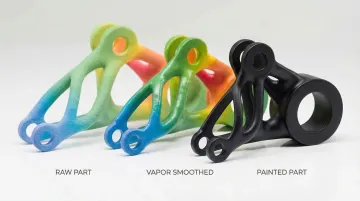
- Understanding of post-processing for optimal surface finish
Key Takeaways
- ASA maintains 97% tensile strength after 1,000 hours of UV exposure—outperforming ABS for outdoor applications
- Industrial FDM systems with enclosed heated chambers deliver functional prototypes in 2-5 days
- Evaluate providers on ASA-specific capabilities, post-processing options, and certifications
- Ideal for automotive exteriors, aerospace fixtures, outdoor products, and industrial housings
Overview of ASA in Rapid Prototyping Applications
ASA (Acrylonitrile Styrene Acrylate) is an engineering-grade thermoplastic specifically formulated for outdoor durability. Unlike ABS, which contains butadiene rubber that degrades under UV light, ASA uses acrylate rubber that remains stable when exposed to sunlight and weathering.
This fundamental difference makes ASA the superior choice for prototypes requiring long-term outdoor exposure. The material's performance characteristics directly address the challenges engineers face when testing parts in real-world conditions.
Key Material Properties
ASA delivers performance advantages critical for functional outdoor prototyping:
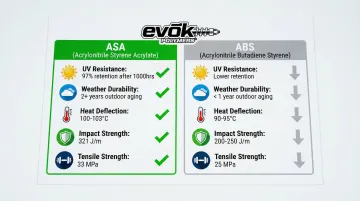
- UV Resistance: Retains approximately 97% of tensile strength after 1,000 hours of accelerated UV exposure, whereas ABS degrades significantly under identical conditions
- Weather Durability: Maintains integrity for 2+ years of natural outdoor aging with minimal color change
- Thermal Stability: Heat deflection temperature of 100-103°C, higher than standard ABS
- Impact Strength: 321 J/m Izod impact strength (unnotched), exceeding ABS performance
- Mechanical Properties: 33 MPa ultimate tensile strength with 9% elongation at break
These technical advantages explain why ASA adoption continues accelerating across demanding industries.
Market Growth and Adoption
Automotive and aerospace sectors drive this expansion through increased demand for weather-resistant functional prototypes that can undergo real-world environmental testing without premature failure.
The services profiled below offer:
- Professional ASA printing with industrial equipment
- Material expertise for optimizing part design
- Proven track records delivering quality engineering-grade prototypes
Top ASA 3D Printing Services for Rapid Prototyping in 2025
These providers were selected based on specific capabilities critical for ASA printing success:
- Enclosed heated chamber technology for dimensional stability
- Proven ASA material expertise and handling protocols
- Rapid turnaround times for prototype delivery
- Quality certifications (ISO 9001, AS9100, ISO 13485)
- Track record with engineering thermoplastics
Service Provider 1: Stratasys Direct Manufacturing
Stratasys Direct Manufacturing brings over 30 years of experience in engineering-grade additive manufacturing. Their extensive industrial FDM fleet and materials science expertise make them well-suited for ASA functional prototypes.
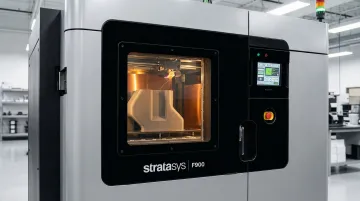
Their ASA capabilities use Stratasys F900 production systems with large build envelopes and precise temperature control. They offer multiple ASA color options, design consultation, and comprehensive post-processing services including vapor smoothing and custom finishing.
| Category | Details |
|---|---|
| ASA Printing Capabilities | Industrial FDM with Stratasys F900 systems featuring enclosed heated chambers; build volume up to 914 x 610 x 914 mm; layer resolution 0.127-0.508 mm; multiple ASA color options; XY accuracy ±0.089 mm or ±0.0015 mm/mm (whichever is greater) |
| Turnaround Time & Pricing | Standard lead time: 2-5 business days for prototypes; expedited next-day options available; instant online quoting system; volume discounts for batch orders; pricing based on part volume, complexity, and finish requirements |
| Quality & Certifications | ISO 9001:2015 certified; AS9100D aerospace certification; ISO 13485 medical device quality management; dimensional inspection with CMM verification; material certifications provided; DFM support included |
Service Provider 2: Protolabs
Protolabs operates manufacturing facilities across North America, Europe, and Asia. Their automated quoting platform and distributed manufacturing facilities enable fast turnaround for engineering thermoplastic prototypes and bridge production runs.
Their ASA service combines automated design analysis with experienced engineers who review every upload for manufacturability. They offer multiple FDM material grades and can scale from single prototypes to small-batch production quantities.
| Category | Details |
|---|---|
| ASA Printing Capabilities | Industrial FDM technology with temperature-controlled build chambers; maximum part dimensions 294 x 192 x 165 mm; layer heights 0.178-0.330 mm; natural, black, and custom color options; standard and fine surface finish options |
| Turnaround Time & Pricing | Prototype delivery: 3-5 business days standard; small-batch runs: 5-10 business days; transparent online pricing with instant quotes; volume discounts automatically applied for quantities 10+; no minimum order requirements |
| Quality & Certifications | ISO 9001:2015 quality management system; ITAR registered facility; automated design analysis for every part; dimensional inspection reports available upon request; secure file handling with automatic deletion after 180 days |
Service Provider 3: Xometry
Xometry's marketplace platform connects customers with a vetted network of manufacturing partners. This model provides access to diverse equipment capabilities and competitive pricing across multiple facilities.
Their ASA printing service uses multiple partner facilities with industrial FDM equipment, providing flexibility in capacity and geographic proximity. The platform's AI-powered quoting engine delivers instant pricing transparency.
| Category | Details |
|---|---|
| ASA Printing Capabilities | Access to industrial FDM systems across partner network; build sizes vary by facility (up to 400 x 400 x 400 mm typical); layer resolution 0.15-0.30 mm standard; ASA in natural, black, white, and custom colors; finishing services including vapor smoothing and painting |
| Turnaround Time & Pricing | Standard lead time: 5-7 business days; expedited 3-day service available; instant AI-powered quotes with transparent pricing breakdown; volume discounts for quantities 25+; quote response time under 60 seconds |
| Quality & Certifications | Partner facilities ISO 9001 certified; quality inspection procedures standardized across network; dimensional inspection available as add-on service; IP protection through secure platform; NDA coverage standard for all projects |
Service Provider 4: Sculpteo
Sculpteo provides online 3D printing services with facilities in France and the United States, specializing in engineering materials for functional prototyping. Their technical expertise in material science and post-processing enables high-quality ASA parts for demanding applications.
Their ASA offering emphasizes material quality and consistency, using premium filament suppliers and calibrated printing parameters. They provide detailed material data sheets and can accommodate custom material testing requirements.
| Category | Details |
|---|---|
| ASA Printing Capabilities | Professional FDM systems with enclosed heated chambers; maximum part size 300 x 300 x 300 mm; layer heights 0.15-0.35 mm; ASA material specifications include tensile strength 33 MPa, HDT 100°C; finishing options include sanding, priming, and painting |
| Turnaround Time & Pricing | Delivery schedules: 4-6 business days standard, 2-3 days rush available; pricing model based on material volume and machine time; bulk pricing available for quantities 50+; instant quote functionality with design feedback |
| Quality & Certifications | ISO 9001 quality management certification; material certificates provided with technical data sheets; dimensional inspection using optical metrology; confidentiality protections standard; design optimization recommendations included |
Service Provider 5: Shapeways
Shapeways operates a digital manufacturing platform with production facilities in New York and the Netherlands, focusing on engineering-grade additive manufacturing. Their commitment to material innovation and quality control makes them well-suited for ASA functional prototypes.
Their ASA printing service utilizes industrial Stratasys equipment with sophisticated material handling and environmental controls. They offer comprehensive post-processing capabilities and can support both prototype and small-series production volumes.
| Category | Details |
|---|---|
| ASA Printing Capabilities | Stratasys industrial FDM systems with fully enclosed heated chambers; build envelope up to 355 x 355 x 355 mm; layer resolution 0.178-0.254 mm; ASA material portfolio includes standard and impact-modified grades; post-processing includes vapor smoothing, dyeing, and coating |
| Turnaround Time & Pricing | Typical delivery: 5-8 business days for prototypes; rush service reduces timeline to 3-4 days; pricing model clarity with upfront costs; volume-based discounts starting at 10 units; production runs up to 500 units supported |
| Quality & Certifications | Quality management certifications for production facilities; testing and validation services available; regulatory compliance support for specific industries; confidentiality protections through standard NDAs; design consultation included with larger orders |
How We Chose the Best ASA 3D Printing Services
Selecting an ASA printing service requires evaluating technical capabilities beyond price alone. Common mistakes include choosing providers without proper heated chamber equipment, resulting in warped parts and failed prints, or selecting services lacking material expertise to optimize print parameters for ASA's specific requirements.
Key selection factors we evaluated:
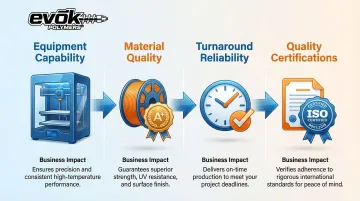
- ASA-specific equipment: Enclosed heated chambers maintaining stable ambient temperatures
- Material quality: Sourcing from reputable suppliers with consistent specifications
- Turnaround reliability: Proven track records with on-time delivery
- Quality certifications: Process control standards that ensure consistency
- Transparent pricing: Clear cost structures without hidden fees
These factors directly impact business outcomes:
- Proper equipment and expertise reduce prototype iterations by delivering dimensionally accurate parts on the first attempt
- Faster turnaround accelerates time-to-market for product development cycles
- Quality certifications lower risk of part failure during testing
- Predictable pricing enables accurate project cost forecasting
Conclusion
Selecting the right ASA printing service requires evaluating equipment capabilities, material expertise, and proven track records—not just comparing price quotes.
Professional services with industrial FDM systems, enclosed heated chambers, and ASA-specific printing experience deliver superior results compared to lower-tier providers lacking proper environmental controls.
Key validation steps before committing to a service provider:
- Request sample parts printed in ASA to evaluate surface finish and dimensional accuracy
- Verify quality certifications relevant to your industry
- Assess post-processing options that may be required for your application
These steps reduce risk and ensure your chosen partner can deliver prototypes that accurately represent production performance.
After validating ASA prototypes through environmental testing and functional verification, the next step is transitioning to injection molding for volume production. EVOK Polymers specializes in this transition, bringing 25 years of experience in engineering-grade thermoplastics, comprehensive DFM support, and production tooling capabilities to ensure smooth scaling from prototype to high-volume manufacturing.
Frequently Asked Questions
What makes ASA better than ABS for rapid prototyping?
ASA offers superior UV resistance by replacing butadiene rubber with acrylate rubber, preventing sunlight degradation. This results in better weather durability, reduced warping, and improved surface finish with long-term color stability.
How long does ASA 3D printing typically take?
Standard lead times range from 3-7 business days for individual prototypes, with small-batch runs requiring 1-2 weeks depending on quantity and complexity.
What industries commonly use ASA 3D printing services?
Key sectors include automotive (exterior trim components and mirror housings), aerospace (environmental testing fixtures), consumer products (outdoor equipment and recreational gear), and industrial machinery (protective housings and enclosures requiring outdoor exposure).
Can ASA parts be used outdoors long-term?
Yes, ASA demonstrates excellent outdoor durability with UV stability for multi-year exposure. Testing shows ASA maintains 97% tensile strength after 1,000 hours of UV exposure while resisting weathering, temperature cycling, and color fading.
What's the typical cost difference between ASA and PLA printing?
ASA typically costs 30-50% more than PLA due to higher material costs ($25-50/kg vs. $15-25/kg for PLA), longer print times from slower speeds required for proper layer adhesion, and required heated chamber equipment not needed for PLA printing.
Do I need special post-processing for ASA parts?
Common options include acetone vapor smoothing for aesthetic finish, painting with primer and acrylic or enamel-based paints, and optional UV coating for extreme exposure conditions.