Bringing a new product to market today is less about scale and more about speed, accuracy, and flexibility. Rapid injection molding has emerged as a practical solution for teams that need functional, production-grade parts without waiting months for traditional tooling.
It removes the usual bottlenecks of long lead times and high upfront costs, allowing engineers to validate designs, materials, and fit early in the development cycle.
For industries like automotive, medical devices, and electronics, rapid injection molding offers a reliable path from CAD design to real-world testing, quickly, efficiently, and with manufacturing realism.
Key Takeaways
Rapid injection molding compresses the typical 10-15 week tooling timeline into just 5-15 business days, enabling faster feedback loops and quicker revenue generation.
Unlike additive manufacturing, rapid prototype injection molding utilizes the exact thermoplastic resins intended for mass production, ensuring mechanical and chemical performance is verified early.
This process is perfectly suited for low-to-medium volume runs (typically 100 to 10,000 parts), serving as an ideal solution for market testing or bridge production while high-volume tools are being fabricated.
Rapid injection molding allows for cost-effective iterations, making it easier to modify the tool if design changes are required after the first trial.
The move toward speed does not mean a compromise in engineering rigor. Understanding the technical process is essential for maximizing the benefits of this technology.
What is Rapid Injection Molding?
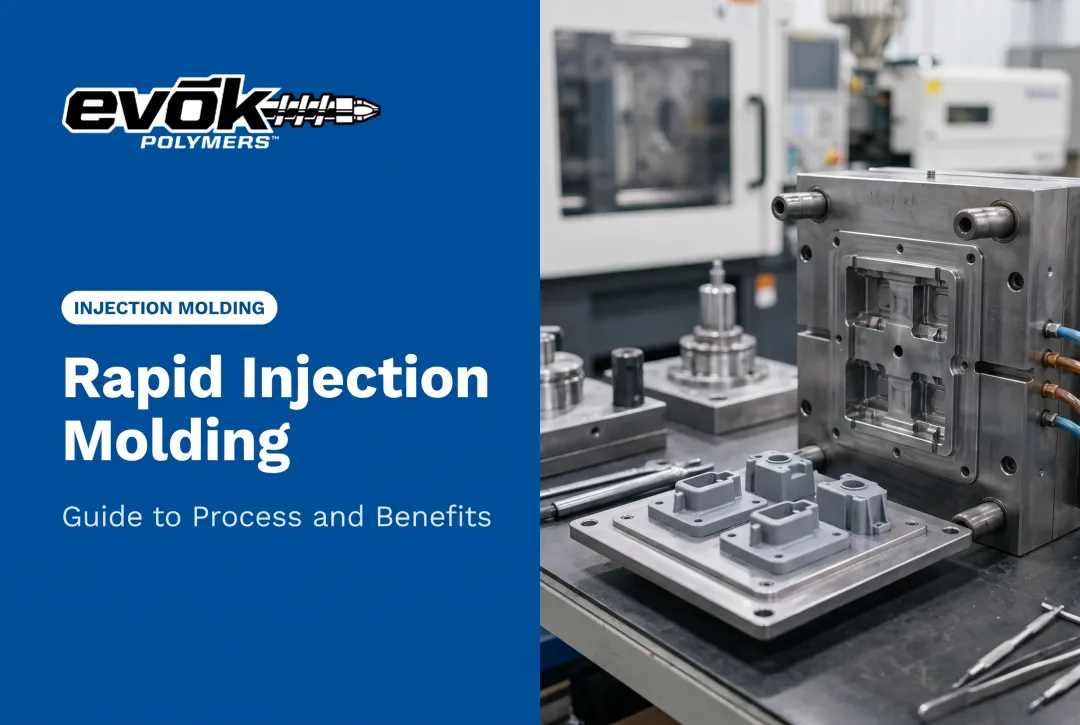
Rapid injection molding is a streamlined manufacturing process designed to produce high-quality plastic parts in significantly shorter timeframes.
It follows the same core principles as traditional injection molding but accelerates production by using faster-to-machine tooling materials, simplified mold designs, and early design-for-manufacturing validation.
This approach has become increasingly important as the global injection molding market is set to reach $426.7 billion by 2032, growing at a CAGR of 4.6% from 2025 to 2032, reflecting industry-wide demand for speed and flexibility.
At the heart of rapid injection molding is rapid tooling, typically using aluminum alloys or pre-hardened steels that can be CNC-machined quickly.
When combined with modern simulation and DFM software, manufacturers can validate flow, cooling, and part geometry early, reducing rework and enabling functional, production-grade prototypes in days rather than months.
To learn more about how we utilize these simulations, you can visit our About Us page.
With the definition established, let's explore the step-by-step workflow that makes this speed possible.
The Rapid Injection Molding Process: From CAD to Part
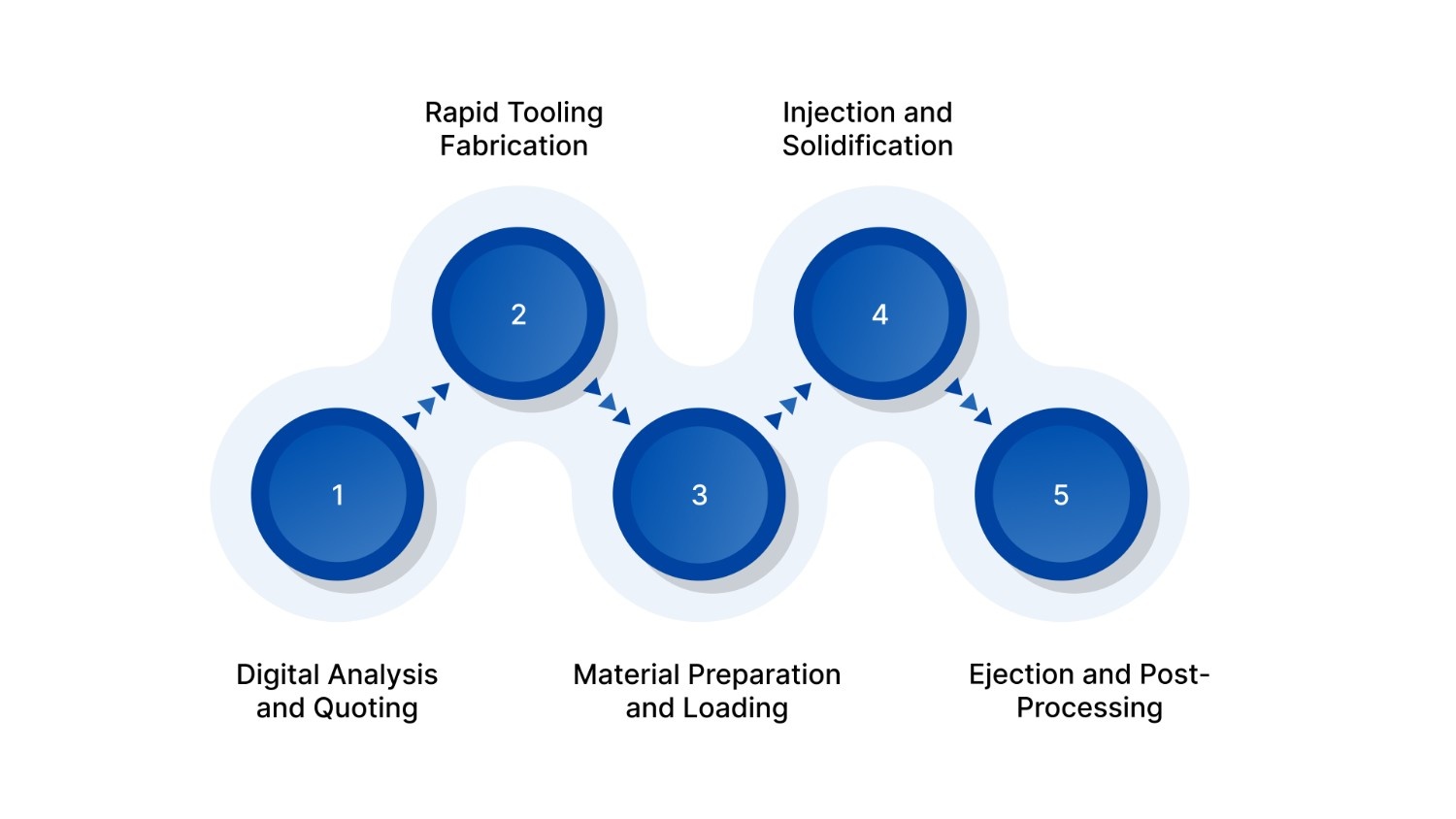
The lifecycle of a rapid prototype molding project is designed to eliminate bottlenecks. Here is a detailed breakdown of how rapid prototyping injection molding works at a high-performance facility.
1. Digital Analysis and Quoting
The process begins with the upload of a 3D CAD model. A modern rapid prototyping injection molding service uses automated algorithms to analyze the geometry for draft, wall thickness, and undercut issues.
This digital-first approach ensures that the custom in custom injection molding doesn't lead to delays.
2. Rapid Tooling Fabrication
Once the design is finalized, the rapid tooling injection molding begins. Using high-speed 5-axis CNC machines, the mold cavities are cut directly into aluminum or soft-steel bolsters.
For parts with complex internal features that cannot be machined, modular inserts or hand-loaded cores are used to simplify the tool construction and maintain the rapid injection molding schedule.
3. Material Preparation and Loading
While the tool is being cut, the selected thermoplastic resin is staged. Because rapid prototype injection molding uses real production materials, the resin often requires drying to remove moisture, ensuring the highest structural integrity.
This is critical for engineering plastics like Nylon or Polycarbonate.
4. Injection and Solidification
The mold is loaded into an injection molding press. Molten plastic is injected into the cavity at high pressure. The cooling time is a critical variable that the rapid injection molding process optimizes through the thermal properties of the tool.
Since aluminum dissipates heat much faster than steel, the cooling phase, and thus the cycle time, is significantly reduced.
5. Ejection and Post-Processing
After the part solidifies, it is ejected. Any necessary secondary operations, such as installing brass inserts, pad printing, or ultrasonic welding, are performed.
Even with these extra steps, the fast injection molding workflow keeps the project moving toward the shipping dock.
The technical workflow is optimized for speed, but the true value lies in the tangible benefits it offers to engineers and business leaders.
Also Read: Common Injection Molding Defects and How to Solve Them
Strategic Benefits of Rapid Injection Molding
The adoption of rapid prototype solutions has changed the ROI calculation for new product development. In 2026, companies are leveraging these benefits to outpace their competition.
1. Unmatched Speed and Efficiency
The primary advantage of rapid injection molding is time. In sectors like consumer electronics or medical technology, being first to market is the difference between dominance and obsolescence.
By reducing lead times by up to 70%, companies can iterate designs, conduct clinical trials, or perform market testing months ahead of schedule.
2. Drastic Reduction in Tooling Costs
Traditional production molds for complex parts can easily exceed $50,000 to $100,000. Rapid tooling injection molding utilizes more affordable materials and simplified mold designs to bring those costs down to the $2,000 to $15,000 range.
This makes it feasible for startups and established firms alike to validate their designs with real parts without exhausting their R&D budgets.
3. Functional Testing with Real Resins
3D printing is great for aesthetics, but it cannot replicate the performance of injection molded prototypes. Rapid prototyping services, injection molding, allow you to test your part with the exact material properties required:
Chemical Resistance: Essential for medical and industrial parts.
Thermal Stability: Critical for automotive and aerospace components.
Mechanical Strength: Necessary for structural parts or snap-fit assemblies.
4. Scalability and Bridge Tooling
Rapid injection molding is not just for five or ten parts. It is an excellent solution for bridge tooling, the production of the first 1,000 to 5,000 units needed while waiting for a high-volume steel tool.
This ensures that production lines are not sitting idle, providing a seamless transition from the rapid prototype injection molding phase to mass manufacturing. It allows for a gradual ramp-up in production while identifying any last-minute adjustments.
To achieve these benefits, engineers must adhere to specific design guidelines optimized for the rapid process.
Learn More About Our Team: Evok Poly Engineering Experts
Design Guidelines for Rapid Injection Molding
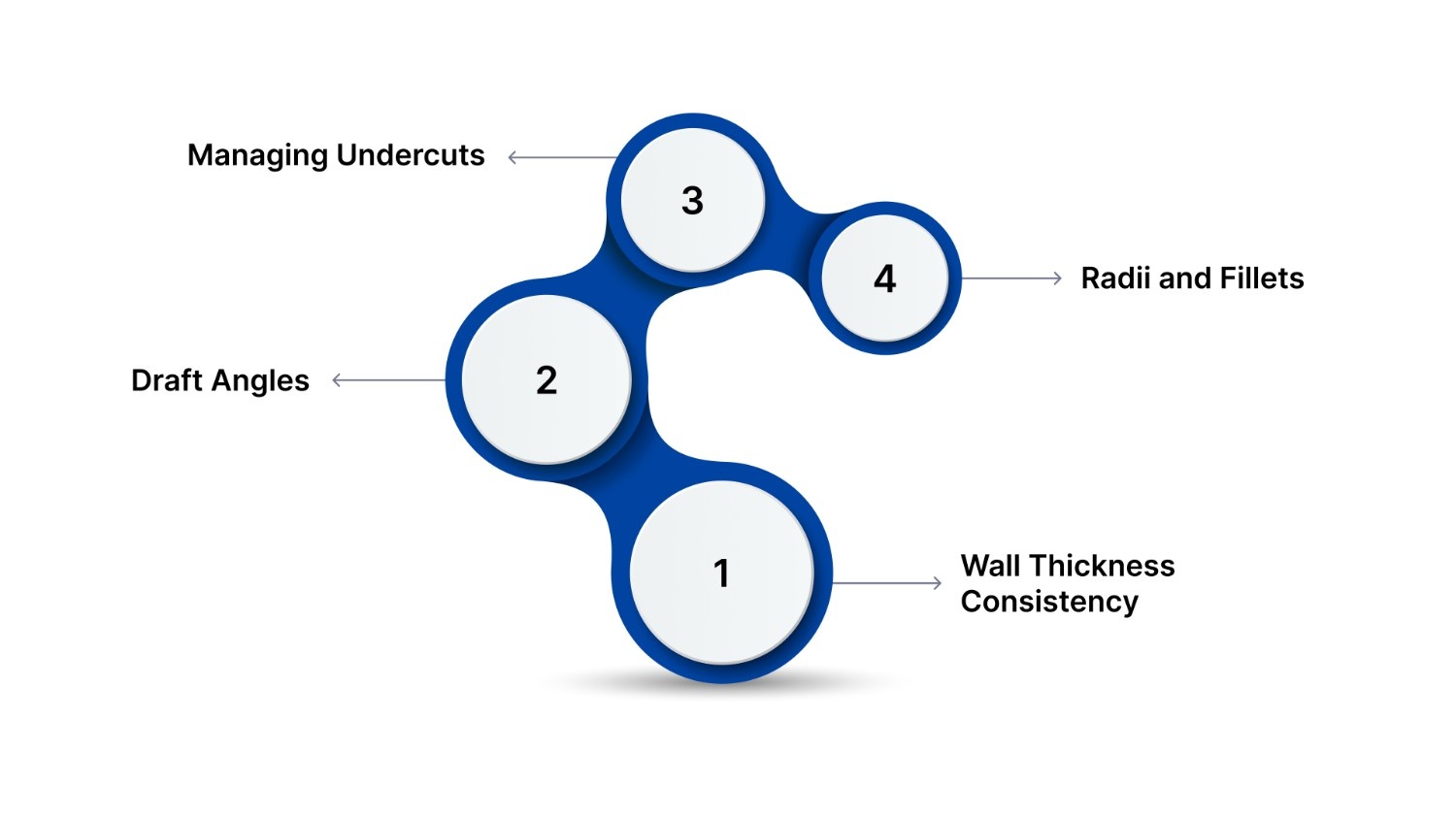
Success in rapid injection molding prototyping requires a synergy between part design and tooling capabilities. By following these design for manufacturing rules, you can ensure your project remains in the fast lane.
Wall Thickness Consistency
Uniform wall thickness is the most important rule of any injection molding rapid prototyping project. Variations in thickness cause the plastic to cool at different rates, leading to internal stress, sink marks, and warpage.
For rapid tools, keeping walls between 0.040 inches and 0.125 inches is generally optimal for the best results. If a design requires thicker sections, they should be cored out to maintain a uniform profile.
Draft Angles
To ensure the part can be ejected quickly from the rapid prototype injection molding tool, draft angles are required. A minimum of one degree is standard, though three degrees or more is recommended for textured surfaces.
A proper draft prevents the part from dragging against the tool, which can cause cosmetic scuffs and increase cycle times. Without a sufficient draft, the vacuum created during ejection can warp the part or damage the mold surface.
Managing Undercuts
In high-volume production, undercuts are handled by complex mechanical slides and cams. In rapid injection molding, these features are often managed through hand-loaded inserts.
While this adds a small amount of manual labor to the cycle, it drastically simplifies the mold design and reduces tooling costs. Engineers should attempt to minimize undercuts where possible to maintain the highest speed of production.
Radii and Fillets
Sharp internal corners are difficult to machine and create stress points in the final part. Adding radii to corners allows the CNC milling bits to move more fluidly during the rapid tooling injection molding phase, leading to a stronger part and a more durable tool.
A radius of at least half the wall thickness is a good starting point for most engineering designs.
The choice of material for both the part and the tool is the next critical decision in the process.
View Our Work: Injection Molded Parts Gallery
Material Selection in Rapid Injection Molding
In 2026, the versatility of rapid prototyping services injection molding allows for the use of hundreds of thermoplastic resins. Selecting the right one involves balancing performance with manufacturability.
Tooling Materials: Aluminum vs. Steel
The decision between an aluminum rapid prototype injection molding tool and a soft-steel tool depends on your volume and the abrasive nature of your resin.
Aluminum (7075-T6): The fastest to machine and has superior cooling properties. Ideal for most rapid injection molding projects up to 5,000 parts. It is susceptible to wear from glass-filled resins but is excellent for commodity plastics.
Soft Steel (P20): Offers better durability for abrasive resins, such as those with glass or carbon fillers. It is the preferred choice for rapid injection molding projects that may need to scale up to 50,000 units.
Common Resins for Rapid Molding
ABS (Acrylonitrile Butadiene Styrene): Tough and impact-resistant. The standard for rapid prototype solutions in consumer products and electronics enclosures.
Polycarbonate (PC): Offers high clarity and heat resistance. Common in medical devices and automotive lighting components.
Polypropylene (PP): Excellent chemical resistance and living-hinge capabilities. Widely used for laboratory equipment and durable packaging.
PEEK/PEI: High-performance plastics for the most demanding aerospace and medical rapid prototyping injection molding applications.
Conclusion
The evolution of rapid injection molding has redefined what is possible in the world of product development.
By combining the speed of the digital age with the reliability of traditional manufacturing, this process offers a path for companies to innovate with confidence and reach the market faster than ever before.
Whether you are seeking a rapid prototyping services injection molding partner for a new medical device or need custom injection molding for an automotive project, the benefits of speed, cost-effectiveness, and material authenticity are undeniable.
At Evok Polymers, we pride ourselves on being more than just a vendor; we are an engineering partner. Our rapid injection molding capabilities are designed to handle the most demanding projects with a focus on US-based quality and precision.
From the initial DFM analysis to the final shipment of your rapid prototype solutions, we are here to ensure your manufacturing journey is as seamless as the parts we produce.
Ready to accelerate your product launch?
Request a Quote from Evok Polymers today and let our experts show you how rapid injection molding can transform your next project from a CAD file into a high-performance reality.
Frequently Asked Questions (FAQs)
1. Can rapid injection molding produce parts with complex geometries?
Absolutely. While the process is optimized for speed, it can handle very complex geometries through the use of hand-loaded inserts and advanced CNC machining. If your part has undercuts or intricate internal features, rapid tooling injection molding can still deliver high-quality results by simplifying the mold-opening mechanism.
In 2026, 5-axis milling allows us to create geometries that were previously considered impossible for rapid tooling.
2. What is the difference between rapid and bridge tooling?
The terms are often used interchangeably in rapid prototyping services injection molding. However, rapid tooling usually refers to the speed of creation for prototypes used in design verification.
Bridge tooling refers to a tool designed to fill the production gap between a design freeze and the arrival of a high-volume, multi-cavity hardened steel tool. Rapid injection molding tools are excellent for both purposes because they are durable enough for several thousand cycles.
3. Is there a minimum order quantity for rapid injection molding?
One of the key benefits of rapid prototype injection molding is the lack of strict minimum order quantities. You can order as few as 10 to 25 parts to verify a design, or scale up to 10,000 parts for a market pilot.
This flexibility is why it is considered one of the most versatile rapid prototype solutions available. It allows businesses to test the market without committing to massive inventory levels.
4. Can I use colorants and additives in rapid injection molding?
Yes. Since the process uses real injection molding machines, you can add colorants, UV stabilizers, and reinforcements like glass or carbon fiber. This ensures that your injection molding rapid prototyping phase yields parts that are aesthetically and mechanically identical to the final product.
We can match specific Pantone or RAL colors to ensure brand consistency during the prototyping stage.
5. How does the 2026 push for sustainability impact rapid injection molding?
The industry is moving toward circular manufacturing. Rapid injection molding supports this by producing less waste than subtractive methods like CNC machining and by allowing the use of recycled or bio-based resins.
Furthermore, the precision of fast injection molding reduces scrap rates during the bridge production phase. Many US companies now require carbon footprint data for their prototypes, which our automated systems can provide.