This comparison matters now more than ever. 3D printing technology has advanced significantly, with production-grade parts accounting for a growing portion of additive manufacturing orders. The global polymer AM market continues to expand, driven by technologies like Multi Jet Fusion (MJF) and Selective Laser Sintering (SLS). Meanwhile, injection molding remains the gold standard for high-volume manufacturing, accounting for nearly 50% of all plastic processing methods with a market size of approximately USD 362.47 billion in 2025. The lines between prototyping and production are blurring, making the decision more nuanced than ever before.
Key Takeaways
- High-volume production (10,000+ parts) costs $0.50-$5.00 per part with injection molding but requires $3,000-$100,000+ tooling
- Tooling-free 3D printing delivers parts in 1-3 days versus 4-8 weeks for molds, ideal for volumes under 1,000 units
- Break-even typically occurs between 1,000-13,000 parts depending on part complexity and tooling costs
- Molded parts offer superior strength consistency, while MJF 3D printing reaches 95-100% of molded tensile strength
- Hybrid approach works best: prototype with 3D printing to validate design, then transition to injection molding once volume justifies tooling investment
Injection Molding vs 3D Printing: Quick Comparison
Upfront Costs
Injection Molding: High tooling investment ranging from $3,000 for simple aluminum molds to over $100,000 for complex multi-cavity hardened steel molds. Steel molds cost significantly more than aluminum but can produce 100,000-1,000,000+ parts versus 2,000-10,000 for aluminum.
Tooling lead time adds 4-8 weeks before first parts arrive, though expedited options exist at 20-30% premium.
3D Printing: Zero tooling required—only printer hardware, materials, and labor costs. Professional systems range from $5,000-$30,000 for entry-level SLA/FDM to $100,000+ for industrial production fleets.
Production begins immediately after CAD file finalization, with no waiting for mold fabrication.
Per-Part Cost
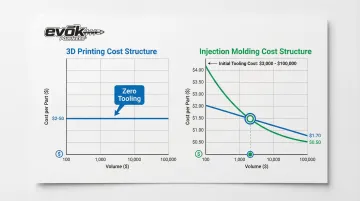
Injection Molding: Low unit costs at high volumes due to spreading tooling costs across many parts. Costs drop from approximately $4.00 at 100 units to $1.70 at 100,000 units for typical parts. Production runs typically achieve $0.50-$5.00 per part depending on size and complexity.
3D Printing: Higher per-part costs that remain relatively flat regardless of volume. Typical costs range from $2.00-$50.00+ depending on process (SLS vs. MJF) and geometry. The 100th part costs essentially the same as the first part.
This per-part cost difference directly impacts your timeline decisions and when each process makes financial sense.
Lead Time
Injection Molding: Standard tooling requires 4-8 weeks including mold design, CNC machining, sampling, and adjustments. Expedited tooling can reduce this to 2-4 weeks but typically incurs premiums of 20-30% or more.
Design changes after tooling is committed require expensive mold modifications.
3D Printing: Same-day to 3-day turnaround from file to finished parts. No tooling delays mean production begins immediately.
Design changes can be implemented instantly between print runs by simply uploading a revised CAD file.
Once production actually starts, the speed dynamics shift dramatically.
Production Speed
Injection Molding: Very fast cycle times of 30 seconds to 2 minutes per cycle once molds are ready. Multi-cavity molds multiply output—a 2-cavity mold doubles production, while 8+ cavity molds can produce dozens of parts simultaneously.
Aluminum molds cool up to 40% faster than steel, further reducing cycle times.
3D Printing: Slower production with build times measured in hours. A large-format printer might take 6 hours to produce 78 parts.
Multiple printers can increase throughput, but build times remain significantly longer than injection molding cycles. Post-processing (support removal, finishing) adds additional time.
Material Properties & Durability
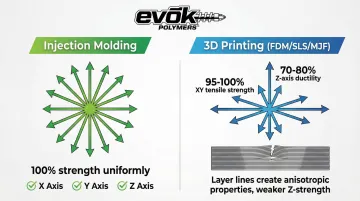
Injection Molding: Superior mechanical properties with isotropic strength (strength is uniform in all directions). Wide range of production-grade resins including engineering plastics like glass-filled nylon, PEEK, and Ultem.
Parts exhibit consistent performance with no layer-line weaknesses.
3D Printing: Good mechanical properties with newer materials, but inherent anisotropy (directional weakness) due to layer-by-layer construction. FDM shows significant Z-axis weakness.
SLS and MJF deliver near-isotropic performance (95-100% of injection-molded tensile strength) but Z-axis ductility remains 20-30% lower. Material options expanding rapidly but still more limited than injection molding.
What is Injection Molding?
Injection molding is a manufacturing process where molten plastic is injected into a precision mold cavity under high pressure (typically 10,000-30,000 psi), then cooled and ejected as a finished part.
Once a mold is dialed in, it produces thousands or millions of identical parts with minimal variation. This consistency makes injection molding the dominant method for mass-producing plastic components across virtually every industry, from automotive interiors to medical devices to consumer electronics.
Core benefits include:
- Low per-part costs at volume — tooling investment spreads across production runs. At 100,000 units, per-part costs can drop below $2.00 even for moderately complex parts.
- Exceptional consistency — injection molding achieves dimensional tolerances of ±0.001", ensuring parts fit together perfectly in assemblies.
- Production-grade materials — access to thousands of thermoplastic resins reduces warranty claims and enables parts to withstand demanding environments from automotive under-hood applications to outdoor exposure.
Different mold types expand capabilities beyond basic part production. Prototype molds use aluminum construction with lower upfront costs ($3,000-$10,000) and shorter machining times, suitable for 1,000-10,000 parts during design validation or bridge production.
Production molds employ hardened steel (often H13 or P20) with higher initial investment ($20,000-$100,000+) but lifespans exceeding 1,000,000 cycles. Specialized processes include overmolding (combining multiple materials in one part), insert molding (encapsulating metal components), and multi-shot molding (creating multi-color or multi-material parts in a single cycle).
Use Cases of Injection Molding
Injection molding fits manufacturing workflows where design is finalized and production volume justifies tooling investment. It's ideal for established product designs moving to market, replacement parts requiring consistency across years of production, and any application where per-part cost must be minimized across thousands or millions of units.
The method works best when design changes are unlikely, since mold modifications are expensive and time-consuming.
Example industries and products span virtually every sector:
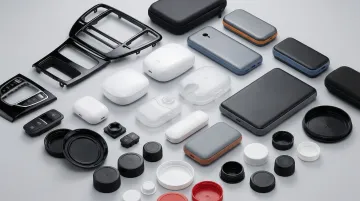
- Automotive: Interior components (dashboards, door panels, console parts), under-hood components (fluid reservoirs, air intake manifolds), exterior trim pieces, and connectors
- Consumer electronics: Housings for smartphones, laptops, and tablets; connectors and charging ports; internal structural components; buttons and switches
- Medical devices: Syringes, IV components, diagnostic test housings, surgical instrument handles, and device enclosures requiring biocompatible materials and strict quality standards
- Packaging and consumer goods: Bottle caps, containers, cosmetic packaging, household product housings, and toys
Injection molding accounts for nearly 50% of all plastic processing methods globally, with the market valued at $362.47 billion in 2025. This scale reflects its unmatched efficiency for high-volume production where consistency, material performance, and per-part economics are critical.
What is 3D Printing?
3D printing (additive manufacturing) builds parts layer-by-layer directly from digital CAD files, eliminating the need for molds, dies, or tooling. A printer deposits or fuses material in successive thin layers—typically 0.05mm to 0.3mm thick—until the part is complete.
This difference from subtractive or molding processes enables on-demand production without minimum order quantities, making it economically viable to produce a single part or a thousand with the same per-unit cost structure.
3D printing has expanded dramatically beyond prototyping. While it originated as a rapid prototyping technology in the 1980s, advances in materials, speed, and precision now support production applications for low-to-mid volume manufacturing, complex geometries, and mass customization scenarios where traditional methods struggle.
Core benefits linked to operational impact:
- Zero tooling costs eliminate capital barriers that make low-volume production prohibitive with injection molding. No need to invest $10,000-$100,000 upfront before seeing your first part.
- Design freedom for complex geometries enables internal channels, organic shapes, lattice structures, and consolidated assemblies that would require multiple molded parts or be impossible to manufacture traditionally. No need for draft angles, undercut limitations, or assembly operations.
- Rapid iteration cycles mean design changes implemented in hours, not weeks. Upload a revised CAD file and print the updated version immediately, accelerating time-to-market and reducing development risk.
3D Printing Technologies
Multiple 3D printing technologies serve different applications:
- FDM/FFF (Fused Deposition Modeling) extrudes thermoplastic filament layer-by-layer, offering the most economical option with fast turnaround and ability to use various materials to simulate production plastics
- SLA/MSLA (Stereolithography) uses UV lasers to cure liquid resin, delivering high detail, smooth surface finishes, and dimensional accuracy ideal for cosmetic prototypes
- SLS (Selective Laser Sintering) fuses nylon powder with lasers, creating strong functional parts without support structures and good mechanical properties
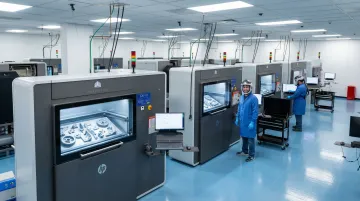
- Production-focused technologies like Multi Jet Fusion and Carbon DLS deliver improved speed, strength, and surface finish, closing the gap with injection molding for certain applications
Use Cases of 3D Printing
3D printing fits workflows where speed, flexibility, or geometric complexity outweigh per-part cost considerations.
It excels at prototyping and design validation before committing to expensive tooling—testing form, fit, and function with physical parts in days rather than waiting weeks for molds. Bridge production during mold fabrication keeps projects moving while tooling is being manufactured.
Low-volume custom or personalized products (medical implants, custom fixtures, limited-edition products) that would be economically impossible with injection molding become viable. Replacement parts for legacy equipment where original molds no longer exist can be reverse-engineered and printed on-demand. Complex assemblies can be redesigned as single printed parts, eliminating assembly operations and reducing part count.
Example industries and products demonstrate the expanding production role:
- Aerospace: Brackets and ducting with topology-optimized geometries that reduce weight by 40-60% compared to traditionally manufactured alternatives; complex internal geometries for fluid flow optimization
- Medical: Patient-specific implants and surgical guides customized to individual anatomy from CT scan data; dental aligners and orthodontic devices produced in mass-customization workflows
- Automotive: Functional prototypes for design validation; low-volume performance parts for specialty vehicles; custom tooling and fixtures for assembly lines
Startups like Optima Recovery use HP MJF to produce 60% of their device's parts, eliminating tooling costs for conservative first-year volumes. Companies like Blueflite integrate approximately 48 printed parts per aircraft using MJF to reduce weight and assembly complexity. This shift from prototyping to production represents the blurring lines between traditional manufacturing and additive methods.
Injection Molding vs 3D Printing: What is Better?
Neither technology is universally "better"—the right choice depends on your specific production volume, budget constraints, timeline urgency, part complexity, material performance needs, and whether your design is finalized or still evolving. Understanding these decision factors helps you select the method that maximizes value for your particular situation.
Volume-Based Recommendations
Production volume determines how tooling costs get amortized across your project:
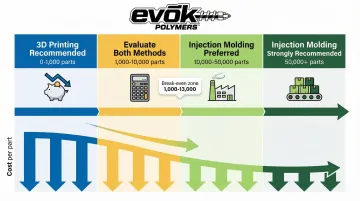
- Under 1,000 parts: 3D printing avoids tooling investment entirely. For a typical mixer latch part, 1,000 units cost $600 via 3D printing versus $3,920 for injection molding—an 85% savings.
- 1,000-10,000 parts: Evaluate both methods with quotes. Break-even varies by part size and complexity.
- 10,000-50,000 parts: Injection molding becomes cost-effective as tooling spreads across units.
- 50,000+ parts: Injection molding delivers overwhelming per-part advantages and production speed.
Research indicates break-even occurs between 1,000-13,000 parts, with one study identifying 13,050 units for a small latch component.
For larger, more complex parts, comprehensive analysis found injection molding preferable only above 70,000 units when total costs and environmental factors were weighed.
Timeline-Based Recommendations
3D printing excels when speed matters:
- Time-to-market is critical (can't wait 4-8 weeks for tooling)
- You need parts within days for testing or customer demos
- You're racing competitors to market
- Bridge production is needed while molds are being manufactured
Injection molding works best with flexible timelines:
- You have 4-8 weeks for proper mold development (2-4 weeks expedited)
- You're establishing long-term production capacity
- Your product launch allows for upfront tooling investment
- You're planning ongoing production beyond initial launch
Design Maturity Recommendations
For evolving designs, 3D printing offers flexibility:
- You expect to test multiple iterations
- You need to evaluate several design variations
- Customer feedback might require changes
- You want to avoid locking in expensive tooling prematurely
For finalized designs, injection molding provides efficiency:
- Design is validated through prototyping
- Fit, form, and function testing is complete
- Design changes are unlikely
- You're transitioning from development to production
Complexity Recommendations
3D printing handles complex geometries:
- Internal channels, lattice structures, or organic shapes impossible to mold
- Geometries requiring expensive multi-piece molds with slides and lifters
- Severe undercuts requiring complex mold actions
- Consolidated assemblies eliminating multiple molded parts
Injection molding suits optimized designs:
- Simpler geometries without complex undercuts
- Designs modified for molding constraints (draft angles, eliminated undercuts)
- Parts where traditional manufacturing limitations are acceptable
- Applications optimized for manufacturability
Hybrid Approach: The Best of Both Worlds
Many successful projects leverage both technologies strategically:
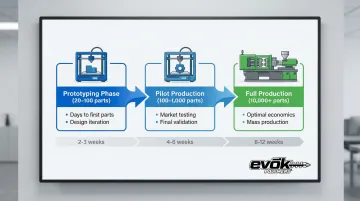
Prototyping phase (20-100 parts):
- Use 3D printing for design validation and testing multiple iterations
- Gather user feedback and refine design without tooling investment
Pilot production (100-1,000 parts):
- Continue with 3D printing for initial market testing
- Complete final design validation before committing to tooling
Full production (10,000+ parts):
- Transition to injection molding once design is locked
- Achieve optimal per-part economics for mass production
This approach de-risks tooling investment by validating design thoroughly before spending $10,000-$100,000 on molds. It accelerates development by getting functional parts into testing immediately.
EVOK supports this workflow by offering both rapid prototyping services (SLA/FDM) and production injection molding, with seamless transition guidance throughout the development process.
Real World Examples/Case Studies
A powersports component manufacturer approached EVOK facing a common dilemma: they needed to produce 8,500 custom plastic brackets annually for a new product line. Initial quotes from 3D printing service bureaus seemed attractive because they eliminated upfront tooling costs, but the per-part pricing raised concerns about long-term sustainability as volumes grew.
The parts faced demanding requirements that 3D printing couldn't reliably meet at volume:
- Consistent mechanical properties and surface finish across all 8,500 units
- Aesthetic quality for customer-visible applications (no visible layer lines)
- Resistance to vibration and temperature cycling in outdoor powersports use
- Uniform strength in all directions (FDM printed parts have directional weakness that creates reliability risks under dynamic loading)
These technical demands pointed toward injection molding, but the customer needed to justify the upfront tooling investment.
The Decision Point: Why Injection Molding
EVOK's upfront cost transparency showed that tooling investment would be recouped within the first 3,000 parts based on the per-part cost differential. The Polyestimator tool provided detailed financial modeling comparing total project costs across different volume scenarios, making the economic case clear.
While the initial $12,000 mold investment seemed significant, the per-part cost of $1.85 versus $6.50 for 3D printing meant each part saved $4.65—recovering tooling costs by unit 2,581.
EVOK's Engineering Approach
EVOK's team conducted comprehensive Design for Manufacturability (DfM) analysis using Autodesk Moldflow simulation to optimize the part design before cutting steel. The analysis identified opportunities to:
- Reduce cycle time by 18% through optimized gate placement and cooling channel design, improving production throughput
- Eliminate potential sink marks by adjusting wall thickness transitions, ensuring cosmetic quality
- Minimize warpage through balanced filling and strategic rib placement, meeting tight dimensional tolerances
Material selection expertise identified a glass-filled polypropylene that met the structural requirements while reducing material cost by 12% compared to the engineering-grade nylon initially specified. The material delivered equivalent performance at lower cost, directly improving project economics.
Measurable Outcomes
Within six months of production launch, the customer produced 8,500 parts with a 99.7% first-pass quality rate—only 25 parts required rework out of the entire production run.
Per-part cost was 68% lower than 3D printing quotes for equivalent volume ($1.85 vs. $6.50), generating over $39,000 in cost savings on this production run alone.
EVOK's partnership approach included transparent cost itemization showing exactly where money was being spent (material, labor, machine time, tooling amortization), enabling the customer to make informed decisions throughout development. The design optimization delivered parts that met exacting cosmetic and functional standards while maintaining competitive economics.
Evaluating injection molding for your next project? EVOK's engineering team can provide transparent cost analysis and design optimization to help you make the right manufacturing decision. Contact us for a detailed quote and DfM consultation that shows exactly how injection molding economics compare to alternatives for your specific volume and requirements.
Conclusion
Neither injection molding nor 3D printing is universally "better"—the right choice depends on your specific production volume, timeline constraints, budget, and design requirements.
3D printing excels when you need speed, flexibility, and low volumes (under 1,000 parts), eliminating tooling costs and enabling rapid iteration. Injection molding delivers unmatched economics and consistency for production runs above 10,000 parts, with per-part costs dropping to $0.50-$5.00 and superior mechanical properties.
The decision framework involves three key evaluations:
- Calculate your break-even volume considering total project costs (not just per-part pricing)
- Evaluate your timeline constraints and design maturity
- Assess whether your design is finalized or still evolving
For most projects in the 1,000-10,000 unit range, request detailed quotes for both methods to identify your specific crossover point.
The hybrid approach often delivers the best results by staging your production method:
- Prototype phase: 3D print 20-100 parts to validate design and gather feedback
- Pilot production: Continue 3D printing for initial market testing (100-1,000 parts)
- Production scale: Transition to injection molding once design is locked and volume justifies tooling investment (10,000+ parts)
This strategy de-risks expensive tooling commitments while accelerating development timelines.
When you reach the production-scale phase, partnering with EVOK provides the cost transparency and design optimization needed to maximize your tooling investment. EVOK's DfM analysis, material selection expertise, and upfront cost modeling help you identify exactly when injection molding becomes economically advantageous for your specific part—eliminating guesswork and ensuring you make the right manufacturing decision for your project's success.
Frequently Asked Questions
Is 3D printing replacing injection molding?
No—3D printing complements rather than replaces injection molding. While 3D printing works well for low-to-mid volumes (under 10,000 parts) and complex geometries, injection molding remains the most cost-effective method for high-volume production. Most companies use both technologies strategically based on volume and complexity requirements.
Can you drink out of 3D printed cups?
Generally no, unless strict protocols are followed. Even food-safe filaments create porous parts with layer lines that trap bacteria, requiring food-grade coatings to seal surfaces. Injection molded food-grade plastics remain the safer choice for repeated use.
What is the break-even point between 3D printing and injection molding?
Break-even typically occurs between 1,000-13,000 parts depending on part size, complexity, and tooling costs. Smaller parts break even around 13,000 units, while complex parts with expensive molds may favor 3D printing until 70,000+ units. Request quotes for both methods to calculate your precise break-even point.
Can I start with 3D printing and transition to injection molding later?
Yes—this is a common and recommended approach. Prototype with 3D printing to avoid premature tooling investment, then transition to injection molding once volume justifies it (typically 5,000-10,000+ annual units). Work with your injection molding partner early to ensure your design is optimized for both methods.
How long does injection molding tooling last?
Injection molded parts have superior and more consistent mechanical properties due to uniform material throughout (isotropic strength). 3D printed parts may have weaknesses along layer lines, though newer technologies like MJF achieve 95-100% of injection-molded tensile strength. Test printed prototypes under actual use conditions to validate whether 3D printing meets your requirements.