Introduction
Product developers face a critical challenge when transitioning from prototype to production: how do you validate market demand without committing to expensive high-volume tooling that could cost $50,000 to $500,000? A single misstep at this stage can drain capital, delay market entry, and leave you with obsolete tooling if customer feedback requires design changes.
Low-volume manufacturing offers a strategic middle ground that bridges prototyping and mass production. It allows companies to test markets with production-grade parts, refine designs based on real-world feedback, and generate revenue—all without the massive upfront investment that high-volume production demands.
According to industry research, production runs of 10 to 10,000 units per year enable companies to cross the "valley of death" between prototype and scale.
TLDR: Key Takeaways
- Low-volume manufacturing produces 100-10,000 units annually with lower financial risk than mass production
- Reduces tooling costs by 50-75% while enabling faster market entry and product validation
- Best for market testing, bridge production, niche markets, and iterative design refinement
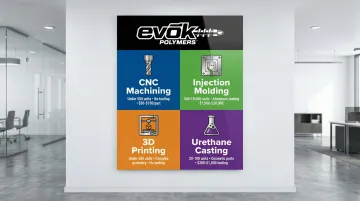
- Primary methods: CNC machining (under 500 units), aluminum-tooled injection molding (500-10,000 units), and 3D printing
What is Low Volume Manufacturing?
Low-volume manufacturing refers to production of parts or products in quantities typically ranging from 100 to 10,000 units. It sits between prototyping (1-100 units) and high-volume manufacturing (10,000+ units).
The approach uses production-grade materials and processes to deliver functional, end-use parts that meet quality standards. However, tooling and setup are optimized for smaller quantities rather than maximum efficiency.
Key Characteristics
The defining features of low-volume manufacturing include:
- Production-grade quality: Parts meet the same specifications and standards as high-volume production
- Flexible tooling: Uses aluminum molds, rapid tooling, or tooling-free processes instead of expensive hardened steel
- Real-world validation: Produces enough units to test actual market response and gather customer feedback
- Design iteration capability: Allows modifications between production runs without scrapping costly tooling
Strategic Role in Product Lifecycle
Low-volume manufacturing serves as a critical phase in the product development lifecycle. Companies can validate designs, test markets, and generate revenue while minimizing financial risk before scaling to mass production.
The approach proves particularly valuable when demand is uncertain or when products require frequent updates based on user feedback.
Volume ranges are flexible and industry-dependent. Medical device manufacturers might consider 500 units "high volume" due to specialized clinical needs, while automotive suppliers consider 50,000 units "low volume."
The definition shifts based on regulatory requirements, product complexity, and market dynamics.
How It Differs from Prototyping and High-Volume Production
Low-volume manufacturing differs from prototyping in purpose and economics:
Prototyping vs. Low-Volume Production:
- Prototypes focus on design testing and validation
- Low-volume production delivers sellable products to customers
- Low-volume requires more investment than prototyping but far less than high-volume tooling
Low-Volume vs. High-Volume Production:
- Accepts higher per-unit costs in exchange for lower upfront investment
- Enables faster setup and greater design flexibility
- Makes sense when market demand is unproven or when serving specialized applications
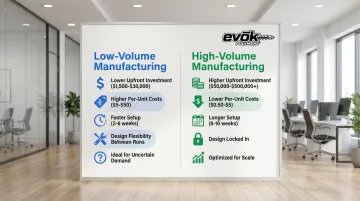
Low Volume vs. High Volume Manufacturing: Key Differences
Production Volume Ranges
The fundamental distinction lies in annual production quantities:
- Low-volume: 100 to 10,000 units per year
- High-volume: 10,000 to 100,000+ units per year
These thresholds represent economic inflection points where different manufacturing technologies become cost-effective.
Upfront Investment and Tooling Costs
Tooling is the largest cost differential between approaches.
Low-volume tooling:
- Aluminum molds, soft tooling, or rapid tooling
- Costs approximately 50-75% less than steel
- Typical investment: $1,500 to $30,000 depending on part complexity
- Tool life: 10,000 to 25,000 shots
High-volume production requires hardened steel molds built for extended lifecycles:
- Hardened steel molds designed for millions of cycles
- Investment range: $50,000 to $500,000+
- Tool life: 1,000,000+ shots
- Requires longer lead times but delivers lowest per-unit costs
Per-Unit Cost Comparison
The per-unit economics create a natural break-even point between approaches:
- Low-volume: $5 to $50 per part due to less automation and longer cycle times
- High-volume: $0.50 to $5 per part through economies of scale and optimized processes
For simple plastic parts, injection molding becomes more cost-effective than CNC machining around 500-1,000 units, while hardened steel tooling typically makes financial sense above 10,000 units. These thresholds help determine the optimal transition point for your production strategy.
Lead Times and Flexibility
Low-volume advantages:
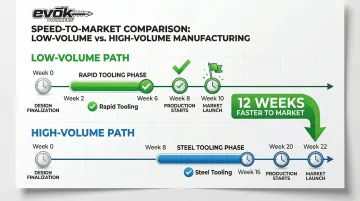
- Faster initial setup: 2-6 weeks for aluminum tooling
- Easy design changes between production runs
- Rapid response to customer feedback
- Lower risk if product fails in market
High-volume advantages:
- Longer setup: 8-16 weeks for steel tooling
- Faster production once running
- Lowest per-unit costs at scale
- Optimized for consistent, repeatable production
Break-Even Analysis
The volume threshold where high-volume manufacturing becomes more cost-effective depends on several factors:
- Tooling cost difference: How much more expensive is steel tooling versus aluminum?
- Per-unit cost savings: How much cheaper is each part with high-volume methods?
- Expected product lifetime: How many total units will you produce?
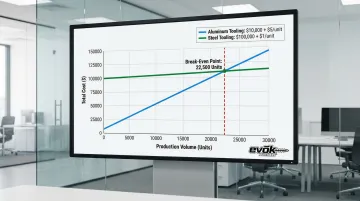
Calculation framework: Break-even occurs when total costs equal across methods.
For a part where aluminum tooling costs $10,000 (at $5 per unit) versus steel tooling at $100,000 (at $1 per unit), the break-even point is 22,500 units. Below that volume, aluminum tooling delivers lower total cost.
When Should You Use Low Volume Manufacturing?
Market Testing & Validation
When launching new products with uncertain demand, low-volume manufacturing allows you to produce enough units—typically 500 to 2,000—to test real market response without massive capital commitment.
This approach helps you:
- Validate pricing assumptions with real customers
- Gather actionable product feedback
- Measure actual demand before committing to high-volume tooling
Industry practitioners note that while selling a few hundred units is relatively easy, scaling to thousands requires validation that low-volume production enables.
Bridge Production
Bridge production fills the critical gap between initial market launch and full-scale manufacturing. When you need to generate revenue while waiting for high-volume tooling to be completed—typically a 3-6 month process—low-volume manufacturing keeps your business moving forward.
This strategy reduces time-to-market by weeks or months, allowing you to establish market presence while final production tooling is being manufactured. Plus, cash flow from bridge production can help fund your investment in high-volume tooling.
Niche & Custom Products
For specialized markets with limited demand, low-volume manufacturing is often the permanent production strategy. Applications where this makes sense:
- Medical devices requiring regulatory compliance
- Aerospace components with strict quality standards
- Custom industrial equipment for niche applications
- Products with annual demand below 10,000 units
Evok's work with clients like Boston Scientific and Polaris shows how custom injection molded components serve these specialized markets. Production tooling is optimized for quality and reliability rather than maximum volume efficiency.
Seasonal & Limited Edition Products
Products with short selling windows or intentionally limited quantities—holiday items, special editions, fashion accessories—benefit from low-volume manufacturing's flexibility. This approach provides the production capacity you need without creating excess inventory risk or requiring capital investment in tooling that will sit idle most of the year.
Design Iteration & Improvement
When product design is still evolving based on user feedback or technology improvements, low-volume manufacturing allows design changes between production runs without scrapping expensive tooling. This flexibility is particularly valuable for technology products where features and specifications may shift as you learn from early adopters.
Evok's approach to design optimization through comprehensive CAD engineering services and prototype validation helps customers refine designs iteratively. This ensures the final production tooling delivers optimal part performance and cost efficiency.
Manufacturing Technologies for Low Volume Production
CNC Machining
CNC machining serves as the primary low-volume method for parts requiring tight tolerances and robust material properties.
This subtractive process machines parts from solid blocks of material—metal or plastic—without requiring any tooling investment.
Key advantages:
- No tooling costs or lead times
- Excellent for complex geometries and tight tolerances (±0.05-0.1 mm)
- Ideal for volumes under 500 units
- Typical lead time: 1-3 weeks
Cost considerations: Standard aluminum parts typically range from $30 to $150 per unit at low volumes. Costs remain relatively flat regardless of quantity since there's no tooling to amortize.
Injection Molding with Rapid/Soft Tooling
Using aluminum molds or 3D-printed mold inserts instead of hardened steel produces production-quality plastic parts at a fraction of the tooling cost. Aluminum tooling can be machined and ready for production in 15-25 business days, compared to 35-60 days for steel.
Why choose rapid tooling:
- Production-quality parts with excellent surface finish
- Tooling costs: $1,500 to $30,000
- Suitable for 500 to 10,000 units before tool wear becomes significant
- Faster cycle times due to aluminum's superior thermal conductivity
Material capabilities: Aluminum tooling works with most standard thermoplastics but may wear faster with abrasive materials like glass-filled nylon.
Additional Technologies
Three additional approaches round out the low-volume manufacturing toolkit:
3D Printing (Additive Manufacturing):
- Best for complex geometries and rapid iteration
- Competitive for volumes under 500 units
- No tooling required
- Technologies include SLS, MJF for polymers; DMLS for metals
Urethane Casting:
- Ideal for rubber-like parts and cosmetic samples
- Volume range: 20 to 100 pieces
- Mold costs: $200 to $1,000
- Per-part costs: $10 to $100
- Fast turnaround for bridge production
Sheet Metal Fabrication:
- Suitable for enclosures and brackets
- No tooling for laser cutting
- Bending and forming may require simple fixtures
- Cost-effective for low volumes of metal components
Benefits of Low Volume Manufacturing
Reduced Financial Risk
Low-volume manufacturing dramatically reduces capital at risk when launching new products:
- Lower upfront investment: $1,500 to $30,000 versus $50,000 to $500,000 for high-volume tooling
- Faster break-even point: Recover tooling investment with fewer units sold
- Preserved cash flow: Capital remains available for marketing, business development, and other growth initiatives
- Lower failure cost: If the product doesn't succeed, losses are contained
Beyond financial protection, low-volume production unlocks another critical advantage: the freedom to refine your design.
Design Flexibility
The ability to make improvements between production runs provides strategic advantages:
- Incorporate customer feedback into subsequent batches
- Respond to competitive developments without scrapping expensive tooling
- Test multiple design variants to optimize performance
- Pivot strategy based on market response
Companies like EVOK support this iterative approach through detailed manufacturability reviews at each production stage, helping customers refine parts before committing to high-volume tooling.
Speed-to-Market Benefits
Faster tooling and setup compress product launch timelines:
- Rapid tooling (2-6 weeks versus 3-6 months for hardened steel)
- Start selling while competitors are still in development
- Establish market presence first, creating competitive advantage
- Gather customer feedback sooner to inform product evolution
Common Industries and Applications
Low-volume manufacturing serves industries where specialized requirements, regulatory constraints, or market dynamics prevent high-volume production. The following sectors rely on this approach for different strategic reasons.
Medical Devices
Medical devices rely on high-mix, low-volume production due to specialized patient needs and rigorous regulatory requirements.
FDA approval cycles and clinical trials naturally limit production volumes during validation phases, making low-volume manufacturing essential.
Common applications include clinical trial components, specialized surgical instruments, patient-specific devices, and regulatory validation batches.
Aerospace & Defense
Certified components with strict traceability requirements are manufactured in limited quantities. Aircraft interiors, engine components, and replacement parts typically have annual demand below 10,000 units, making low-volume production the permanent strategy.
Common applications include complex structural components, certified replacement parts, custom interior fittings, and specialized equipment.
Consumer Electronics
Rapid product iteration and market testing drive low-volume manufacturing adoption in consumer electronics. Companies use bridge production to launch products while final high-volume tooling is completed.
Typical uses:
- Pre-production runs for market validation
- Limited market releases to test demand
- Custom configurations for niche segments
- Rapid iteration cycles during development
Automotive Aftermarket
Custom parts, performance upgrades, and restoration components for out-of-production vehicles represent ideal low-volume applications. Original tooling no longer exists, making low-volume methods the only viable option.
Common applications include custom performance parts, restoration components, specialized accessories, and limited-edition upgrades.
Industrial Equipment
Specialized machinery and replacement parts for industrial equipment typically require low-volume production due to limited market size and customization requirements.
| Application Type | Production Driver |
|---|---|
| Custom machine components | Unique specifications per customer |
| Replacement parts inventory | Low annual demand per SKU |
| Specialized tooling | Niche equipment requirements |
| Equipment upgrades | Limited retrofit market |
Getting Started with Low Volume Manufacturing
Initial Assessment Process
Evaluate whether low-volume manufacturing is the right strategy by examining:
Expected volumes:
- Annual production forecast
- Multi-year volume projections
- Market size and penetration estimates
Product lifecycle timeline:
- Time to market requirements
- Expected product lifespan
- Anticipated design evolution
Budget constraints:
- Available capital for tooling investment
- Per-unit cost targets
- Break-even volume requirements
Design maturity:
- Confidence in current design
- Likelihood of changes based on feedback
- Regulatory or certification requirements
Selecting Manufacturing Partners
Once you've determined low-volume manufacturing fits your needs, finding the right partner becomes critical. Look for vendors with specific capabilities and approaches:
Industry experience:
- Track record in your specific vertical
- Understanding of regulatory requirements
- Portfolio of similar projects
Transparent pricing:
- Clear breakdown of tooling versus per-unit costs
- Detailed quotes with no hidden fees
- Willingness to explain cost drivers
Design for Manufacturability support:
- Early DFM reviews
- Ways to optimize your design
- Material selection guidance
- Tolerance analysis
Quality certifications:
- ISO 9001 or industry-specific certifications
- Documented quality processes
- Inspection and testing capabilities
Collaborative approach:
- Partnership mindset versus transactional relationship
- Transparent communication
- Willingness to guide strategy decisions
If your low-volume phase proves successful and you're ready to scale to high-volume production, partners like EVOK specialize in the transition to production tooling. Their three-phase process (Planning, Strategy, Results) and expertise in design optimization help bridge the gap from prototype to lifecycle manufacturing.
Practical Steps to Begin
1. Prepare detailed documentation:
- Complete CAD files in standard formats
- Material specifications and requirements
- Tolerance and quality requirements
- Expected annual volumes
2. Request DFM reviews:
- Identify manufacturability issues early
- Understand tooling implications and lead times
- Confirm material selections work for your process
3. Get comprehensive quotes:
- Request quotes from multiple vendors
- Compare tooling costs separately from per-unit pricing
- Understand lead times for tooling and production
- Clarify what's included in pricing
4. Plan for potential transition:
- Consider how design might evolve
- Understand path to high-volume production if successful
- Evaluate tooling that can bridge to scale production
- Factor in learning from initial production runs
Frequently Asked Questions
What is considered low-volume manufacturing?
Low-volume manufacturing typically refers to production runs of 100 to 10,000 units annually. The exact definition varies by industry—medical devices might consider 500 units substantial production, while automotive suppliers view 50,000 units as low volume.
What is the difference between high-volume and low-volume manufacturing?
Low-volume uses aluminum tooling ($1,500-$30,000) with higher per-unit costs ($5-$50) but allows design changes, while high-volume requires steel tooling ($50,000-$500,000+) with lower per-unit costs ($0.50-$5) but locks the design. Lead times differ too: 2-6 weeks for low-volume versus 8-16 weeks for high-volume production.
What is an example of low-volume manufacturing?
A medical device company producing 1,000 units for clinical trials using aluminum injection molds, or a consumer electronics firm manufacturing 2,000 units for market testing before committing to production tooling. Automotive aftermarket suppliers often produce 5,000 custom parts annually using low-volume methods.
What technologies are used for low-volume manufacturing?
Common technologies include CNC machining (under 500 units), injection molding with aluminum tooling (500-10,000 units), and 3D printing for complex geometries. Urethane casting works well for cosmetic parts (20-100 units), while sheet metal fabrication suits enclosures and structural components.
How much does low volume manufacturing cost?
Tooling costs typically range from $1,500 to $30,000 for aluminum injection molds, with per-unit costs of $5 to $50 depending on part complexity, materials, and production volumes. CNC machining eliminates tooling costs but has higher per-unit costs ($30-$150).
How do I choose between low-volume and high-volume manufacturing?
Choose low-volume when annual demand is under 10,000 units, market demand is uncertain, design may evolve, or you need faster time-to-market. Choose high-volume when demand exceeds 10,000 units annually, your design is finalized, and volume justifies the tooling investment.