Introduction: Why Lead Times Matter in Injection Molding
Missed product launch deadlines due to underestimated lead times remain one of the most common—and costly—pain points in manufacturing. A single miscalculation can cascade into delayed market entry, lost revenue, and expensive expedited shipping fees.
Injection molding lead times encompass far more than just production. The complete timeline includes design finalization, tooling development, sampling iterations, validation protocols, and production ramp-up.
Each phase carries distinct requirements and potential bottlenecks that can extend your schedule by weeks or even months if not properly planned.
This guide provides realistic timelines for each project phase, explains the key factors that affect schedules, and offers proven strategies to optimize your timeline without sacrificing quality. Whether you're launching a new product or scaling existing manufacturing, understanding these timelines is essential for successful market delivery.
TLDR: Quick Guide to Injection Molding Lead Times
- Prototype molds deliver initial samples in 2-6 weeks, ideal for design validation before production investment
- Expect 8-20+ weeks for production tooling depending on complexity, cavity count, and regulatory requirements
- Complete project timelines from inquiry to production parts typically span 3-6 months for standard complexity
- Finalize specifications early to avoid 2-6 week delays from mid-tooling design changes
- Upfront DFM analysis catches costly issues early, saving 2-3 weeks in the tooling phase
Understanding Injection Molding Lead Times: The Complete Timeline
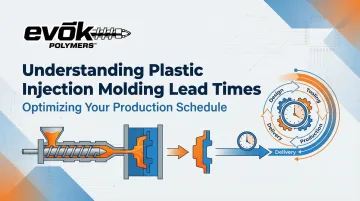
Lead time in injection molding refers to the complete duration from initial project inquiry through delivery of first production-ready parts. This includes tooling development, sampling iterations, validation protocols, and production setup—not just the time to manufacture parts once the mold is ready.
A typical end-to-end timeline includes several distinct phases:
- RFQ and design review: 1-2 weeks for DFM analysis and specification finalization
- Material procurement: 1-3 weeks depending on steel grade and component availability
- Machining and assembly: 4-12+ weeks (the longest segment)
- Sampling and qualification: 2-6 weeks
- Production ramp-up: 2-4 weeks
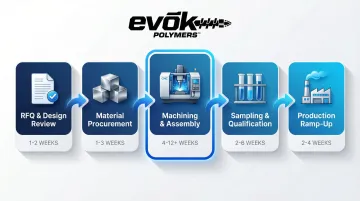
Standard custom injection molding projects typically span 8 to 20 weeks depending on complexity and sourcing location.
Simple single-cavity prototype molds can be ready in 3-4 weeks, while complex multi-cavity production molds with intricate features often require 12+ weeks of machining time alone.
Two terms often get mixed up: "tooling lead time" and "production cycle time." Tooling lead time measures weeks or months required to design and build the mold itself. Production cycle time, by contrast, measures seconds to minutes per part during actual manufacturing once the mold is operational.
Industry data reveals that design iterations occurring during the build phase can add 2 to 6 weeks to timelines due to scrapping and re-cutting steel. This represents one of the most common causes of delays, making design freeze discipline essential for schedule control.
Tooling Lead Times: From Prototype to Production Molds
Prototype Molds (Rapid Tooling)
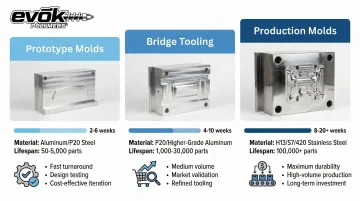
Prototype molds typically deliver first samples in 2-6 weeks from design approval. These tools are specifically designed for design validation, functional testing, and low-volume sampling, typically producing 50 to 5,000 parts before requiring replacement.
Rapid tooling uses aluminum (such as 7075 grade) or softer steels like P20 that machine faster than hardened production steels. Aluminum tooling can reduce lead times by 20-40% compared to steel alternatives, making it ideal for urgent prototype requirements.
Prototype molds carry important limitations. Their shorter lifespan makes them unsuitable for production volumes, and they may not support all production-grade materials or maintain the tight tolerances required for final parts.
These tools serve a specific purpose: validating design concepts before committing to expensive production tooling.
Bridge Tooling (Low-Volume Production)
Bridge tooling occupies the middle ground, requiring 4-10 weeks for completion. These "soft" tools can produce thousands to tens of thousands of parts—enough for market testing, regulatory submissions, or initial production while production tooling is being manufactured.
Bridge tooling makes strategic sense when:
- Market validation requires actual production parts before full tooling investment
- Regulatory submissions need manufactured samples for approval processes
- Production tooling timelines would miss critical market windows
- Initial sales must begin while the manufacturer builds final production molds
The trade-off focuses on durability versus speed. Bridge tools use higher-grade aluminum or P20 steel capable of producing 1,000 to 30,000 parts before wearing out. For products with uncertain demand or evolving designs, waiting for production tooling often proves more cost-effective than building bridge tools that may become obsolete.
Production Molds (High-Volume Manufacturing)
Production molds represent the most significant investment, requiring 8-20+ weeks depending on complexity and validation requirements. These extended timelines reflect the precision engineering required for long-term manufacturing success.
Production-grade tooling uses hardened tool steels such as H13, S7, or 420 stainless steel. These materials require heat treatment and precision finishing that extend build times but deliver molds capable of hundreds of thousands to millions of cycles. The additional time investment pays dividends through consistent part quality and minimal maintenance over the tool's lifespan.
Complex cooling system design adds time but dramatically improves production efficiency. Since cooling time accounts for 80% of the total cycle, sophisticated cooling channel layouts built into production molds reduce per-part costs throughout the product lifecycle.
For regulated industries, validation requirements add significant time. Medical device manufacturers must complete IQ/OQ/PQ (Installation/Operational/Performance Qualification) protocols.
Material certifications, dimensional stability studies, and process validation documentation can extend timelines by several weeks but are non-negotiable for FDA-regulated components.
Key Factors That Impact Lead Times
Part Design Complexity
Complex part features directly extend tooling timelines. Undercuts requiring side actions add approximately 1-2 weeks per action to the build schedule. Internal threads, tight tolerances (±0.001"), and intricate geometries require slower machining speeds and more frequent quality checks, adding 1-2 weeks to the build.
Design for Manufacturability (DFM) analysis conducted before tooling release can save 2-3 weeks of engineering time by identifying issues when they're cheapest to fix. A part requiring slides and lifters for undercut features may take 10-12 weeks to tool, while a simple two-plate mold with no side actions might be completed in 6-8 weeks.
These design complexities directly influence the mold specifications needed to produce your parts.
Mold Specifications and Requirements
Cavity count significantly impacts timelines, though not linearly. Doubling the number of cavities from 2 to 4 typically increases tooling time by 30-40%, not 100%.
The additional complexity comes from balancing fill patterns, synchronizing ejection systems, and ensuring consistent cooling across all cavities.
Surface finish requirements add measurable time. High-polish finishes or intricate texturing require additional EDM (Electrical Discharge Machining) and manual polishing. Textured surfaces can add 3-7 days per surface to the schedule, while mirror-finish requirements may add even more.
Hot runner systems improve production efficiency but increase tooling complexity. Standard hot runner components may be available quickly, but custom manifolds often require 2-4 weeks for procurement and integration.
The investment typically pays off in reduced cycle times and material waste for high-volume production.
Supplier Capacity and Supply Chain Factors
Mold maker workload directly affects delivery schedules. Even capable suppliers can't compress timelines beyond physical machining limitations.
Standard tool steels like P20 or H13 usually arrive within 7-10 days, but specialty alloys or custom components can take 1-3 weeks.
Geographic sourcing strategy plays a major role in total lead time. Domestic (US/EU) tooling typically delivers in 8-12 weeks compared to 12-20 weeks for offshore projects. The differential is largely driven by shipping logistics adding 3-5 weeks for ocean freight, plus communication lags that can delay decision-making.
While offshore tooling often offers lower upfront costs, the extended timeline and potential communication challenges make domestic sourcing strategic for time-critical product launches.
Beyond sourcing and logistics, certain industries face additional timeline requirements that must be accounted for upfront.
Regulatory and Validation Requirements
Regulated industries face additional validation time that must be built into project schedules. Medical device components require material certifications, dimensional reports, and process validation documentation. FDA-regulated products need comprehensive IQ/OQ/PQ protocols that can add 4-8 weeks to timelines.
Automotive and aerospace sectors have similar requirements. First Article Inspection (FAI) reports, material traceability documentation, and process capability studies (Cpk analysis) extend validation phases but are non-negotiable for these industries.
Planning these requirements upfront prevents them from becoming critical path delays. Building validation time into initial project schedules—rather than treating it as an afterthought—keeps launches on track.
Customer Readiness and Communication
Design finalization delays represent one of the most controllable timeline factors. Late changes to specifications, incomplete CAD files, or unclear requirements prevent tooling from starting on schedule. Each day of design delay translates directly to delayed delivery.
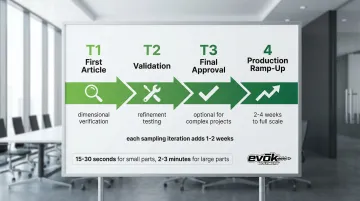
Timely feedback during sampling phases proves equally critical. Each sampling iteration (T1, T2, T3) typically requires 1-2 weeks for shipping, evaluation, and feedback. Establishing a 48-hour approval protocol for sample reviews can save 1-2 weeks over the course of a project.
Clear communication and quick decision-making directly affect project flow. Programs with engaged stakeholders who respond promptly to design questions and approve samples quickly consistently finish faster than projects with delayed feedback loops.
Production Lead Times: From First Shot to Full-Scale Manufacturing
The sampling and approval process follows a structured sequence:
- T1 (first article inspection) produces initial samples for dimensional verification and functional testing
- T2 samples validate that adjustments made after T1 achieved desired results
- T3 iterations may be needed for complex projects, though effective DFM analysis upfront typically limits sampling to two rounds
T1 parts often show where refinements can improve results—gate sizing adjustments, vent modifications, or wall thickness changes to minimize sink marks. Each iteration adds time, making first-time success valuable.
Once samples are approved, production ramp-up to consistent full-scale manufacturing typically requires 2-4 weeks. This phase involves scheduling machine capacity, ordering raw materials in production quantities, and stabilizing process parameters for consistent output.
Within each production run, individual part cycle times vary significantly based on part characteristics. Small components with thin walls may cycle in 15-30 seconds. Larger parts with thick sections requiring extended cooling can take 2-3 minutes per cycle.
Part thickness drives cooling requirements, which account for 80% of total cycle time.
Material selection affects cycle times as well. Engineering resins like PEEK or Ultem require specialized mold temperatures and longer cycles compared to commodity resins like polypropylene or ABS. Efficient cooling channel design in the mold becomes critical to minimizing this phase and maximizing throughput.
How to Optimize Your Project Timeline
Design & Preparation Phase
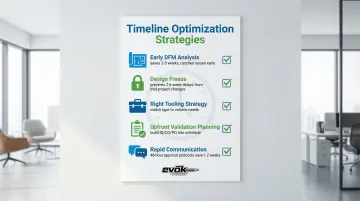
Implement Early DFM Analysis
Running Design for Manufacturability reviews before the quoting phase can save 2-3 weeks by identifying and resolving issues like undercuts or insufficient draft angles early.
Digital DFM platforms provide instant feedback on geometry and tolerances, reducing dependency on physical prototypes and catching errors when they're cheapest to fix.
Enforce a Strict Design Freeze
Freezing the design before tooling release is essential. Changes during the build phase can add 2-6 weeks as manufacturers must scrap completed steel and re-cut it.
Aligning all stakeholders on final specifications before cutting steel prevents these costly delays.
Tooling & Manufacturing Decisions
Choose the Right Tooling Strategy
Match tooling type to your volume and timeline requirements:
- Prototype tooling (2-6 weeks): Design validation, fewer than 5,000 parts
- Bridge tooling (4-10 weeks): Market testing, 1,000-30,000 parts, or production while final tooling builds
- Production tooling (8-20+ weeks): High-volume manufacturing, 100,000+ parts
For urgent projects, consider parallel processing—building a single-cavity bridge tool for initial parts while the multi-cavity production mold is being manufactured.
Plan for Validation Requirements Upfront
Regulated industries must build validation time into project schedules from the start. IQ/OQ/PQ processes, material certifications, and dimensional stability studies aren't optional.
Building these requirements into schedules prevents them from becoming critical path crises.
Maintain Clear Communication and Quick Decision-Making
Delayed customer feedback extends project timelines directly. Setting up rapid approval processes—such as 48-hour turnaround on sample reviews—can save 1-2 weeks over a project lifecycle.
Engaged stakeholders who respond promptly to design questions keep projects moving efficiently.
Choosing the Right Partner to Meet Your Timeline
When evaluating injection molding partners, prioritize these timeline-critical factors:
- Demonstrated expertise in your industry
- Transparent communication about realistic timelines
- Production capacity to handle your project without delays
- DFM expertise that prevents timeline issues before they occur
EVOK's 25 years of injection molding experience enables the team to identify potential timeline risks during the quoting phase rather than during production. Their structured design review process, using advanced mold flow analysis, catches manufacturing challenges early when they're least expensive to address.
This proactive approach extends throughout the entire project lifecycle. Partners who provide clear visibility into the mold building process—including where projects stand when delays or engineering changes are required—enable better planning and faster issue resolution.
EVOK gives customers instant access to timeline-rich data through their Polyestimator tool, providing control over project variables from the start.
This transparency, combined with their focus on production tooling designed for long-term manufacturing success, helps ensure realistic timeline expectations and successful market delivery.
Frequently Asked Questions
What is the lead time for injection molding?
Total project timelines typically span 3-6 months from initial inquiry to consistent production. Tooling requires 2-20+ weeks depending on mold type, sampling adds 2-6 weeks, and production ramp-up takes 2-4 weeks to stabilize processes.
How long does it take to make an injection mold?
Prototype molds require 2-6 weeks, bridge tooling takes 4-10 weeks, and production molds need 8-20+ weeks. Simple single-cavity molds may be completed in 3-4 weeks, while complex multi-cavity tools often require 12+ weeks depending on part complexity and surface finish requirements.
What is the cycle time in plastic injection molding?
Cycle time measures seconds to minutes per part during production, distinct from lead time (weeks/months for tooling). Small parts cycle in 15-30 seconds, while larger components with thick sections can take 2-3 minutes. Cooling accounts for approximately 80% of total cycle duration.
What factors can delay injection molding lead times?
Design changes mid-project add 2-6 weeks as steel may need scrapping and re-cutting. Delayed customer feedback during sampling adds 1-2 weeks per iteration. Offshore sourcing adds 3-5 weeks for shipping, while supplier capacity constraints and complex features like undercuts can extend timelines further.
How can I reduce my injection molding project timeline?
Finalize design specifications before tooling kickoff to avoid mid-project changes. Conduct DFM analysis upfront to save 2-3 weeks by catching issues early. Maintain rapid approval protocols for sample reviews and work with experienced partners who provide transparent timeline communication.
What's the difference between tooling lead time and production lead time?
Tooling lead time measures the weeks to months required to design, machine, and validate the mold itself. Production lead time measures the time to manufacture parts once the mold is operational, which depends on order volume and cycle time.