Are you losing time and budget on prototype iterations that never translate into production-ready parts?
Product development remains a high-risk investment. Research shows that for every successful product, companies experience an average of twelve failures, and Fortune 1000 firms collectively waste more than $60 billion annually on ineffective research and development.
Much of this loss stems from late-stage design changes, material mismatches, and inadequate validation before production.
Industrial prototyping exists to reduce that risk. When engineers apply the right tools and techniques early, they validate form, fit, and function before committing to expensive tooling. The real challenge is selecting the correct method for precision, speed, and scalability.
In this guide, you will learn what industrial prototyping is, how additive and subtractive methods compare, the 5 most effective tools used in modern manufacturing, and how to choose the right approach for your next project.
Key Takeaways
Rapid tooling bridges development and manufacturing. It allows mold and cycle testing before full capital investment.
Material alignment determines real-world performance. Prototypes must reflect end-use conditions to deliver reliable validation results.
Additive and subtractive methods serve different goals. 3D printing accelerates iteration, while CNC ensures production-grade precision.
Digital simulation strengthens engineering decisions. CAD and FEA tools uncover structural and thermal risks before physical builds.
Early validation prevents expensive late-stage failures. Industrial prototyping reduces the risk of tooling rework and production delays.
What Is Industrial Prototyping and Why Does It Matter?
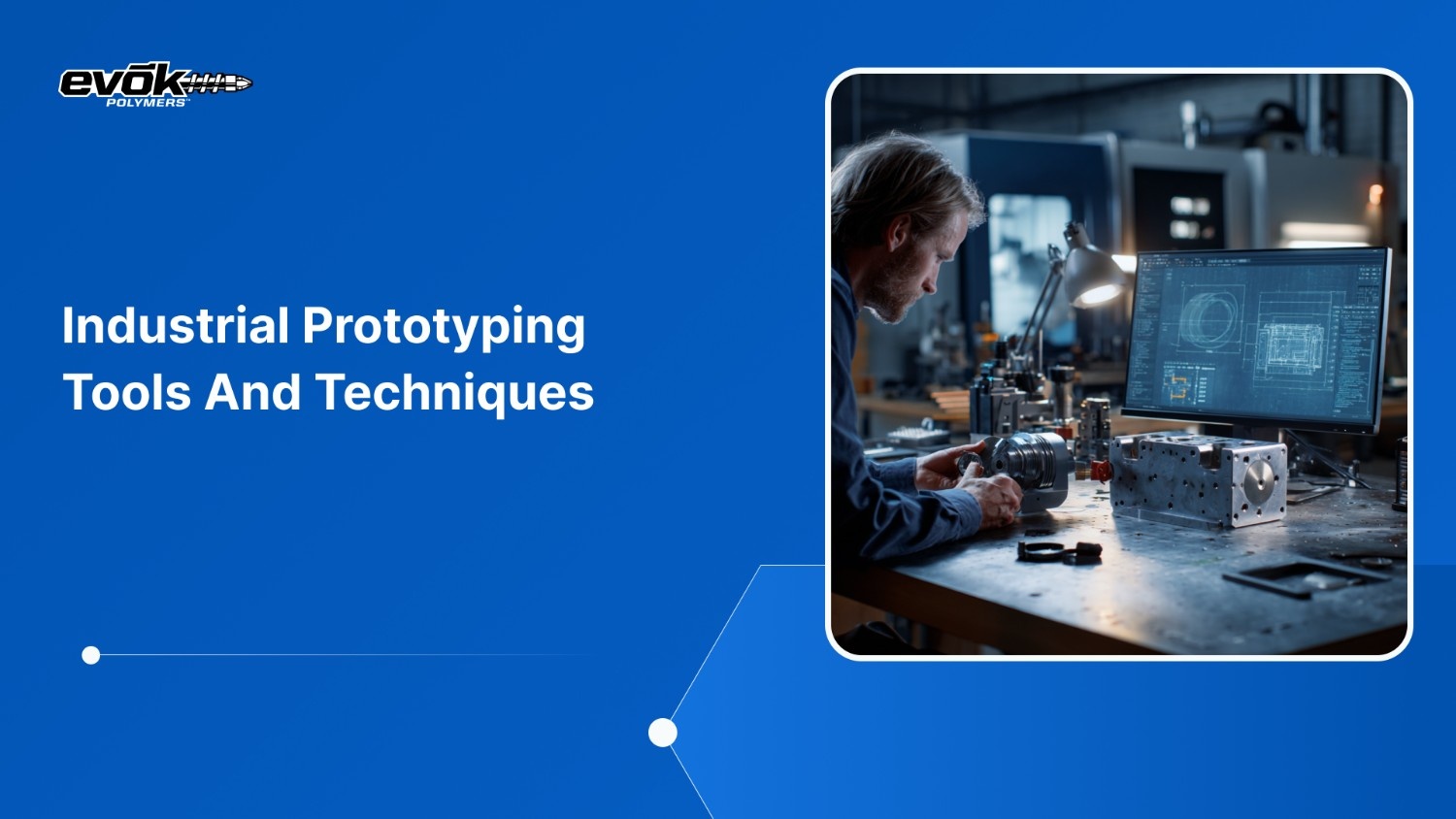
Industrial prototyping is the process of creating functional or visual pre-production models to validate engineering design before mass manufacturing. It bridges concept development and full-scale production by allowing engineers to test assumptions under controlled conditions.
Done correctly, it helps you:
Reduce downstream production risks.
Improve time-to-market predictability.
Identify design flaws before tooling investment.
Validate mechanical performance and material behavior.
Verify assembly fit and tolerance stack-ups across components.
Optimize part geometry for manufacturability and cycle time efficiency.
Evaluate regulatory or compliance requirements before production tooling.
Without structured industrial prototyping, teams often find tolerance conflicts, material failures, or tooling constraints after capital investment. Early validation reduces uncertainty and supports data-driven engineering decisions.
Before committing to physical prototypes, however, most engineering teams begin with digital validation tools that simulate real-world performance.
Digital and Virtual Prototyping in Modern Engineering
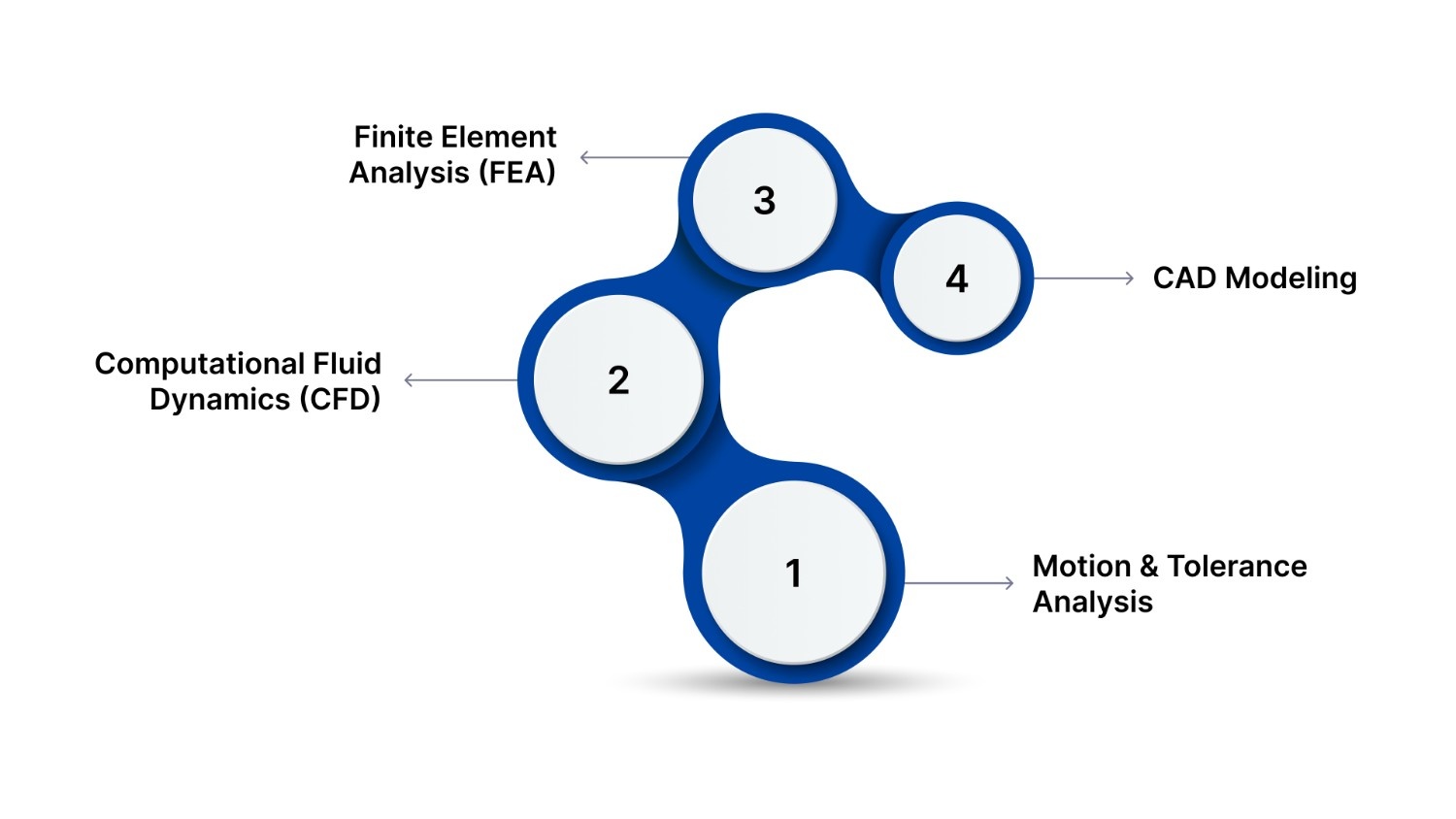
Digital prototyping allows engineers to simulate performance before cutting material. It reduces material waste and accelerates early decision-making.
Key tools include:
Motion & Tolerance Analysis: Detects interference and assembly misalignment early.
Computational Fluid Dynamics (CFD): Evaluates thermal flow and fluid behavior in complex systems.
Finite Element Analysis (FEA): Simulates stress, strain, and load distribution under real-world conditions.
CAD Modeling: Parametric design enables rapid geometry changes without rebuilding entire assemblies.
Digital validation strengthens industrial prototyping by identifying performance risks before physical resources are committed.
However, digital tools alone are not enough. Physical validation still plays a critical role.
Additive vs. Subtractive Prototyping Methods
Engineers frequently compare additive manufacturing and subtractive machining to determine which method best fits project requirements.
Each approach offers distinct advantages.
Factor | Additive Manufacturing (3D Printing) | Subtractive Manufacturing (CNC Machining) |
Material Waste | Minimal material waste | Higher waste due to material removal |
Speed for Complex Geometry | Excellent for intricate shapes | Slower for complex internal features |
Tolerance Precision | Moderate (varies by process) | High precision and tight tolerances |
Surface Finish | May require post-processing | Superior finish directly from machining |
Production Material Matching | Limited material range | Uses production-grade materials |
Cost at Low Volume | Cost-effective | Higher setup costs |
Mechanical Strength | Layer-dependent strength | Uniform material properties |
Additive methods support fast design iteration, while subtractive methods offer production-grade accuracy.
5 Best Industrial Prototyping Tools and Techniques
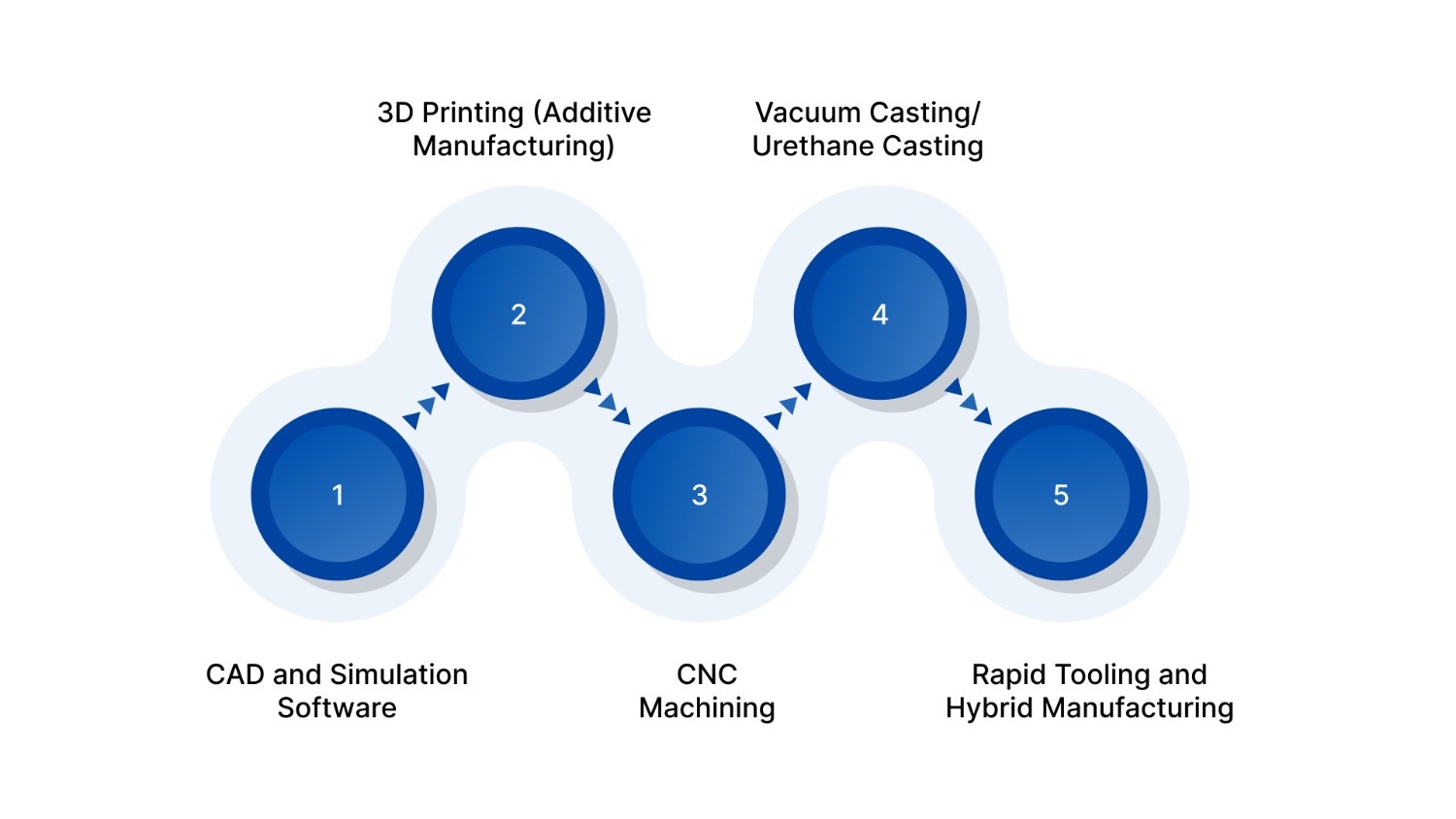
Selecting the right industrial prototyping tool depends on function, material, tolerance, and scalability.
Below are the 5 most effective techniques used in U.S. manufacturing environments.
1. CAD and Simulation Software
It forms the digital backbone of industrial prototyping workflows.
Detects interference and tolerance stack-up issues early.
Allows rapid parametric modifications without redesigning assemblies.
Simulates structural loads and environmental stress before fabrication.
Reduces physical prototype iterations by validating performance digitally first.
Performs thermal, vibration, and fatigue analysis under simulated operating conditions.
2. 3D Printing (Additive Manufacturing)
Ideal for early-stage concept validation.
Allows iterative testing before committing to hard tooling.
Produces fast visual and functional prototypes with minimal setup.
Supports FDM, SLA, and SLS for varying material and resolution needs.
Reduces lead time for design verification during early development stages.
Creates complex internal geometries that traditional machining cannot achieve.
3. CNC Machining
Often used before final production tooling approval.
Delivers superior surface finish for functional testing.
Validates mechanical strength and dimensional stability.
Produces tight tolerances using production-grade metals and plastics.
Allows accurate testing of threaded features, press fits, and mating surfaces.
Provides consistent material properties identical to end-use production parts.
4. Vacuum Casting/Urethane Casting
Useful for low-volume validation.
Provides production-like surface finishes.
Supports small-batch runs for testing and market sampling.
Uses silicone molds to replicate master patterns accurately.
Produces multiple functional parts quickly without full steel tooling investment.
Allows evaluation of color matching and cosmetic features before mass production.
5. Rapid Tooling and Hybrid Manufacturing
This approach links industrial prototyping directly to manufacturing readiness.
Supports bridge production before full tooling investment.
Creates prototype tooling faster than conventional methods.
Combines additive inserts with CNC-machined components.
Allows mold flow and cycle time validation under near-production conditions.
Reduces financial risk by testing tooling performance prior to hardened steel molds.
How to Choose the Right Industrial Prototyping Technique?
Selecting the correct method depends on project constraints and technical requirements.
Consider the following:
Timeline: 3D printing offers faster iteration cycles.
Scalability Goals: Rapid tooling supports transition to production.
Material Requirements: CNC machining matches final production materials.
Mechanical Testing Needs: Subtractive methods provide consistent strength.
Budget: Additive methods reduce upfront costs; CNC supports precision validation.
Strategic selection ensures industrial prototyping supports long-term manufacturing success.
Beyond selection, workflow discipline ensures repeatability and reliability.
Best Practices for Industrial Prototyping Workflows
Structured workflows improve predictability and reduce rework.
Align design and manufacturing teams early.
Document testing criteria and validation metrics.
Plan multiple iteration cycles instead of single builds.
Integrate DFM reviews before final prototype sign-off.
Track dimensional and performance data systematically.
These best practices ensure industrial prototyping contributes measurable value rather than isolated experiments.
How Evok Polymers Supports Industrial Prototyping?
Successful industrial prototyping requires engineering discipline and production foresight. At Evok Polymers, we help companies move from early concept validation to manufacturing readiness with structured processes and measurable outcomes.
We provide:
Engineering-Driven DFM Reviews: Analyze part geometry, wall thickness, draft angles, and gating strategies early to eliminate manufacturability risks, reduce tooling revisions, and ensure prototypes transition smoothly into scalable production environments.
Optimize Material Selection: Evaluate mechanical, thermal, and chemical performance requirements to match resins with end-use demands, ensuring prototypes accurately reflect real-world operating conditions and regulatory compliance expectations.
Deliver Precision Machining and Validation: Produce tight-tolerance prototype components using production-grade materials, enabling accurate functional testing, assembly verification, and mechanical performance validation before full tooling investment.
Implement Rapid Tooling Strategies: Develop bridge tooling and hybrid mold solutions to validate mold flow, cycle time, and part quality under near-production conditions while minimizing upfront capital risk.
Manage Prototype-to-Production Transition: Oversee qualification, process parameter optimization, and first article validation to ensure repeatability, dimensional consistency, and confident production launch readiness.
By aligning design intent with manufacturing execution, Evok Polymers reduces risk and accelerates product development timelines.
Conclusion
Industrial prototyping reduces risk, improves validation accuracy, and shortens time-to-market when executed strategically. By combining digital simulation, additive manufacturing, CNC precision, and rapid tooling, engineering teams can validate performance before major capital investments.
Are prototype delays, tolerance issues, or material mismatches slowing your development cycle? Evok Polymers helps engineering teams move from concept validation to production readiness with confidence. Our structured prototyping and DFM approach ensures technical accuracy and scalable outcomes.
Request a quote today to evaluate the right industrial prototyping strategy for your next project and accelerate your path to production.
Frequently Asked Questions
1. What is industrial prototyping?
Industrial prototyping is the process of creating pre-production models to test design, functionality, and manufacturability before full-scale manufacturing. It allows engineers to validate performance, materials, and assembly fit while reducing the risk of costly tooling changes and production delays later in development.
2. What are the main types of industrial prototyping?
The main types include digital prototyping (CAD and simulation), additive manufacturing (3D printing), CNC machining, vacuum or urethane casting, and rapid tooling. Each method serves different needs depending on material requirements, tolerance precision, mechanical testing, and production scalability goals.
3. When should a company use CNC machining instead of 3D printing?
CNC machining is preferred when tight tolerances, superior surface finish, and production-grade material properties are required. It provides consistent mechanical strength and accurate dimensional performance, making it ideal for functional testing and validation before committing to injection molding or full production tooling.
4. How does industrial prototyping reduce production costs?
Industrial prototyping identifies design flaws, tolerance issues, and material weaknesses before investing in hard tooling. Early validation prevents expensive rework, tooling modifications, and production downtime. By resolving engineering challenges upfront, companies improve predictability and protect long-term manufacturing budgets.
5. What is rapid tooling in industrial prototyping?
Rapid tooling involves creating prototype molds or bridge tooling using accelerated manufacturing methods. It allows engineers to test mold flow, cycle time, and part quality before investing in hardened steel production molds, reducing financial risk while improving production readiness.