Introduction
Material selection is one of the most critical decisions in injection molding, directly affecting part performance, cost, manufacturability, and product success.
The stakes are high: research shows that 30-40% of FDA medical device recalls are attributed to material issues, often resulting from engineers relying on idealized datasheet values rather than real-world application testing.
Wrong material choices lead to part failures, costly redesigns, production delays, and missed market opportunities.
A 2017 NHTSA recall involving 12,584 RV power tongue jacks with a 40% defect rate traced back to improper plastic selection—the laminated touchpad cracked, allowing water intrusion that caused complete system failure.
This guide walks through material properties, common plastic families, and a practical decision framework to select the right material for your application.
Key Takeaways
- Match materials to your application's mechanical needs (strength, flexibility, impact resistance), operating environment (temperature, chemicals, UV), and budget
- Choose from commodity (PP, PE, ABS), engineering (PC, Nylon, POM), or high-performance plastics (PEEK, PEI) based on performance demands
- Evaluate tensile strength, temperature limits (HDT/Vicat), chemical resistance, certifications (FDA, UL 94), and total cost including tooling
- Fillers like glass fiber can triple tensile strength while additives (flame retardants, UV stabilizers) customize properties for specific needs
- Work with injection molding specialists like Evok Polymers to align material selection with part design and production efficiency
What is Plastic Material Selection for Injection Molding?
Plastic material selection is choosing the optimal thermoplastic resin that meets the functional, environmental, regulatory, and economic requirements of an injection molded part. It requires balancing performance, manufacturability, cost, and volume requirements.
Material selection doesn't happen in isolation. It's interconnected with part design, tooling strategy, and manufacturing parameters.
Key trade-offs include:
- Mechanical performance vs. cycle time and tooling costs
- Cost-effective materials vs. design modifications for performance
- Processing ease vs. tight tolerance requirements
- Material availability vs. lead time constraints
These interdependencies make early collaboration with your injection molding partner critical. At Evok Polymers, we integrate material selection with design optimization from day one, ensuring your material choice supports both part performance and manufacturing efficiency.
Key Material Properties to Consider
Understanding fundamental material properties allows you to match technical specifications to real-world application demands and narrow down suitable material candidates. Each property addresses specific performance requirements, and the right material balances all relevant characteristics for your application.
Mechanical Properties: Strength, Stiffness, and Toughness
Tensile strength measures resistance to being pulled apart, which is critical for parts under tension or load. Flexural modulus indicates stiffness or resistance to bending, determining if a part maintains its shape under load. Impact resistance measures the ability to absorb sudden force without breaking, essential for parts exposed to drops or collisions.
These properties determine if a part can withstand operational loads. Research typical load ranges for your application and compare against material data sheets tested per ASTM D638 for tensile strength and ASTM D256 for impact resistance. Glass-filled nylon, for example, can achieve flexural modulus values of 4,000-10,000 MPa compared to unfilled grades.
Thermal Properties: Temperature Resistance and Stability
Key thermal metrics include:
- Heat Deflection Temperature (HDT) and Vicat softening point: Maximum short-term temperature exposure before deformation under specified loads
- Continuous Use Temperature (CUT) or Relative Thermal Index (RTI): Long-term thermal performance limits without significant degradation over years of service
Thermal expansion and contraction rates affect dimensional stability across temperature changes, critical for precision assemblies or parts exposed to temperature cycling. Materials with high Coefficient of Thermal Expansion (CTE) may require design adjustments like additional clearances or stress-relief features.
Chemical Resistance and Environmental Durability
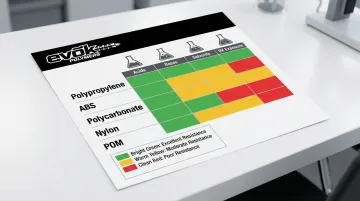
Different plastics resist degradation from chemicals (acids, bases, solvents, oils), UV radiation, moisture absorption, and outdoor weathering to vastly different degrees.
Polypropylene excels in chemical resistance to acids and bases, while ABS degrades rapidly when exposed to UV without stabilizers.
Chemical compatibility testing is essential: a material that excels mechanically may fail rapidly if exposed to incompatible chemicals in your application. Environmental stress cracking, where chemicals accelerate crack formation under stress, is a common failure mode that proper material selection prevents.
Electrical Properties
Dielectric strength and electrical insulation properties are critical for electronic housings, connectors, and components that must prevent current flow or electrical arcing. Materials like polycarbonate and ABS provide excellent insulation for consumer electronics, while specialized grades offer enhanced performance.
Beyond basic insulation, some applications require:
- Static dissipation: ESD-safe materials for electronics manufacturing
- EMI shielding: Conductive additives like carbon fiber for electromagnetic interference protection
These specialized requirements significantly influence material choice and cost.
Regulatory Compliance: FDA, UL, RoHS
Industry-specific regulations drive material selection:
- FDA compliance: Medical devices and food-contact parts must meet 21 CFR Part 177 standards
- UL 94 flammability ratings: Electrical components require HB, V-2, V-1, V-0, or 5VA/5VB classifications
- RoHS compliance: Restricts hazardous substances like lead, mercury, and cadmium across many industries
Compliance certifications are material-grade specific, not just material-family specific. A standard polycarbonate may not meet FDA requirements, but FDA-compliant PC grades are available.
Always verify the exact resin grade meets your regulatory requirements through supplier documentation and UL Yellow Cards.
Common Plastic Materials for Injection Molding
Thousands of plastic resins exist, but they fall into three main categories based on performance level and cost: commodity plastics for high-volume cost-sensitive applications, engineering plastics for enhanced performance, and high-performance specialty plastics for extreme environments.
Commodity Plastics: Cost-Effective for High-Volume Production
The commodity family (PP, PE, PS, ABS) represents the most widely used and economical materials, suitable for applications without extreme mechanical, thermal, or chemical demands. Polyethylene held the largest market revenue share at over 24% in 2025, reflecting its dominance in packaging and consumer products.
Polypropylene (PP) offers excellent chemical resistance to acids and bases, good fatigue resistance for living hinges, and low cost. Key properties include:
- Tensile strength: 28-38 MPa
- Heat deflection temperature (HDT): 67-110°C
- Applications: containers, closures, automotive interior components, medical syringes
- Limitation: Lower strength and temperature resistance than engineering grades
Acrylonitrile Butadiene Styrene (ABS) delivers a good balance of toughness, rigidity, and ease of processing with excellent surface finish. Its properties make it ideal for visible parts:
- Density: 1.04-1.06 g/cm³
- Shrinkage: 0.4-0.7% (excellent dimensional stability)
- Applications: consumer electronics housings, automotive trim, appliance components, toys
- Limitation: Lacks strong chemical and UV resistance without additives
Polyethylene (PE) comes in LDPE (flexible, low-density) and HDPE (tough, chemical-resistant) variants. HDPE floats in water (density <1.0 g/cm³) and offers high shrinkage characteristics. Applications include packaging films, containers, and pipes across diverse industries.

Engineering Plastics: Enhanced Performance for Demanding Applications
Engineering plastics (PC, Nylon/PA, POM, PBT) offer superior mechanical strength, temperature resistance, and dimensional stability compared to commodities—at moderate cost premium. They enable applications where commodity plastics would fail.
Polycarbonate (PC) provides exceptional impact resistance (Izod Impact ~70 kJ/m²), high clarity, and good heat resistance (HDT ~135°C). With tensile strength of ~65 MPa, FDA-compliant grades are available for medical devices.
Common applications include safety lenses, medical device housings, lighting components, and electronic enclosures. However, PC is susceptible to stress cracking from certain chemicals.
Nylon/Polyamide (PA) delivers high strength especially when glass-filled, excellent wear resistance, and good chemical resistance to oils and fuels. PA66 unfilled offers tensile strength of ~82 MPa, while glass-filled PA achieves 100-250 MPa.
A key limitation is moisture absorption—PA absorbs water from air, which lowers stiffness and alters dimensions. Applications include gears, bearings, structural components, and under-hood automotive parts.
Polyoxymethylene/Acetal (POM) excels in dimensional stability, low friction, high stiffness, and creep resistance, making it ideal for precision mechanical parts. It handles tonnage of 3.0-4.0 per in² with shrink values of 0.004-0.007 inches. Applications include gears, bearings, fasteners, and components replacing metal in mechanical assemblies.
High-Performance Specialty Plastics: Extreme Environment Solutions
When engineering plastics aren't enough, specialty materials step in. These resins (PEEK, PEI/Ultem, PPSU) offer exceptional temperature resistance (often 300°F+), superior chemical resistance, flame retardancy, and mechanical properties—at significantly higher cost. PEEK is typically 5-10 times more expensive than PEI.
High-performance materials are justified when facing extreme temperatures, aggressive chemical exposure, flame retardancy requirements, biocompatibility for implantable medical devices, or applications where material failure has safety implications.
PEEK (Polyetheretherketone) provides exceptional thermal stability with continuous use temperature of ~250°C, chemical inertness, and inherent flame retardancy (UL 94 V-0). It retains mechanical properties at elevated temperatures better than most thermoplastics. Applications include aerospace brackets, spinal implants (biocompatible grades), and downhole oil & gas connectors.
PEI (Ultem) is an amorphous resin with high heat resistance (HDT ~200°C, Tg 217°C) and excellent dimensional stability. It offers broad chemical resistance and hydrolytic stability at moderate cost compared to PEEK. Applications include medical sterilization trays, electrical connectors, and aircraft interiors.
PPSU (Polyphenylsulfone) delivers superior impact strength and hydrolytic stability, withstanding virtually unlimited steam sterilization cycles without degrading. With HDT of 207°C, it's used in surgical instrument handles, medical implant trials, and plumbing fittings requiring repeated autoclave exposure.
High-performance materials often require specialized processing and may have longer lead times. Working with an experienced injection molding partner early ensures proper tooling design and processing parameters—critical for achieving the full performance potential of these premium resins.
Critical Factors When Choosing Injection Molding Materials
Optimal material selection requires evaluating your specific application requirements against material capabilities, while considering manufacturing constraints and total cost of ownership. A systematic approach prevents costly mistakes and ensures long-term part performance.
Application Environment: Temperature, Chemicals, and Exposure Conditions
Define worst-case environmental conditions: temperature extremes (both high and low), chemical exposures, UV/outdoor exposure, humidity, and mechanical stress conditions. Materials must handle the harshest expected conditions, not just typical use.
Document the full range of environmental conditions the part will experience over its lifecycle. Key questions to answer:
- Will it face temperature cycling or continuous high heat?
- What chemical exposures will occur during use?
- Will UV degradation outdoors affect performance?
- What humidity levels will the part encounter?
Each environmental factor narrows material candidates. A part performing well at room temperature may fail completely at 80°C if the wrong material is selected.
Mechanical Requirements: Load Types and Stress Analysis
Different load types require different material properties:
- Static loads (constant force) require adequate tensile strength
- Dynamic/cyclic loads (repeated stress) demand fatigue resistance
- Impact loads (sudden force) need high impact strength
- Creep (deformation under constant load over time) requires high creep resistance
Understanding load magnitude, frequency, and duration helps determine required material properties. Calculate actual stress levels and compare to material allowables with appropriate safety factors. Don't rely solely on room-temperature datasheet values—use application-specific testing when loads or temperatures deviate from standard test conditions.
Part Geometry and Design Considerations
Part geometry influences material selection significantly:
- Thin walls require materials with good flow characteristics and low viscosity
- Thick sections need materials resistant to sink marks and voids
- Complex geometries benefit from materials with lower shrinkage rates
Material selection and part design are interdependent. Switching from unfilled nylon to glass-filled nylon can eliminate deflection issues without redesigning the part.
Conversely, material limitations may require design modifications like adding ribs for stiffness or adjusting wall thickness for manufacturability.
Manufacturing Considerations: Cycle Time, Tooling, and Processability
Material properties affect manufacturing efficiency directly. Faster-flowing materials reduce cycle times and per-part costs. Materials with lower shrinkage rates improve dimensional accuracy and reduce warpage. Some materials are highly abrasive (glass-filled resins), requiring hardened tool steel and increasing tooling costs.
Coated molds have shown wear resistance improvements of 25x to 58x over uncoated steel in glass-filled applications. Factor these tooling considerations into material selection decisions, as they impact both initial investment and long-term tool maintenance costs.
Total Cost Analysis: Material, Processing, and Lifecycle Costs
Material selection should reduce total cost of ownership, not just material price per pound. Consider:
- Material cost per pound
- Manufacturing efficiency (cycle time impacts per-part cost)
- Tooling costs and tool life
- Scrap rates and rework
- Potential warranty or field failure costs
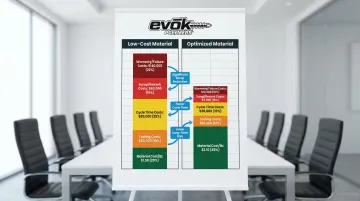
Calculate cost scenarios comparing candidate materials across these factors. Sometimes a more expensive material reduces total cost through faster cycles, longer tool life, or eliminating costly field failures and recalls.
How Evok Polymers Can Help With Material Selection
Evok Polymers brings 25 years of injection molding expertise to help clients navigate material selection, ensuring the right choices that balance performance, manufacturability, and cost. We understand that material selection is one of the most challenging decisions in part development, and we guide you through every consideration.
We integrate material selection with design optimization—we evaluate how material properties interact with part geometry, tooling strategy, and production requirements to deliver the best total solution. This approach prevents isolated material decisions that often create manufacturing problems or performance failures downstream.
Our Material Expertise
Evok's comprehensive knowledge spans commodity, engineering, and specialty plastics:
- Deep processing experience with 19 different plastic materials and detailed parameters
- Material additives and fillers expertise to customize properties
- Established supplier relationships to source the right resins
- Guidance on virgin, reprocessed, and recycled material tradeoffs based on your cost and quality requirements
Our collaborative process includes:
- Early-stage design reviews to identify material requirements based on your application environment
- Material recommendations with technical justification for each resin choice
- Rapid prototyping ($100-$500 per prototype) to validate materials before production tooling
- T1 trial testing to evaluate materials and additives with actual tooling
- Ongoing optimization to reduce costs while maintaining performance as volumes scale
We provide transparent cost analysis through our proprietary Polyestimator tool, showing how material choices impact tooling design, cycle time, and per-part costs. This financial clarity helps you make informed decisions aligned with your business objectives.
You get the performance you need at a price that supports your market competitiveness.
Conclusion
Material selection directly impacts product performance, manufacturing costs, and market success. Poor choices lead to severe consequences—FDA recalls, field failures, and costly redesigns—making systematic evaluation essential.
The goal is finding the optimal material for your specific application, not the "best" material in absolute terms.
The right choice balances:
- Mechanical performance and environmental resistance
- Regulatory compliance requirements
- Manufacturability and tooling considerations
- Total lifecycle costs
Material selection isn't a one-time decision. As your products evolve or production volumes scale, periodic review with an experienced partner like Evok Polymers can identify ways to reduce costs, improve performance, or enable design possibilities you hadn't considered.
Ready to select the right material for your application? Connect with our team to discuss your requirements and explore material options tailored to your specific needs.
Frequently Asked Questions
What plastic materials are used in injection molding?
Three main categories exist: commodity plastics (PP, PE, PS, ABS) for cost-sensitive applications, engineering plastics (PC, Nylon, POM, PBT) for enhanced performance, and specialty plastics (PEEK, PEI, PPSU) for extreme environments. Thousands of grades within these families offer different property combinations.
How do I choose a plastic material for injection molding?
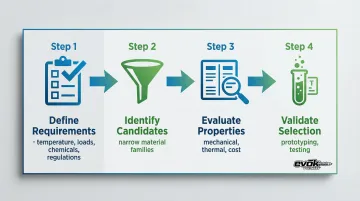
Start by defining your application requirements (mechanical loads, temperature range, chemical exposure, regulatory needs). Then evaluate candidate materials for both performance and manufacturing considerations like cycle time and processability. Validate through prototyping before committing to production tooling.
What is the cheapest plastic material for injection molding?
Polypropylene (PP) and polyethylene (PE) cost least per pound. However, total part cost depends on cycle time and yield—a material with better flow properties may cost more upfront but reduce total cost through faster cycles and higher efficiency.
What is the difference between commodity and engineering plastics?
Commodity plastics (PP, PE, PS, ABS) offer good general-purpose properties at low cost for high-volume applications without extreme demands. Engineering plastics (PC, Nylon, POM) provide superior mechanical strength, temperature resistance, and dimensional stability at moderate cost premium, enabling demanding applications where commodity plastics would fail.
How do fillers and additives affect plastic material properties?
Fillers like glass fiber increase strength and stiffness—often doubling tensile strength—while reducing cost per part. Additives (flame retardants, UV stabilizers, colorants) modify specific properties. However, fillers create tradeoffs including increased brittleness, anisotropic properties, and accelerated tool wear.
Should I select material before or after designing my part?
Material selection and part design should happen concurrently through collaboration with your injection molding partner. Material properties influence design decisions while geometry affects material requirements. With proper tooling design, final material selection can often be completed after the mold is built during T1 trials.