Introduction
Material selection directly impacts your injection molding project's cost, performance, and timeline. Choose wrong, and you'll face costly rework, performance failures, or blown budgets. Choose right, and you'll optimize manufacturing costs while delivering parts that exceed expectations.
ABS and polycarbonate dominate injection molding for good reason—together they power everything from LEGO bricks to bulletproof shields. Yet they couldn't be more different.
ABS delivers cost-effective rigidity with superior surface finish, while polycarbonate offers unmatched impact resistance and heat tolerance.
This guide breaks down the properties, costs, and applications of both materials. You'll get a clear decision framework to choose the right thermoplastic for your project, whether you're designing automotive interiors, safety equipment, or consumer electronics.
Key Takeaways
- ABS costs $2-3/kg versus polycarbonate at $4-5/kg—a 40-60% savings that makes ABS ideal for high-volume consumer products
- With 2-3x higher impact resistance, PC withstands temperatures up to 132°C versus 97°C for ABS—a critical difference for demanding applications
- ABS processes at lower temperatures (200-250°C) with faster cycles and superior surface finish for painted applications
- PC excels when transparency, extreme toughness, or heat resistance are non-negotiable for your application
- PC-ABS blends offer balanced properties at ~30% lower cost than pure polycarbonate
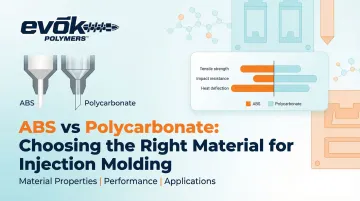
ABS vs Polycarbonate: Quick Comparison
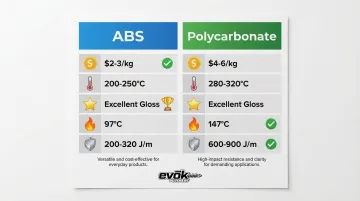
| Property | ABS | Polycarbonate | Winner |
|---|---|---|---|
| Cost ($/kg) | $2.00-$3.00 | $4.00-$5.00 | ABS |
| Tensile Strength | 30-50 MPa | 60-70 MPa | PC |
| Impact Resistance (Izod) | 200-320 J/m | 640-850 J/m | PC |
| Heat Deflection Temp | 97°C | 132°C | PC |
| Processing Temp | 200-250°C | 280-320°C | ABS |
| Shrinkage Rate | 0.4-0.7% | 0.5-0.8% | Comparable |
| Transparency | Opaque | 87-89% transmission | PC |
| Surface Finish | Excellent gloss | Scratch-prone | ABS |
| Cycle Time | Faster cooling | Rapid solidification | Comparable |
What is ABS (Acrylonitrile Butadiene Styrene)?
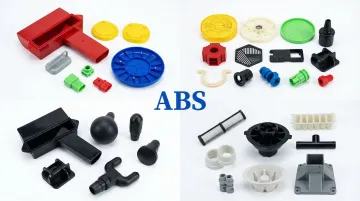
ABS is a terpolymer (three-monomer blend) that combines three monomers into one versatile material. Acrylonitrile provides chemical resistance and hardness. Butadiene delivers impact strength and toughness. Styrene contributes rigidity and that signature glossy finish that makes ABS perfect for consumer products.
Key Processing Advantages:
- Processes at moderate temperatures (200-250°C) with less equipment wear
- Low, predictable shrinkage (0.4-0.7%) ensures tight tolerances
- Excellent flow characteristics fill complex geometries easily
- Superior surface finish accepts paint, chrome plating, and printing exceptionally well
These processing benefits make ABS adaptable across applications. The material naturally comes in opaque ivory or white, though it accepts colorants vividly.
Various grades optimize specific properties—flame retardant versions for electronics, UV-resistant formulations for outdoor use, and high-impact grades for demanding applications.
Limitations to Consider:
- Heat deflection temperature around 97°C limits use to applications below 80°C
- Without UV stabilizers, ABS yellows and becomes brittle under sunlight
- Moderate chemical resistance—avoid prolonged contact with solvents, ketones, and esters
Common Applications of ABS in Injection Molding
ABS dominates high-volume consumer and industrial products where aesthetics meet affordability:
- Automotive interiors: Dashboard components, trim panels, and consoles
- Consumer electronics: Computer housings, keyboard cases, appliance shells
- Toys and recreation: LEGO bricks use ABS for clutch power and durability
- Appliances: Vacuum cleaner housings, kitchen appliance casings, and control panels
ABS excels when surface finish and color consistency are critical. Its ability to accept secondary operations—painting, electroplating, printing—makes it the go-to material when appearance matters as much as function.
What is Polycarbonate (PC)?
Polycarbonate is an engineering thermoplastic polyester known for extreme toughness and glass-like clarity. Its amorphous molecular structure absorbs and distributes energy efficiently, making it virtually unbreakable in standard applications.
Standout Properties:
- Exceptional impact resistance: Izod values of 640-850 J/m make PC 2-3x tougher than ABS
- High heat tolerance: Heat deflection temperature of 132°C allows operation in demanding thermal environments
- Optical clarity: 87-89% light transmission rivals glass at half the weight
- Dimensional stability: Maintains tight tolerances under stress and temperature variation
PC processes at higher temperatures (280-320°C) and demands strict drying protocols—moisture content must stay below 0.02% to prevent hydrolysis and property degradation. According to processing guidelines, PC requires 2-4 hours drying at 120°C before processing.
Challenges:
- PC costs 40-60% more than ABS
- Scratches more easily than glass without protective coatings
- Certain chemicals (particularly alkalines and solvents) can cause stress cracking
- Higher processing temperatures increase energy costs and equipment wear
Despite these limitations, specialty grades address specific application needs. Medical-grade PC meets ISO 10993 biocompatibility standards, while flame-retardant versions achieve UL 94 V-0 ratings. UV-stabilized formulations withstand outdoor exposure without yellowing.
Common Applications of Polycarbonate in Injection Molding
PC dominates applications where safety, clarity, or extreme conditions are non-negotiable:
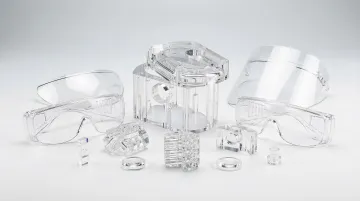
- Safety equipment: Riot shields, safety goggles, and bullet-resistant glazing exploit PC's unbreakable nature
- Medical devices: IV connectors, surgical instruments, and blood oxygenators require transparency and sterilization capability
- Automotive exteriors: Headlamp lenses and light covers replace glass to reduce weight and prevent shattering
- Optical components: LED lenses, light pipes, and display covers demand high light transmission with durability
PC excels when impact resistance, heat tolerance, or transparency cannot be compromised. Research shows PC applications are growing particularly in EV battery enclosures and medical diagnostics due to flame retardancy and biocompatibility.
ABS vs Polycarbonate: Key Differences for Injection Molding
Mechanical Performance
PC delivers significantly higher tensile strength—60-70 MPa versus ABS's 30-50 MPa. For load-bearing brackets and snap-fit connectors under high stress, PC's 40% strength advantage makes it the necessary choice.
Impact resistance tells an even more dramatic story. PC offers 2-3x higher toughness, with Izod values reaching 640-850 J/m compared to ABS's 200-320 J/m. While ABS handles normal impact well, PC handles crash scenarios and safety-critical applications.
ABS counters with better scratch resistance and surface hardness, making it superior for cosmetic applications where appearance matters.
Thermal Performance
Heat deflection temperature differs by 35°C between these materials—a critical factor for many applications. PC maintains structural integrity up to 132°C, while ABS softens around 97°C. This difference determines material selection for automotive lighting, medical sterilization equipment, and any application near heat sources.
For outdoor environments, PC with UV stabilizers withstands temperature cycling and sunlight exposure far better than ABS.
Processing Considerations
These thermal differences directly affect processing requirements and equipment selection.
Temperature Requirements:
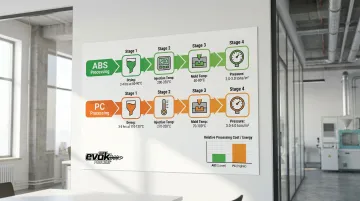
- ABS injection: 200-250°C | PC injection: 280-320°C
- ABS mold: 50-80°C | PC mold: 80-120°C
- Lower temperatures reduce energy costs and equipment wear
Pressure & Tonnage:
- PC requires injection pressures up to 18,000 psi
- PC clamp tonnage: 3.0-4.0 tons/in² vs. ABS: 2.0-3.0 tons/in²
- Higher requirements impact tooling design and machine selection
Drying Protocols:
ABS needs 2-4 hours at 80-90°C targeting <0.1% moisture. PC demands stricter protocols—2-4 hours at 120°C achieving <0.02% moisture with dew point at -20°F.
Failure to dry PC properly results in splay, reduced properties, and part rejection.
Cost Implications
Material cost represents just one piece of the economic puzzle. PC resin costs $4-5/kg versus ABS at $2-3/kg—a 50% premium.
Total project economics must account for:
- Higher tooling costs for PC due to increased clamp tonnage requirements
- Longer setup times for strict drying protocols
- Energy costs from higher processing temperatures
- Cycle time differences (though both materials offer comparable cycles with proper mold design)
- Yield rates and scrap costs
Easier processing often makes ABS more economical in high-volume production runs, even when compared to lower-cost plastics.
Aesthetic and Functional Differences
PC's natural transparency versus ABS's opacity fundamentally defines application suitability. ABS delivers superior surface finish for painted or textured surfaces—its high surface energy ensures excellent paint adhesion and vivid colors.
PC accepts colorants but is chosen primarily when transparency matters. Both materials support secondary operations, though ABS excels in electroplating and chrome finishes for automotive trim.
When to Choose ABS
Select ABS when your priorities include:
- Cost optimization for high-volume production runs
- Superior surface finish for painted, textured, or plated parts
- Ease of processing with faster setup and lower equipment requirements
- Operating temperatures below 80°C in indoor or UV-protected environments
- Moderate mechanical requirements where extreme impact resistance isn't critical
ABS makes sense for consumer housings, appliance components, automotive interiors, and any application where appearance and cost matter more than extreme performance.
When to Choose Polycarbonate
Specify PC when your application demands:
- Maximum impact resistance for safety-critical components
- High heat resistance with operating temperatures up to 120°C
- Optical clarity for transparent or translucent parts
- Dimensional stability under stress and thermal cycling
- Sterilization capability for medical devices
PC is non-negotiable for safety equipment, medical devices, automotive lighting, and outdoor applications requiring UV resistance. The higher cost is justified when performance cannot be compromised.
The Middle Ground: PC-ABS Blends
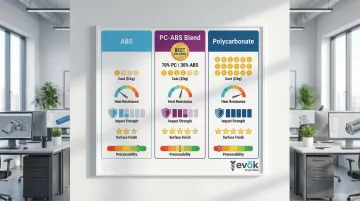
PC-ABS blends combine the best properties of both materials—PC's heat resistance and toughness with ABS's processability and surface finish. Typical 70% PC / 30% ABS ratios deliver:
- Tensile strength around 55 MPa (higher than ABS, lower than pure PC)
- Impact resistance of 9-12 ft-lb/in (retaining much of PC's toughness)
- Heat deflection temperature of 110-135°C (significantly better than ABS)
- Cost roughly 30% lower than pure PC
PC-ABS blends dominate automotive interiors—center consoles, glove boxes, and trim components—where impact safety and premium finish must coexist with cost efficiency. Electronics housings also benefit from balanced properties without pure PC's cost premium.
Real-World Application: Material Selection Success Story
Evok Polymers recently partnered with a powersports manufacturer developing a new instrument panel housing. The client needed a component that would withstand vibration, temperature extremes, and occasional impact while maintaining a premium appearance for their high-end product line.
The Challenge
Initial requirements included:
- Operating temperature range from -20°C to 85°C
- Impact resistance for off-road vibration and occasional drops during maintenance
- High-gloss black finish without visible weld lines
- Production volumes of 50,000 units annually
- Target cost under $3.50 per part
The client initially specified polycarbonate based on its reputation for toughness, but cost projections exceeded budget constraints.
The Decision Process
Evok's engineering team conducted material evaluation using 25 years of injection molding expertise. They analyzed thermal requirements, mechanical loads, and aesthetic expectations against material properties.
Key findings included:
- PC offered superior heat resistance (132°C HDT), but the operating environment peaked at 85°C—well within ABS's 97°C capability
- Impact requirements didn't demand PC's extreme toughness
- Surface finish quality became the critical factor, where ABS excels
Mold flow analysis and tolerance studies confirmed that an optimized high-impact ABS grade would meet all performance requirements. The material processed at lower temperatures (220°C versus 300°C for PC) with faster cycle times.
The Outcome
By selecting a high-impact ABS grade instead of polycarbonate, the project achieved:
- 32% reduction in per-part material cost ($2.38 versus $3.50 for PC)
- 18% faster cycle time due to lower processing temperatures and better flow characteristics
- Superior surface finish with deep black color and high gloss requiring no secondary painting
- 100% first article qualification pass rate with all dimensional and cosmetic requirements met
Production launched on schedule with the optimized ABS tooling. After 12 months and 50,000 parts, field performance data showed zero failures related to material selection, confirming that the engineering analysis correctly matched material properties to application requirements.
Partner with Material Selection Experts
Evok Polymers helps clients navigate material decisions through 25 years of injection molding expertise, testing capabilities, and design optimization services. Our team evaluates material properties alongside total project economics—tooling costs, cycle times, and production efficiency.
Contact us to discuss your injection molding project and get engineering-backed material recommendations that balance performance with cost.
Frequently Asked Questions
Is polycarbonate more expensive than ABS?
Yes, polycarbonate typically costs 40-60% more than ABS, with raw PC averaging $4-5/kg compared to ABS at $2-3/kg. Total project costs extend beyond material—PC's higher processing temperatures and stricter drying requirements add operational expenses.
How to choose material for injection molding?
Identify operating requirements (temperature range, impact exposure, chemical contact), aesthetic needs (transparency, finish, color), and production economics (volume, cycle time, tooling costs). Test prototypes to validate material performance before committing to production tooling.
Can polycarbonate be used for injection molding?
Yes, PC is widely used in injection molding but requires higher processing temperatures (280-320°C), thorough pre-drying to <0.02% moisture, and careful mold design. Proper equipment and protocols are essential to achieve its full performance potential.
Is ABS plastic good for injection molding?
ABS is one of the most popular injection molding materials due to excellent flow properties, low shrinkage (0.4-0.7%), moderate processing temperatures, and superior surface finish. It's ideal for high-volume production of consumer products, automotive interiors, and electronics housings.
Which is better, ABS or polycarbonate?
Neither is universally "better"—the right choice depends on application requirements. ABS excels for cost-effective parts with excellent finish. PC is superior for maximum impact resistance, heat tolerance above 100°C, or transparency.
Is PC-ABS better than ABS or polycarbonate?
PC-ABS blends provide better heat and impact resistance than ABS while being more processable and cost-effective than pure PC (typically 30% lower cost). They're ideal for automotive interiors, electronics housings, and appliances where both performance and economics matter.